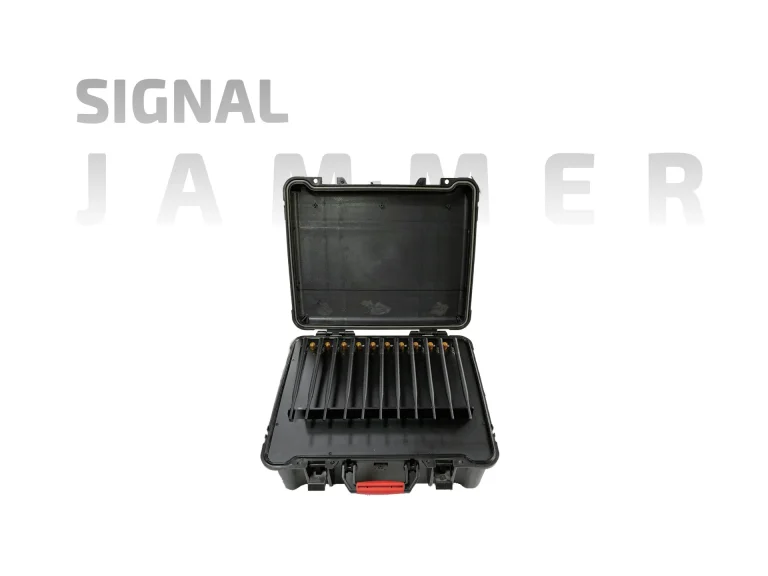
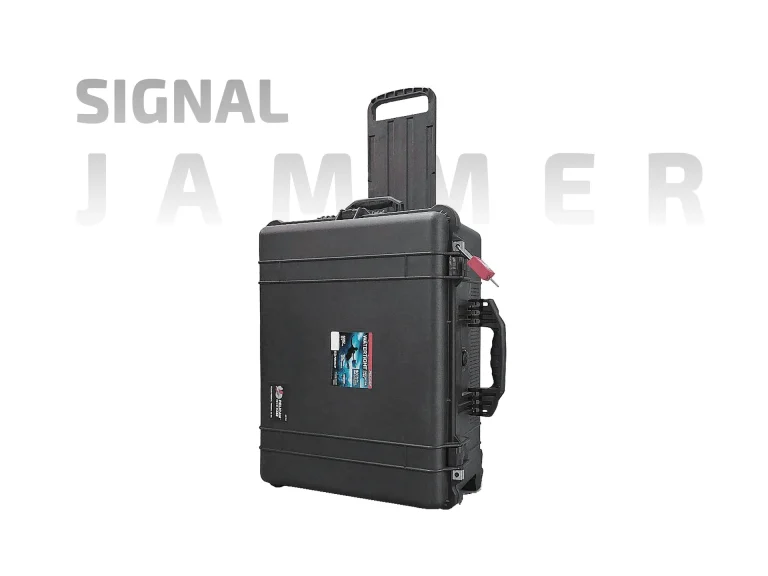
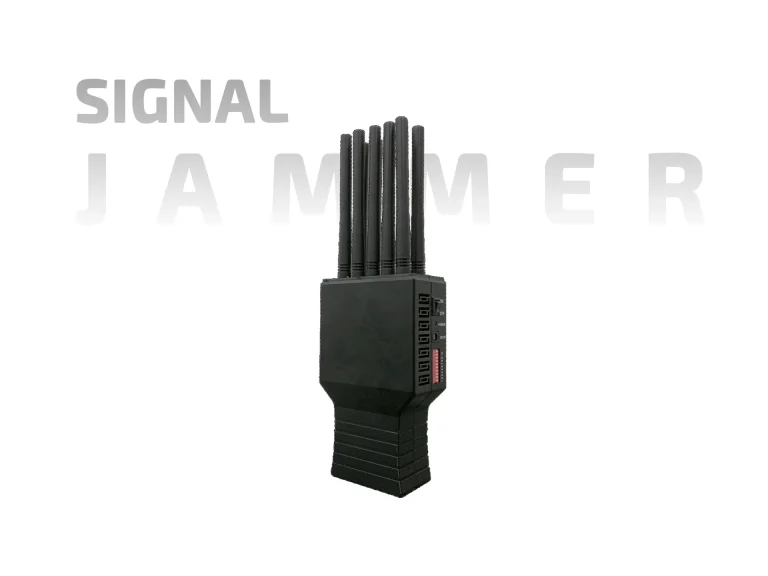
A trolley signal jammer sits in an awkward middle ground. It is not a handheld device that fits in a pocket, and it is not a fixed installation bolted to a wall. It is a wheeled platform that carries RF hardware, power, and cooling from place to place. That mobility is the entire point—and also the source of most of its engineering problems. Buyers who treat a trolley unit as simply “a big portable jammer” tend to underestimate the constraints that come with moving high-power RF equipment around.
For the electrical and thermal costs that a trolley must carry, see High Power Jammer Power Consumption Explained.

Why Put a Jammer on a Trolley?
The trolley form factor exists because some authorized tasks require the equipment to move. A fixed installation covers one zone. A trolley can be repositioned as the protected area changes, as test conditions shift, or as a facility reconfigures. In laboratory and shielded-facility work, a trolley also makes it easier to move equipment between rooms without dismantling it.
| Deployment need | Why a trolley helps | What it does not solve |
|---|---|---|
| Changing protected zones | Reposition without reinstalling | Legal authorization still applies per site |
| Multi-room testing | Move between shielded spaces | Doorways and thresholds limit size |
| Temporary authorized operations | Rapid setup and teardown | Power access must be planned |
| Equipment demonstration | Bring hardware to the test location | Containment must travel too |
| Facility reconfiguration | Adapt to layout changes | Cable routing and safety remain |
The Mobility Penalty
Every design decision that makes a jammer movable takes something away from RF performance or endurance. A fixed unit can use mains power and a large heat sink. A trolley must carry its own energy storage or a heavy cable, and it must shed heat in spaces that were not designed for it. These trade-offs are not marketing talking points; they are the practical limits that determine whether the unit is usable in the field.
| Mobility feature | What it costs | Practical consequence |
|---|---|---|
| Battery bank | Weight, volume, recharge time | Runtime is finite; duty cycle matters |
| Smaller heat sink | Reduced continuous output | Derating or intermittent operation |
| Rugged frame and casters | Added mass and footprint | Doorways and ramps become constraints |
| Onboard controls | Complexity and failure points | Operator training is essential |
| Cable reel or umbilical | Tethering to mains power | Mobility is limited by cable length |
Where Trolley Units Fit—and Where They Do Not
A trolley jammer is a poor default choice. It is heavy, conspicuous, and harder to contain than a bench unit. It makes sense only when movement is a genuine requirement and the surrounding conditions support it.
| Scenario | Fit | Reasoning |
|---|---|---|
| Shielded test hall with multiple zones | Good | Mobility helps; containment is built in |
| Authorized temporary facility | Conditional | Power, containment, and legal basis must be confirmed |
| Laboratory equipment evaluation | Good | Controlled environment, trained operators |
| Open public venue | Poor | Collateral interference and legal exposure |
| Emergency response use | Poor | Interferes with the communications it depends on |
| Fixed permanent coverage | Poor | A fixed installation is simpler and safer |
Operational Discipline Travels With the Trolley
The mobility that makes a trolley useful also makes it easy to misuse. A fixed installation has a defined coverage area and a known power feed. A trolley can be wheeled into a location where its emissions reach unintended receivers. Authorized teams therefore need route planning, pre-deployment checks, and a clear shutdown procedure that travels with the equipment.
| Pre-deployment check | Why it matters for a trolley | Evidence to keep |
|---|---|---|
| Legal authorization for the specific site | Authorization is location-specific | Written approval on file |
| Containment confirmation | Mobility increases spillover risk | Enclosure or boundary survey |
| Power source assessment | Battery or mains must be adequate | Load calculation and cable rating |
| Thermal headroom | Enclosed spaces trap heat | Ambient temperature reading |
| Emergency shutdown drill | Operators must act quickly | Training record |
| Post-operation log | Supports accountability | Signed operation record |
Design Details That Separate Good Trolleys from Bad Ones
A well-designed trolley shows attention to details that are invisible in a photo. Cable management that prevents strain on connectors. Brakes that hold on uneven floors. A control panel positioned for safe operation rather than convenience. Antenna mounts that survive being moved repeatedly. These details matter because a trolley is handled far more often than a fixed unit, and handling is where equipment fails.
A Final Word
A trolley signal jammer is a specialized platform for authorized environments where movement is a real requirement. It is not a shortcut around containment, and it is not a consumer product. The mobility that defines the form factor also defines its risks: power limits, thermal constraints, and a larger unintended footprint. Teams that plan for those risks—and that treat the trolley as a system rather than a box on wheels—will get far more from the equipment than those who focus on the output figure alone.