Security screening works by turning a physical property of an object, person, or surface into a signal that a system—and usually a trained operator—can evaluate. No single technology detects every threat. Instead, checkpoints combine complementary tools: X-ray for bags, CT for volumetric analysis, AIT for people, and trace detection for chemical residues.
The short answer is that screening is a layered decision process, not a single “scan.” A technology generates data, software highlights anomalies, and a human resolves alarms according to procedure. Understanding that chain explains why equipment performance depends as much on workflow and training as on the sensor itself.

The common logic behind every screening technology
Most screening systems follow four steps:
-
Probe the target. The system sends energy through an object, reflects energy from a person, or collects particles from a surface.
-
Build a signal. Detectors convert the response into an image, spectrum, or alarm decision.
-
Compare against signatures. Software and operators look for shapes, densities, material differences, or chemical markers associated with prohibited items.
-
Resolve the alarm. A secondary check confirms or clears the alert.
This is why screening is best understood as a system. A fast scanner can still create long queues if alarm resolution is poorly designed.
How X-ray screening works
X-ray screening uses a generator to pass X-rays through a bag or parcel. Denser materials absorb more X-rays, so the detector produces an image showing differences in attenuation. Dual-energy X-ray systems compare how materials absorb low- and high-energy X-rays, which helps distinguish organic materials from metals and mixed substances.
The operator sees a two-dimensional projection. Color coding and image tools help interpret overlapping items, but clutter and item orientation can hide threats. X-ray is widely used for carry-on bags, mail, parcels, and small cargo because it is fast and familiar. Its main limitation is that it presents a flattened view, so identifying a specific object inside a crowded bag still depends on image quality and operator skill.
How CT screening works
Computed tomography (CT) uses X-rays from many angles to reconstruct a three-dimensional volume. Instead of a single projection, the system can analyze an object slice by slice. This supports automated threat detection and gives operators more spatial information than conventional X-ray.
CT is common in aviation carry-on and checked baggage screening, and it is increasingly used where higher detection confidence is needed. The trade-offs are cost, footprint, and throughput. Automated detection also produces alarms that must be resolved, and algorithms require validation and updates. CT is powerful, but it is not a substitute for a clear alarm-resolution process.
How AIT body scanners work
Advanced Imaging Technology (AIT) screens people rather than bags. Most systems use millimeter-wave or radio-frequency signals to detect anomalies on or near the body. Some systems display an image; others show a generic outline with alarm locations to support privacy requirements.
AIT is used at airports and other access points where metal detectors alone are insufficient. It can reveal non-metallic items that a walk-through metal detector may miss. However, AIT does not “see through” everything, and alarm resolution still requires a pat-down or other procedure. Privacy, dignity, accessibility, and throughput are central design considerations, not afterthoughts.
How trace detection works
Trace detection—often called explosive trace detection (ETD)—looks for chemical residues rather than images. An operator collects a sample by swabbing a surface, container, electronics, or hands, then inserts the swab into an analyzer. Many systems use ion mobility spectrometry to identify trace compounds.
Trace detection is valuable for secondary screening because it addresses a different question: not “what does this object look like?” but “is there a chemical signature here?” Its limits include sampling coverage, consumables, cross-contamination risk, and the fact that it detects residues rather than bulk items. It works best as part of a layered checkpoint, not as a standalone solution.
How the main technologies compare
| Technology | What it measures | What the system produces | Typical checkpoint role | Main limits |
|---|---|---|---|---|
| X-ray | X-ray attenuation at one or more energies | 2D image with density and material cues | Bags, mail, parcels | Clutter, orientation, operator fatigue, limited material identification |
| CT | X-ray attenuation from many angles | 3D volumetric data and automated detection | Carry-on bags, checked baggage, selected cargo | Cost, footprint, throughput, algorithm false alarms |
| AIT | Millimeter-wave or radio-frequency reflections | Body image or anomaly locations | People screening at airports and access points | Privacy procedures, alarm resolution, accessibility, concealment limits |
| Trace detection (ETD) | Chemical residues collected by swab or air sampling | Alarm or non-alarm with compound information | Secondary screening of surfaces, electronics, hands, containers | Sampling coverage, consumables, cross-contamination, residue-only detection |
Why the technologies are used together
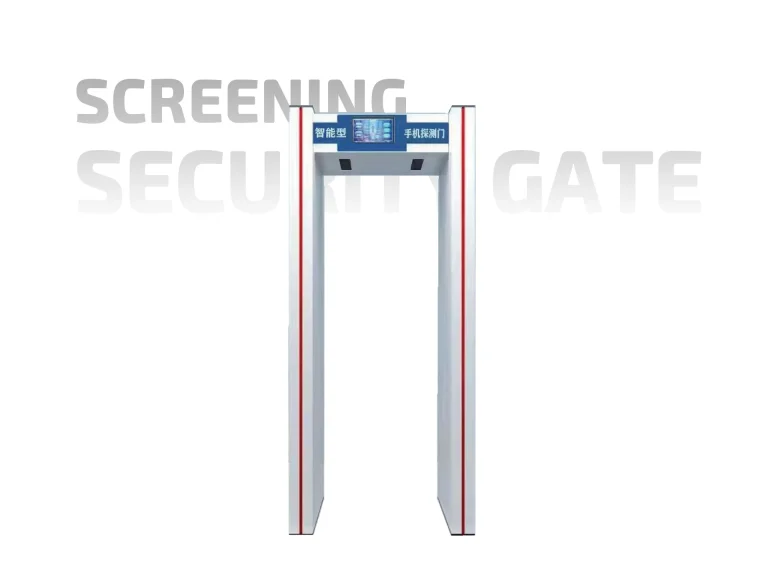
A checkpoint rarely relies on one sensor. X-ray or CT may identify a suspicious object in a bag; trace detection may then check a specific surface; AIT may screen a person after a metal detector alarm. Each layer answers a different question and reduces dependence on a single point of failure.
For teams comparing vendors and planning a checkpoint, the companion practical buyer’s guide to security screening equipment covers requirements, lifecycle costs, and procurement questions in more detail.
What determines real-world performance
The technology matters, but so do five operational factors:
-
Image and alarm resolution procedures. Staff need a clear path for every alarm type.
-
Training and refresher cycles. Operators must recognize threats and understand system limits.
-
Throughput planning. Peak flow, not average flow, shapes queue design.
-
Maintenance and calibration. Uptime depends on service access and spare parts.
-
Privacy and public communication. AIT and secondary screening require clear, respectful procedures.
Final takeaway
Security screening works by combining physical sensing, software analysis, and human alarm resolution. X-ray provides fast two-dimensional inspection, CT adds volumetric analysis, AIT screens people for anomalies, and trace detection looks for chemical residues. Each has strengths and limits. The most effective checkpoints use them as complementary layers—supported by training, maintenance, and a well-designed resolution workflow.