October 22, 2026
China 150W Drone Jammer Module: Sourcing Guide
Sourcing a China 150W drone jammer module? Here is a verification framework covering spec evidence, thermal data, compliance.


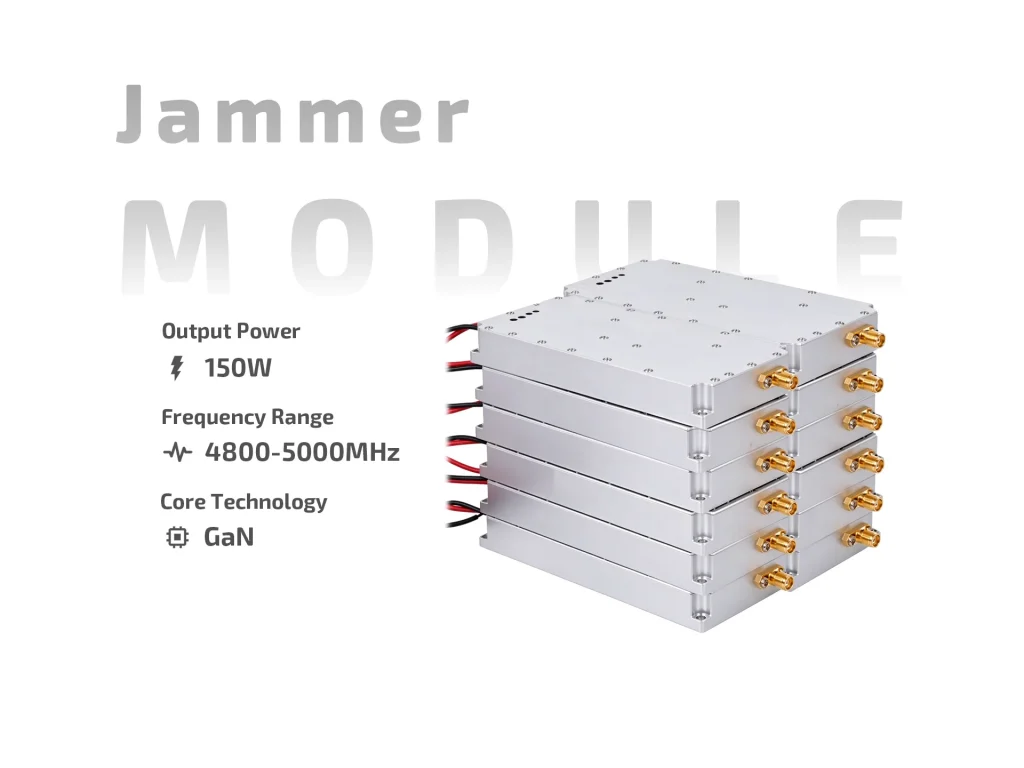
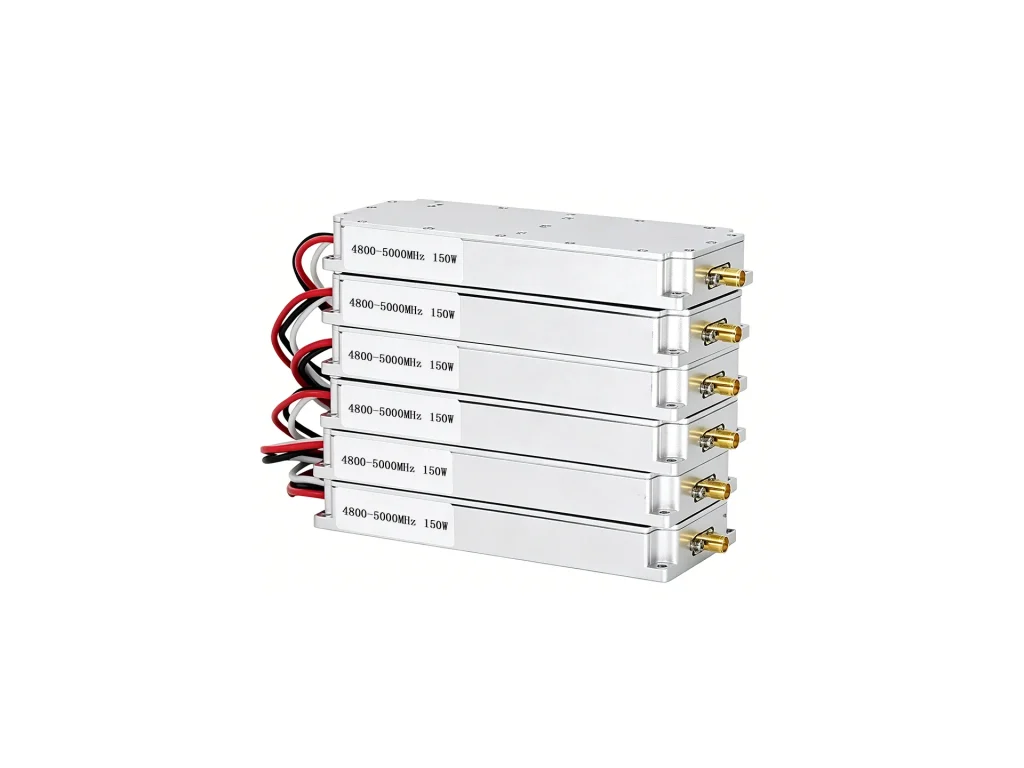

JM4850G150 150W anti-drone jammer module: 4800–5000MHz, DC24–29V, 15A max, ≥40% efficiency, built-in sweep source, SMA female output.
JM4850G150 is a 150W anti-drone jammer module built for 4800–5000MHz counter-UAV RF work. It combines a GaN output stage with an analog integrated RF path and a built-in high-speed sweep source. The module is aimed at integrators who need a compact 5GHz jammer block for a fixed or mobile anti-drone system, not a finished end-user device.

The 4800–5000MHz band covers common 4.8GHz and 5GHz drone control and video links. With 150W RF output, JM4850G150 can support sector antennas or directional panels in perimeter protection, prison security, airport no-fly zones, and event security. The actual covered area depends on antenna gain, mounting height, cable loss, and local RF conditions. It is not a stand-alone product; pair it with a suitable antenna, power supply, and control system.
The output stage uses GaN devices. That matters at this power level because the module must handle high RF density in a small housing. The analog integrated design keeps the RF chain straightforward: sweep source, driver, and GaN amplifier in one module. The built-in sweep source saves integration time. Users do not need to add a separate sweep board for basic jamming patterns, though external modulation can be considered for custom systems.
At 150W, cable loss and connector quality are not small details. A poor jumper or a loose SMA can turn output power into heat. Use rated coax, keep bends reasonable, and torque the connector properly. The module has an SMA female output, so the mating cable should be selected for 5GHz operation. If you test into a load, make sure the load can take the power for the test duration. Short tests are safer than long, unmonitored runs.
Operating voltage is DC24–29V. Maximum current is 15.0A. Efficiency is ≥40%, so thermal design still needs attention. Use a power supply with margin and short, thick DC leads. The switch control is simple: +5V or floating means on; grounding means off. Output VSWR is ≤2.0. An internal absorbing VSWR protection device helps protect the GaN stage when antenna matching is poor. Still, check the antenna and cable before long operation.
The 150W anti-drone jammer module measures 168.5 × 84.5 × 23mm and weighs 0.55kg. The SMA female output makes cable connection easy. Mount it on a metal surface with good heat transfer. Add airflow if the enclosure is closed. Keep the output cable short where possible, and avoid running DC and RF lines in parallel for long distances. The thin profile suits compact jammer housings, but the mounting plate must not block airflow or warp the module.
Do not rely on the housing alone as a heat sink. The 23mm profile gives limited surface area. A thermal pad between the module and a metal chassis helps, and forced air is better in high-duty cycles. Check temperature at the base and near the output stage after 10–15 minutes. If the case gets too hot to touch, improve the mount before increasing run time. Keep the antenna away from metal edges and nearby reflectors; reflected power raises VSWR and stress.
The +5V control line draws very little current, but it should still be clean. Use a dedicated switch or logic output. Do not leave the line floating near noisy DC wiring if you need a defined off state; ground it firmly.
Test the anti-drone jammer module with a dummy load or a well-matched antenna first. Confirm the control logic, supply voltage, and current limit. For field use, set antenna direction and tilt carefully; 5GHz signals are sensitive to aiming and obstructions. Because jammer use is regulated, check local rules and authorization before transmitting. JM4850G150 is a building block for professional anti-drone systems, and its value comes from clean integration rather than from a single headline number.
| Parameter | Specification | Notes | |
| Working Frequency | 4800–5000 MHz | Covers common 4.8 GHz and 5 GHz drone links | |
| Output Power | 150 W | Typical RF output | |
| Output VSWR | ≤2.0 | Keep antenna and cable matched | |
| Operating Voltage | DC24–29 V | Use a regulated supply with margin | |
| Max Operating Current | 15.0 A | Check supply and wiring rating | |
| Efficiency | ≥40% | Thermal design is still required | |
| Switch Control | +5V or floating = on; ground = off | Use a clean control line | |
| Output Connector | SMA female | Select 5 GHz-rated coax | |
| Jammer Source | Built-in high-speed sweep source | No separate sweep board needed for basic use | |
| VSWR Protection | Built-in absorbing VSWR protection device | Helps protect the GaN stage | |
| Dimensions | 168.5 × 84.5 × 23 mm | Thin profile for compact housings | |
| Weight | 0.55 kg | Mount on a suitable metal surface |
Sourcing a China 150W drone jammer module? Here is a verification framework covering spec evidence, thermal data, compliance.
A 150W GaN UAV jammer module is not a linear step up from 100W. Here is where thermal, supply, and enclosure limits appear.

Drone jammer module power is more than watts. Learn ERP, duty cycle, heat, and band-specific power needs for real counter-drone performance.