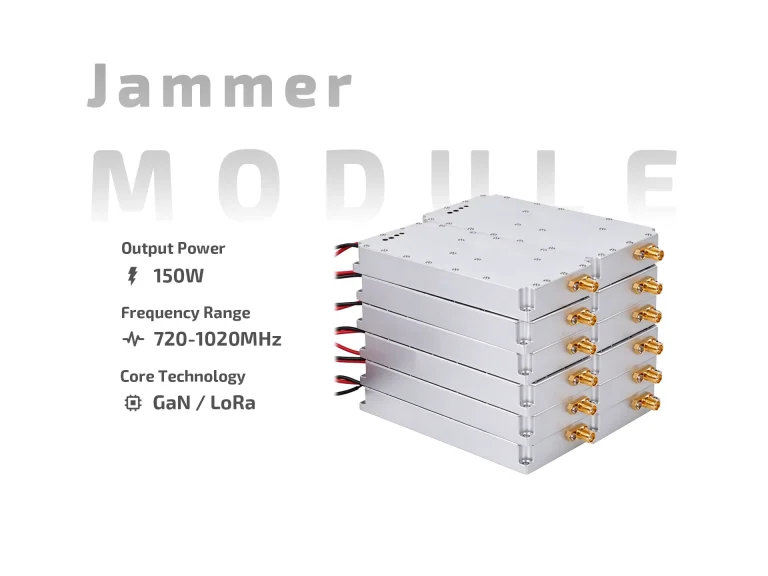
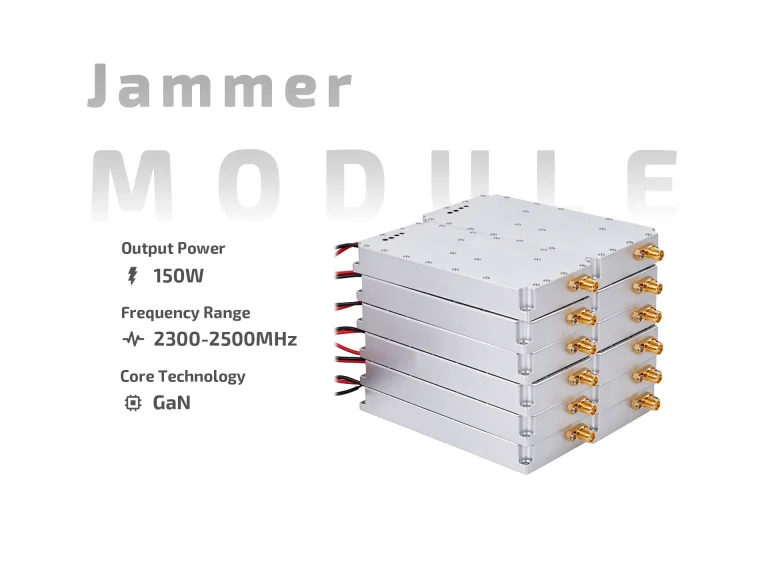
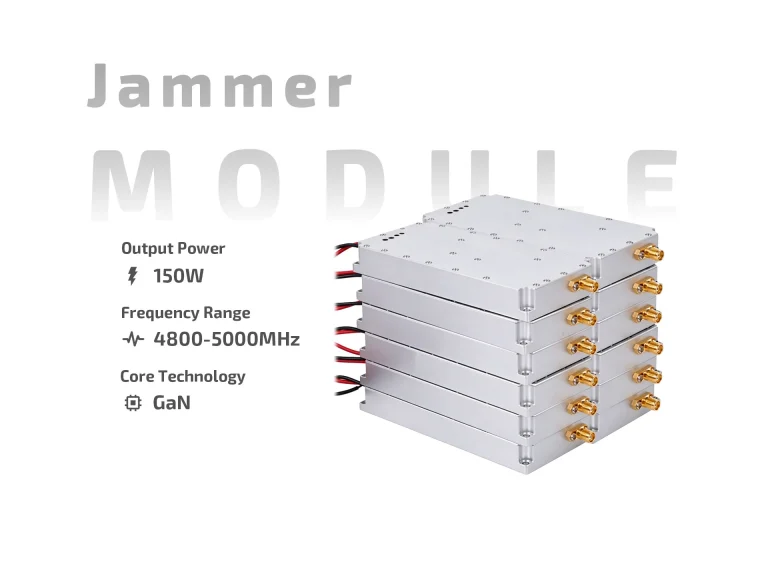
China is a major manufacturing source for RF hardware, and a China 150W drone jammer module is a common line item in counter-drone procurement conversations. The sourcing question, however, is not where the module is made—it is what evidence accompanies it. A supplier’s location tells you about logistics and cost structure; it tells you nothing about whether the module will hold its rated output in your enclosure.
This guide is written for authorized counter-drone programs evaluating Chinese-sourced modules. Jamming is regulated in most markets, and any purchase should be preceded by spectrum authorization, export review, and confirmation that the module can lawfully be deployed in the target jurisdiction.

Why Sourcing Merits Its Own Checklist
RF modules are increasingly commoditized at the hardware level, but integration support, test documentation, and compliance evidence are not. Two suppliers offering superficially similar 150W UAV jammer modules may differ sharply in the data they can provide and in their willingness to support derating, filtering, and enclosure questions after the sale.
A sourcing-specific review therefore focuses on evidence and continuity rather than on the wattage figure alone. The engineering constraints of the 150W class are covered in our article on 150W GaN UAV jammer module scaling limits; this piece concentrates on the supplier-side questions.
Supplier Evaluation Framework
The table below groups the checks that separate a supportable supplier from a catalogue listing. It assumes the buyer has already defined the target band, duty cycle, and enclosure.
| Evaluation dimension | Specific question | Acceptable evidence |
|---|---|---|
| Specification depth | Is 150W rated at the antenna port, and across what bandwidth? | Swept power data, not a single-frequency figure |
| Thermal documentation | What case temperature is expected in a sealed enclosure? | Measured data or a documented derating curve |
| Filtering and spurious | How are harmonics controlled at full output? | Spurious measurements at the operating point |
| Compliance status | Is the module authorized for the target market and use? | Spectrum and export documentation |
| Supply continuity | Is the device family stable for the program lifetime? | Lead-time commitments and lifecycle notes |
| Integration support | Can the supplier answer enclosure and airflow questions? | Named technical contact and response history |
| Customization | Are band, interface, or mechanical changes possible? | Documented options and change process |
Common Sourcing Pitfalls
The first pitfall is price-led shortlisting. A lower unit price often reflects thinner documentation, less filtering, or a smaller thermal margin—costs that reappear during integration.
The second is treating compliance as a paperwork formality. A module that cannot be lawfully deployed, or that lacks export classification clarity, creates program risk regardless of RF performance.
The third is assuming that a sample tested on an open bench represents the delivered unit. Batch consistency, component substitution, and firmware variation can all change behavior. Ask how the supplier controls these.
How to Validate Before Committing
Request a sample and test it in the intended enclosure at realistic ambient temperature and duty cycle. Record sustained output at the antenna, case temperature, and any derating events. Compare the results with the supplier’s published data; discrepancies are a useful signal about documentation quality.
For programs with long delivery timelines, ask for a second sample from a later production batch and repeat a shortened version of the test. Consistency across batches matters as much as peak performance.
Finally, confirm that the supplier can support the module through integration and fielding, not just through the order. A 150W module is a thermal and RF subsystem, and post-sale engineering access is part of what you are buying.
Conclusion
A China 150W drone jammer module can be a practical sourcing option, provided the evaluation centers on evidence rather than origin or price. Swept power data, thermal documentation, compliance clarity, and supply continuity are the deciding factors. Verify the supplier’s claims in your own enclosure, confirm authorization before deployment, and treat the wattage as one specification among many.