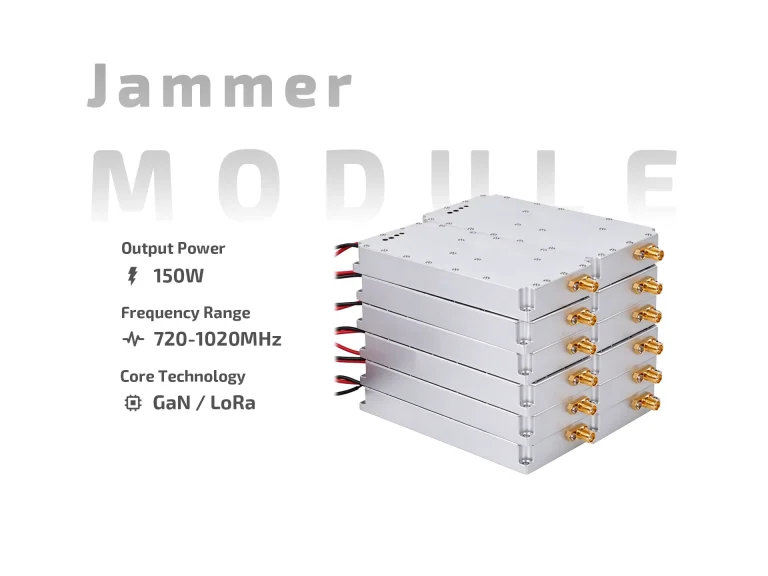
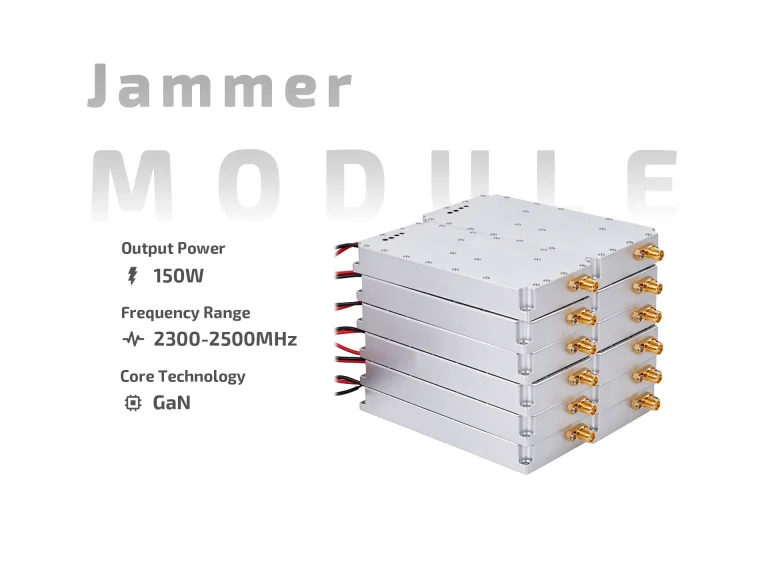
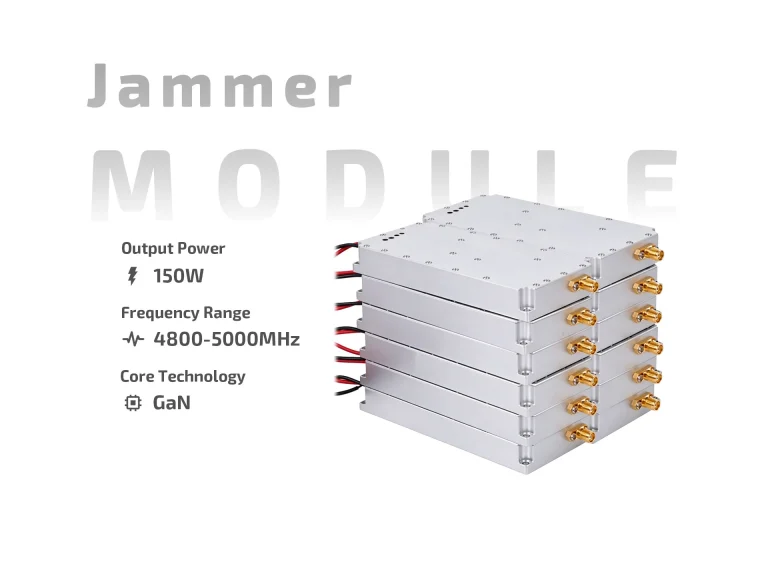
Drone jammer module power is often marketed as a single wattage number, but that number tells only part of the story. A 50 W module is not automatically stronger than a 20 W module. It may have lower antenna gain, a shorter duty cycle, or poor filtering. It may also overheat and fold back its output after a few minutes.
In counter-drone RF systems, power is a system-level property. What matters is how much energy actually reaches the drone receiver, at the right frequency, at the right time, and within legal limits.
This article breaks down drone jammer module power in practical terms: output power, effective radiated power, duty cycle, band-specific needs, thermal design, and common mistakes.

Why Drone Jammer Module Power Is Not Just Wattage
A watt is a unit of power, but not all watts are equal. A module may produce 40 W at the amplifier output, yet only a fraction of that energy reaches the antenna. Cable loss, connector loss, filter loss, and impedance mismatch all reduce the final radiated power.
Then the antenna changes the picture again. A high-gain directional antenna concentrates energy toward the target. An omni antenna spreads it in all directions. The same 40 W module can behave very differently depending on the antenna attached to it.
For a broader view of how power fits into the full signal chain, see how a drone jammer module work.
Key Power Metrics for a Drone Jammer Module
When comparing modules, look beyond the headline wattage. These four metrics matter most.
| Metric | What It Means | Why It Matters |
|---|---|---|
| Output power | RF power at the amplifier output | Starting point, but not final radiated power |
| Effective radiated power (ERP) | Output power plus antenna gain minus losses | Best indicator of real-world strength |
| Duty cycle | Percentage of time the module can transmit at full power | Affects sustained performance and heat |
| Power per band | How output is divided across frequency bands | Multi-band modules may share power unevenly |
Output Power
Output power is the raw RF power produced by the amplifier. It is usually measured in watts or dBm. A module rated at 50 W may produce that power only under ideal test conditions, with a specific input voltage, a matched load, and a short pulse.
Continuous output power is often lower than peak output power. If a datasheet does not state whether the rating is peak or continuous, ask for clarification.
Effective Radiated Power (ERP)
ERP combines transmitter output, antenna gain, and feed line loss. It is the most useful number for estimating real coverage. A 20 W module with a 15 dBi antenna can have much higher ERP than a 100 W module with a 3 dBi omni antenna.
ERP also depends on frequency. The same antenna has different gain and beamwidth at different bands. That is why multi-band modules should provide ERP figures per band, not just one overall number.
Duty Cycle and Average Power
Duty cycle describes how long a module can transmit before it must cool down. A module rated at 100 W peak with a 10% duty cycle delivers only 10 W average over time. A 50 W module with a 50% duty cycle may deliver more usable energy in a real scenario.
For counter-drone use, sustained output often matters more than peak output. A module that shuts down after 30 seconds may not be useful against a drone that keeps flying.
Power per Band
Multi-band modules rarely distribute power equally. A module may offer 30 W on 2.4 GHz, 20 W on 5.8 GHz, and 10 W on GNSS. If the drone uses a band with lower power, performance may suffer.
Always ask for a per-band power table. A single total wattage figure can hide weak bands.
How Drone Jammer Module Power Affects Range
Power and range are related, but not linearly. In free space, received power drops with the square of distance. Doubling range requires roughly four times the power, assuming the antenna and environment stay the same.
In the real world, obstacles, terrain, and interference make the relationship even less predictable. A high-power module in a city may perform worse than a lower-power module with a clear line of sight.
For a detailed range discussion, see drone jammer module range.
Band-Specific Power Considerations
Different frequency bands have different propagation and antenna characteristics. The power needed to achieve a similar effect can vary significantly.
| Band | Typical Role | Power Considerations |
|---|---|---|
| 433/868/915 MHz | Long-range control and telemetry | Lower atmospheric loss, but larger antennas |
| 1.2/1.3 GHz | Video and telemetry | Moderate power, directional antennas common |
| 2.4 GHz | Control, telemetry, Wi-Fi video | Widely used; power needs depend on drone link margin |
| 5.8 GHz | FPV video and high-rate data | Higher path loss; directional antennas help |
| GNSS L1/L2/L5 | Navigation and timing | Low signal power at receiver; even modest power can disrupt |
GNSS is a special case. Because satellite signals are very weak at the receiver, a relatively low-power GNSS jammer can affect a wide area. That does not mean it will stop control or video links. It only affects navigation and timing.
For frequency details, see drone jammer module frequencies.
Thermal Management and Drone Jammer Module Power
Heat is the silent limit on power. Every amplifier loses some energy as heat. If that heat is not removed, the module may reduce output, shut down, or suffer long-term damage.
Key thermal factors include:
-
Amplifier efficiency
-
Heat sink size and airflow
-
Ambient temperature
-
Duty cycle
-
Mounting location
-
Fan or liquid cooling
A module rated at 100 W in a lab may only sustain 40 W in a hot vehicle or direct sunlight. Always check the continuous power rating and cooling requirements.
Power Supply and Battery Considerations
High-power modules demand stable, high-current power supplies. Voltage sag can reduce output or cause shutdown. Battery-powered portable systems must balance power, weight, and runtime.
Consider these points:
-
Peak current draw versus average current draw
-
Battery chemistry and discharge rate
-
Voltage regulation and protection
-
Cable gauge and connector rating
-
Runtime at the desired duty cycle
A 200 W module may need a substantial battery pack, which affects portability. In many field scenarios, a lower-power module with a better antenna is more practical.
Legal Limits and Drone Jammer Module Power
Power is also a legal issue. In the United States, the FCC generally prohibits jamming devices. Similar restrictions exist in the European Union, the United Kingdom, Australia, and many other countries. Authorized use is typically limited to government, military, or law enforcement agencies.
Higher power increases the risk of interfering with nearby communications, navigation, and emergency systems. Even if a drone jammer module is technically capable of high output, operating it may be illegal without proper authorization.
Any discussion of drone jammer module power should include this caveat: legal compliance is not optional.
Common Misconceptions About Drone Jammer Module Power
| Misconception | Reality |
|---|---|
| Higher watts always mean better jamming | Antenna gain, frequency, and aiming often matter more |
| Peak power equals usable power | Duty cycle and cooling determine sustained output |
| One total wattage fits all bands | Multi-band modules need per-band power specs |
| More power always means more range | Range depends on ERP, environment, and drone link budget |
| Power alone defeats any drone | Encrypted, hopping, or autonomous drones may resist |
How to Choose the Right Drone Jammer Module Power
Start with the target link, not the wattage. Ask which frequencies the drone uses for control, video, telemetry, and navigation. Then estimate the required ERP for your scenario.
A practical selection process:
-
Identify target bands.
-
Estimate the drone link budget.
-
Define the required range.
-
Choose antenna type and gain.
-
Calculate needed ERP.
-
Select a module that can sustain that output.
-
Verify cooling, power supply, and legal compliance.
For many users, a medium-power module with a high-gain directional antenna is more effective than a high-power module with a simple omni antenna.
FAQ About Drone Jammer Module Power
What is a typical drone jammer module power rating?
Portable modules often range from 10 W to 50 W. Vehicle and fixed systems may reach 100 W or more, but sustained power depends on cooling and duty cycle.
Is higher power always better?
No. Effective radiated power, antenna gain, frequency, and duty cycle often matter more.
What is ERP in a drone jammer module?
ERP is the effective radiated power after accounting for antenna gain and cable losses. It is a better indicator of real performance than raw output watts.
Why do multi-band modules have different power per band?
Because each band has different amplifier, antenna, and filtering requirements. Power is rarely split equally.
Can I increase power by using a bigger amplifier?
Not safely or legally in most cases. The whole system, including antenna, cooling, and power supply, must support the increase.
Final Thoughts
Drone jammer module power is more than a wattage label. It involves output power, ERP, duty cycle, per-band distribution, thermal design, and legal constraints.
The most effective system is not always the one with the highest number. It is the one that delivers enough power at the right frequency, with the right antenna, for the required duration, within the law.
When evaluating a module, ask for per-band power, continuous duty cycle, ERP data, and cooling specifications. Those details reveal far more than a headline wattage ever will.