October 22, 2026
China 150W Drone Jammer Module: Sourcing Guide
Sourcing a China 150W drone jammer module? Here is a verification framework covering spec evidence, thermal data, compliance.


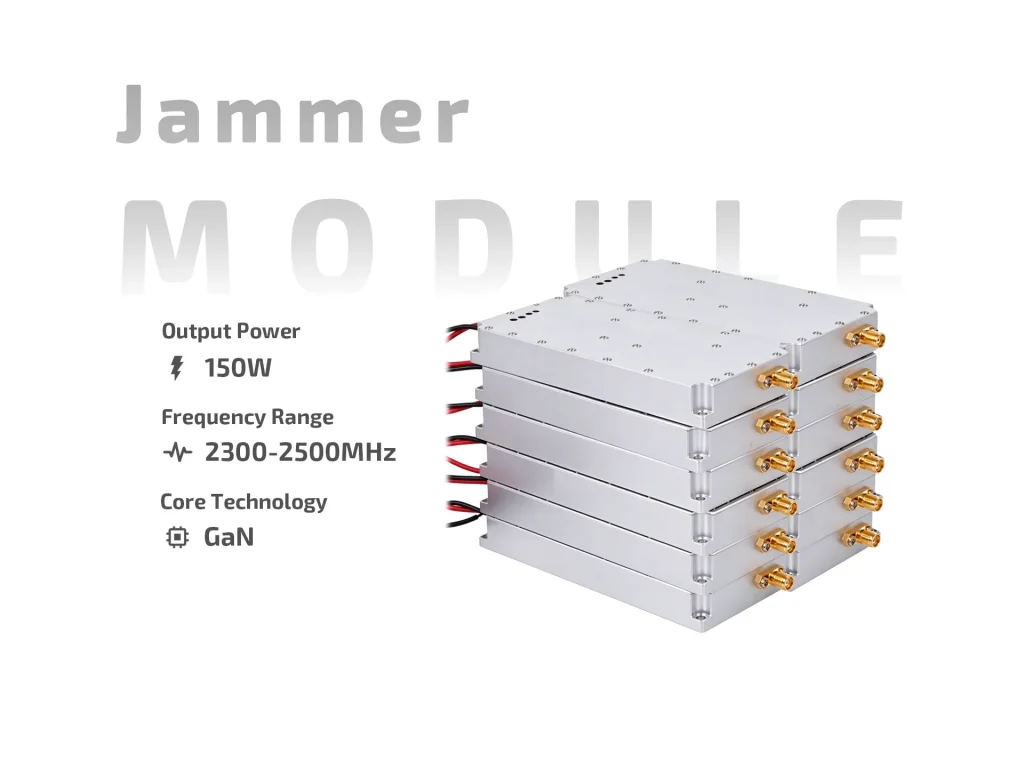
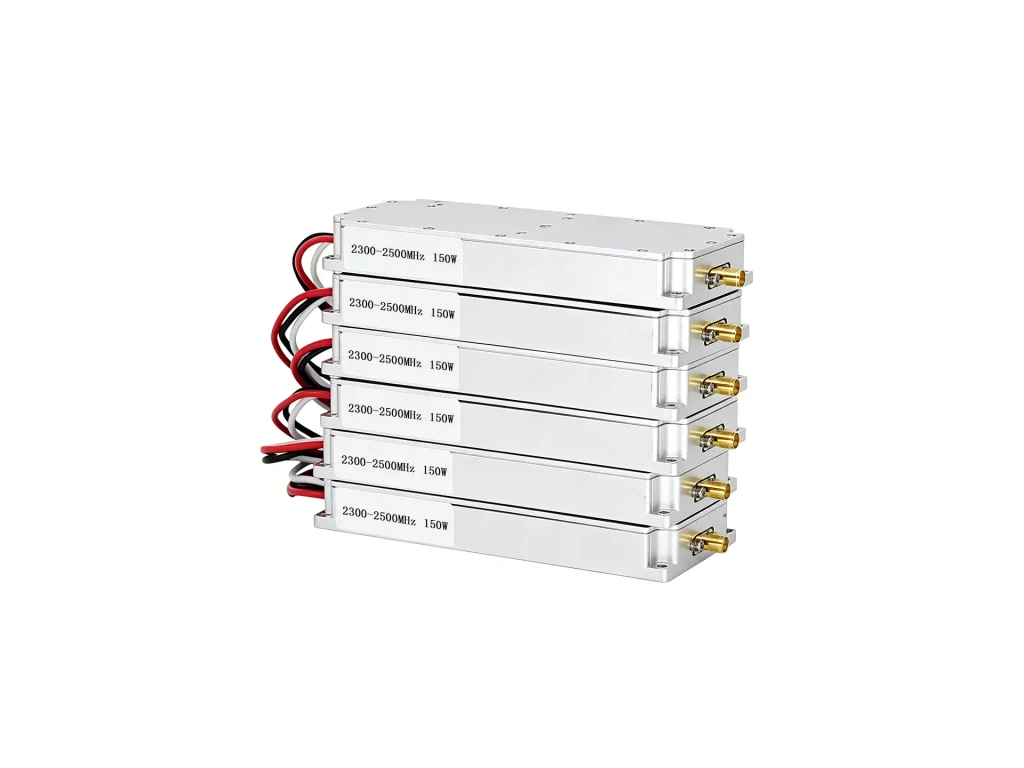

JM2325G150 150W GaN Anti-Drone Module over 2300–2500MHz from 24–29V DC, 15A max, ≥40% efficiency, SMA female, built-in sweep source and VSWR protection.
JM2325G150 is a 150W GaN Anti-Drone Module built for 2300–2500MHz countermeasure work. It combines a high-speed sweep source, a GaN output stage and absorption-type VSWR protection in a compact metal housing. The module is aimed at system integrators who need a ready RF block rather than a bare amplifier board. With 24–29V DC input and up to 15A current, it fits many vehicle, fixed-site and portable platforms where space and heat are tight.

The 2300–2500MHz band is common for video links and control channels, so the output stage must hold up under fast load changes. The JM2325G150 uses GaN devices for high power density and a specified output VSWR of ≤2.0. An internal absorption-type protector takes reflected energy instead of letting it stress the final stage. This helps when antennas are damaged, disconnected or poorly matched during field tests. The SMA female output is straightforward to cable, but keep the mating connector clean and torque it correctly.
Operating voltage is DC24V–29V, with 15.0A maximum current and ≥40% efficiency. That efficiency figure matters in a sealed enclosure because wasted heat raises the temperature of the sweep source and driver stages. Use a stable supply that can deliver the peak current without large voltage sag. The switch control is simple: +5V or floating means on, and grounding means off. Keep the control line away from RF cables where possible. The 168.5*84.5*23mm housing and 0.55kg weight leave room for a heatsink or cold plate, but the mounting surface must be flat and thermally coupled.
The internal high-speed sweep source removes the need for an external modulation box. Integrators can feed DC, connect an antenna and control on/off through the switch pin. The sweep covers the full 2300–2500MHz range, which keeps the RF chain compact and reduces cable losses. For best results, test the final antenna and cable assembly before installation. A poor match may not damage the module because of the protection, but it will reduce effective radiated power and can make the system look weaker than it is.
Mount the module where air or coolant can reach the base. Use short, low-loss RF jumpers and avoid sharp bends. Confirm polarity and voltage before power-up; reverse supply can kill the module. The switch input is not a power output, so do not load it. If the unit sits in a dusty cabinet, clean the fins and connectors on a service schedule. For portable use, shock isolation helps protect the SMA joint and internal board. Finally, check local rules before transmitting: this is an RF component for authorized counter-drone systems, not a consumer device.
The JM2325G150 suits fixed-site perimeter systems, vehicle-mounted counters, and portable test rigs. It can also be used in RF labs for link denial testing when proper shielding and authorization are in place. Because the module already includes the sweep source, a complete subsystem needs only power, control, cabling and an antenna. That short bill of materials helps shorten build time and lowers integration risk.
In a well-matched setup, the module produces the rated output and the housing warms steadily rather than spiking. If current rises or output drops after a cable change, stop and check the load. The internal protector is there for fault conditions, not for continuous operation into an open port. Keep records of supply voltage, current and antenna VSWR during commissioning. These simple readings make later troubleshooting much faster and help distinguish a module fault from a feedline or antenna problem.
The JM2325G150 packs a 150W GaN Anti-Drone Module into a compact housing with built-in sweep and protection. It is a practical RF building block for authorized systems that need 2300–2500MHz coverage without a long development cycle.
| Parameter | Specification | Notes |
| Operating Frequency | 2300–2500 MHz | Continuous coverage |
| Output Power | 150 W | GaN output stage |
| Operating Voltage | DC 24–29 V | Stable supply required |
| Maximum Current | 15.0 A | Peak draw |
| Efficiency | ≥40% | Thermal design matters |
| Output VSWR | ≤2.0 | At rated load |
| Switch Control | +5V or floating = ON; grounding = OFF | Do not load control pin |
| Output Connector | SMA female | Torque correctly |
| Interference Source | Built-in high-speed sweep source | No external modulator |
| VSWR Protection | Built-in absorption-type protector | For fault conditions |
| Dimensions | 168.5 × 84.5 × 23 mm | L × W × H |
| Weight | 0.55 kg | Approx. |
Sourcing a China 150W drone jammer module? Here is a verification framework covering spec evidence, thermal data, compliance.
A 150W GaN UAV jammer module is not a linear step up from 100W. Here is where thermal, supply, and enclosure limits appear.

Drone jammer module power is more than watts. Learn ERP, duty cycle, heat, and band-specific power needs for real counter-drone performance.