October 22, 2026
China 150W Drone Jammer Module: Sourcing Guide
Sourcing a China 150W drone jammer module? Here is a verification framework covering spec evidence, thermal data, compliance.


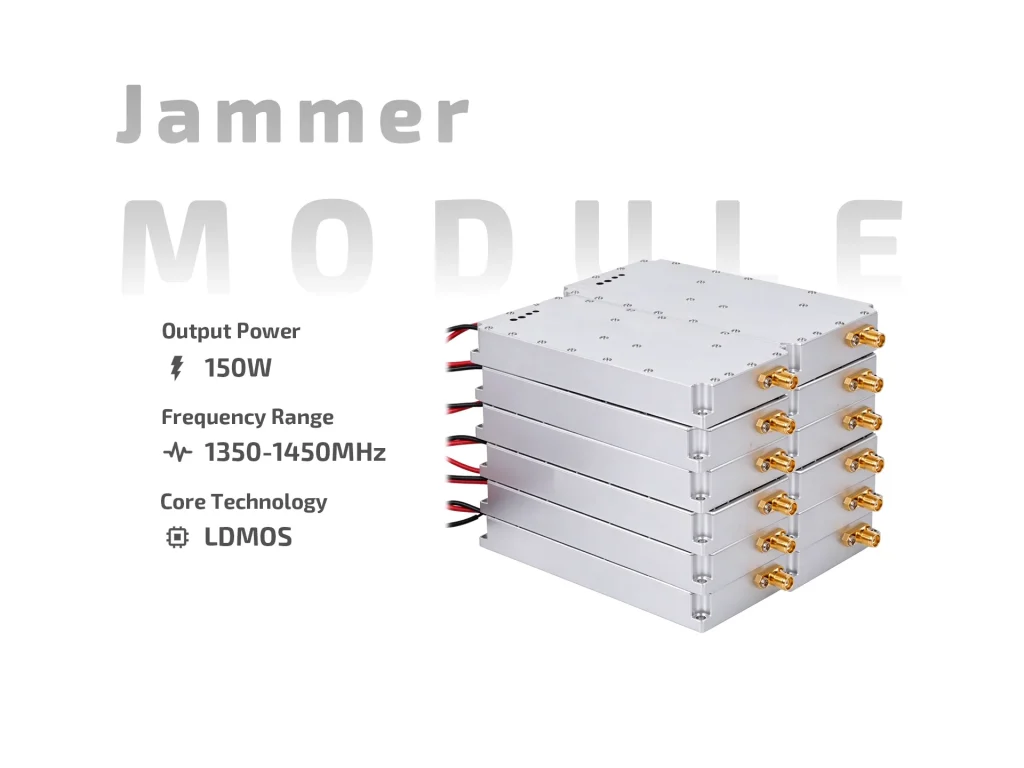
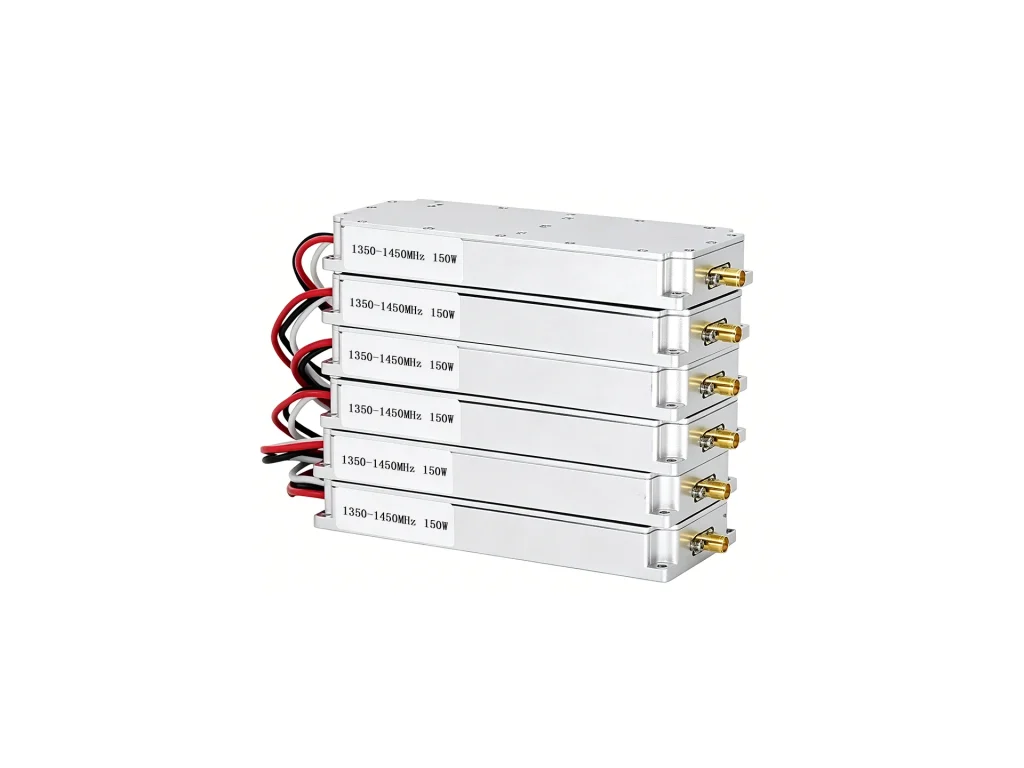

150W LDMOS drone jammer module ETLD-JM1314L150: 1350–1450MHz, 150W, DC24–29V, 15A, ≥40% efficiency, SMA female, built-in sweep source.
The ETLD-JM1314L150 is a 150W LDMOS drone jammer module designed for 1350–1450 MHz. This range is used by several UAV links, including video and control channels in some regions. The module is not just an amplifier. It includes a high-speed sweep source and protection circuits, so it can work as a stand-alone analog jamming unit. That saves integration time for counter-drone teams.

The output stage uses LDMOS technology. LDMOS is known for ruggedness and stable performance in high-power RF work. At 150W, the design keeps efficiency at 40% or better. Output VSWR is ≤2.0. The module runs on DC 24–29V and draws up to 15.0A. These numbers fit many vehicle and industrial power systems, so the module can be dropped into existing racks without a major redesign.
A high-speed sweep source is inside the housing. It moves the jamming signal across the band quickly, covering more frequencies than a fixed tone. The module also has an absorption-type VSWR protection device. If the antenna match changes, the protection helps absorb reflected energy. That reduces stress on the LDMOS stage. In field use, this matters because antennas are often mounted near metal, walls, or moving objects.
Switch control is straightforward: +5V or floating means ON, while grounding means OFF. A microcontroller, relay, or manual switch can drive this line. The output connector is SMA female, which is common in RF labs and field systems. Keep the control line clean and label it clearly. Because a floating pin turns the module on, accidental open circuits can start transmission. That is worth noting during bench tests and installation.
The 150W LDMOS drone jammer module measures 168.5 × 84.5 × 23 mm and weighs 0.55 kg. It needs a metal mounting surface to carry heat away. At 150W, even a short transmission can warm the case if airflow is poor. Use thermal compound between the module and the heatsink. Keep the output cable short and rated for the power. Do not cover the housing with insulation. A fan or open-air mounting helps during long runs.
Place the 150W LDMOS drone jammer module close to the antenna to cut cable loss. Use a regulated 24–29V supply that can deliver more than 15A at peak. Check the antenna match before long operation. If VSWR is high, effective radiated power drops and heat rises. For more range, use a directional antenna instead of overdriving the module. During tests, use a dummy load rated above 150W. Avoid running control wires next to high-power RF cables.
Typical applications include counter-UAV testing, border monitoring, prison security, event protection, and RF research. The 150W LDMOS drone jammer module can work alone or as part of a multi-band system. Since it focuses on 1350–1450 MHz, it is often paired with modules for 2.4 GHz, 5.8 GHz, or GNSS bands. That makes it a useful building block for system integrators.
This is a focused RF module, not a universal amplifier. It is built for analog jamming in one band. Performance depends on cooling, antenna quality, and power supply. Users must follow local laws. Jamming transmitters are regulated, and operation is only allowed with proper authorization. Buyers should confirm the final frequency plan and power limits before deployment.
The ETLD-JM1314L150 delivers 150W LDMOS output, a built-in sweep source, and practical protection in a compact package. For teams that need a ready 1350–1450 MHz jamming block, it offers a clear path from prototype to field use. Good cooling and a clean RF path will decide the real-world result.
| Parameter | Specification | Notes |
| Operating Frequency | 1350–1450 MHz | Focused UAV-related band |
| Output Power | 150 W | LDMOS output stage |
| Output VSWR | ≤2.0 | 50-ohm system recommended |
| Operating Voltage | DC 24–29 V | Regulated supply advised |
| Maximum Operating Current | 15.0 A | Allow margin for peak draw |
| Efficiency | ≥40% | Typical value |
| Switch Control | +5V or floating = ON / grounding = OFF | Simple logic control |
| Output Connector | SMA female | Standard RF interface |
| Jamming Source | Built-in high-speed sweep source | No external generator needed |
| VSWR Protection | Built-in absorption-type VSWR protection device | Helps absorb reflected power |
| Dimensions | 168.5 × 84.5 × 23 mm | Compact metal housing |
| Weight | 0.55 kg | Module only |
Sourcing a China 150W drone jammer module? Here is a verification framework covering spec evidence, thermal data, compliance.
A 150W GaN UAV jammer module is not a linear step up from 100W. Here is where thermal, supply, and enclosure limits appear.

Drone jammer module power is more than watts. Learn ERP, duty cycle, heat, and band-specific power needs for real counter-drone performance.