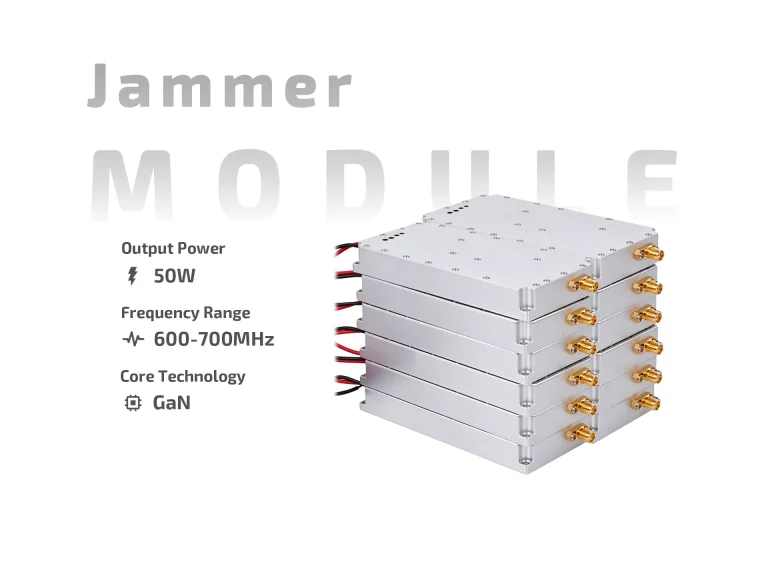
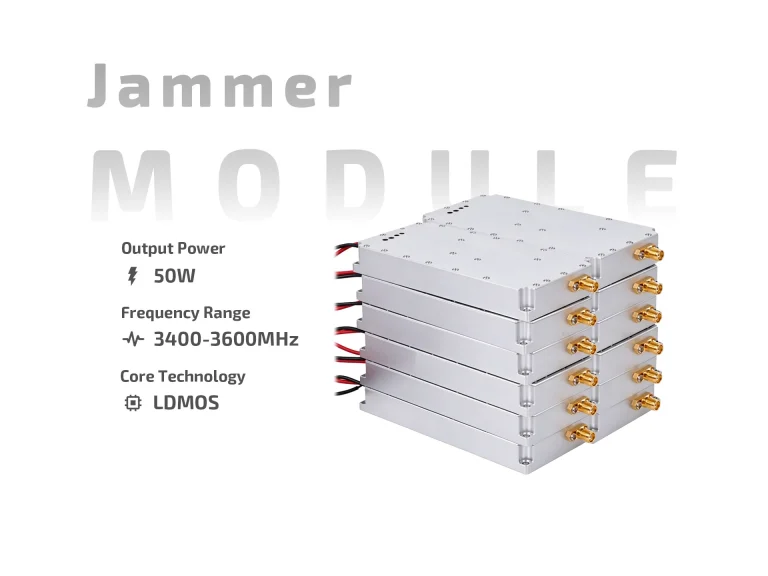
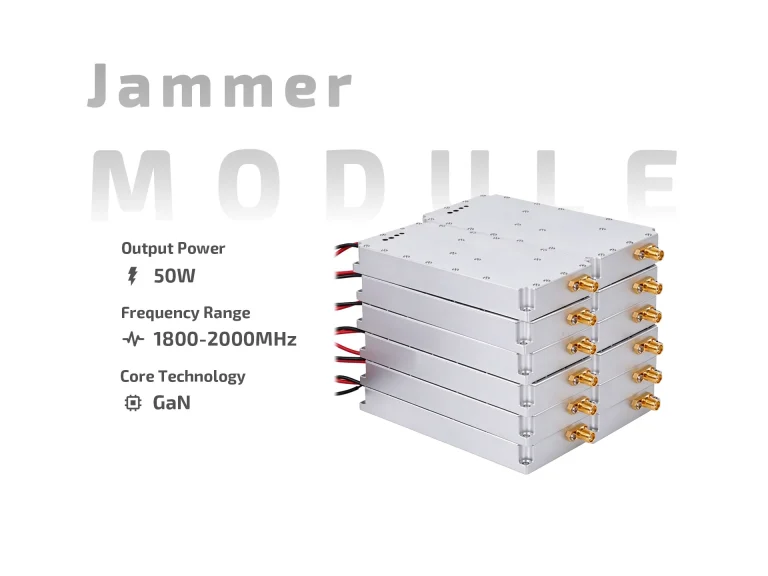
The phrase 50W LoRa drone jammer module sounds straightforward: a module, a power rating, and a target band. In practice, procurement teams and integrators are buying a subsystem, not a number. A 50W-class module has to manage heat, spectral behavior, control interfaces, and regional compliance long after the datasheet headline has been read.
This brief is written for authorized counter-drone programs and system integrators evaluating module options. It is not a build guide. Jamming and interference are tightly regulated in most markets, and deployment should only proceed where spectrum authorization, export controls, and operator training are in place.

Why the LoRa Label Needs Scrutiny
LoRa is a low-power wide-area networking technology. In drone-related discussions, it is sometimes used loosely to describe command, telemetry, or long-range control links. That means a 50W LoRa drone jammer module should be treated as a band-specific product category, not a universal solution. Regional LoRa plans differ—868 MHz in Europe, 915 MHz in the United States, and AS923 variants in parts of Asia, among others. A credible supplier should state the exact operating band, filtering approach, and authorization status rather than using “LoRa” as a generic marketing term.
A common mistake is to compare modules only by wattage. Usable performance depends on antenna gain, duty cycle, thermal derating, enclosure design, and the electromagnetic environment. A well-integrated 30W module with stable cooling and clean filtering can outperform a poorly integrated 50W unit in real deployments.
Design and Procurement Validation Points
The table below summarizes what buyers should verify before shortlisting a module. It is intentionally high-level; detailed RF and safety engineering should be reviewed by qualified specialists.
| Validation area | What to ask for | Why it matters |
|---|---|---|
| RF output and duty cycle | Rated output at defined duty cycle, VSWR protection, derating curve | Prevents misleading power claims and protects the module |
| Thermal design | Heatsink or cold-plate requirement, airflow assumptions, temperature sensors | 50W-class operation creates concentrated heat |
| Filtering and EMC | Band-specific filtering, harmonic and spurious control, shielding data | Supports coexistence and regulatory submissions |
| Control interface | Status telemetry, fail-safe behavior, logging, remote enable/disable | Improves integration and operational accountability |
| Compliance documentation | Regional spectrum authorization, CE/FCC or equivalent evidence, export classification | Reduces legal and program risk |
| Mechanical integration | Connector type, IP rating, mounting, service access | Affects field reliability and maintenance |
For a different frequency band, the engineering questions remain similar but the filtering and antenna planning change. See the 5.8GHz 50W Drone Jammer Module: Design Guide for a band-specific design discussion.
Compliance Is Part of the Product
A 50W LoRa drone jammer module should not be evaluated as a standalone electronic component. In many jurisdictions, transmitting interference is illegal outside narrowly authorized government or security use cases. Procurement should include proof of authorization, clear operating restrictions, export-control review, and documented operator procedures. Vendors that quote range figures without stating test conditions, antenna assumptions, or legal limitations should be treated cautiously.
Practical Shortlisting Checklist
Before a pilot, ask for test data rather than marketing claims: output power versus temperature, duty-cycle limits, spurious emissions, control-interface documentation, and mean time between failures. Require a demonstration under the intended enclosure and antenna configuration. Finally, confirm that the supplier can support integration questions after delivery. A 50W module is a thermal and RF subsystem; support quality matters as much as the power class.
Conclusion
The 50W LoRa drone jammer module market rewards careful buyers. Focus on band-specific design, thermal honesty, EMC evidence, and authorized use. When those foundations are in place, the power rating becomes a useful specification—not a substitute for engineering diligence.