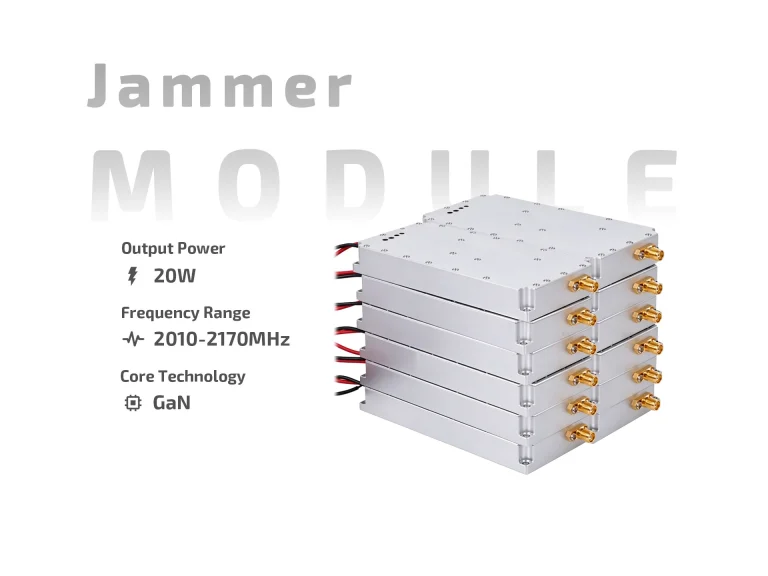
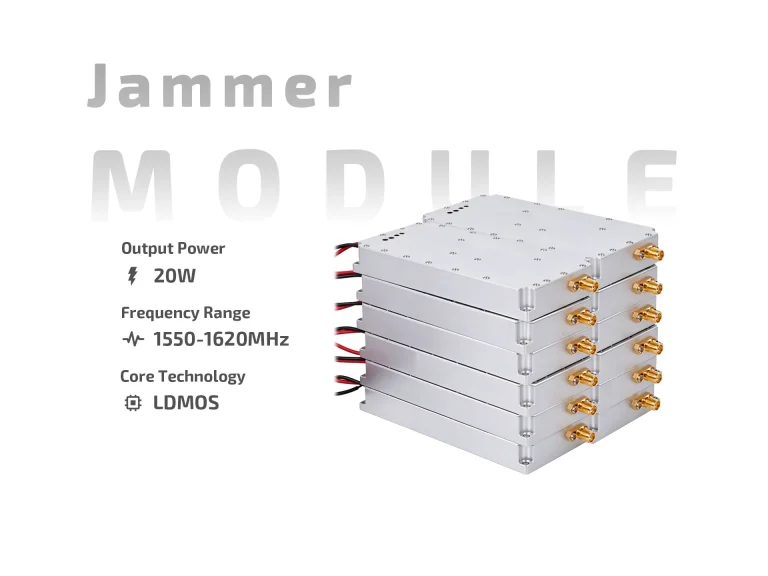
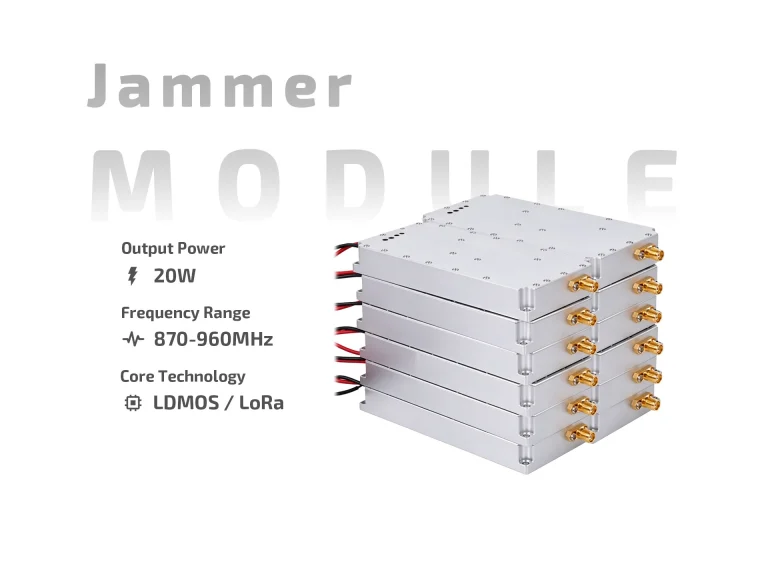
When procurement teams compare a 20W vs 50W drone jammer module, the first question is usually about range. It is tempting to assume that 50W delivers two and a half times the coverage of 20W. In practice, RF behavior is not that simple. Power matters, but antenna gain, frequency band, receiver sensitivity, terrain, duty cycle, cooling, and installation quality often matter more.
For a technical refresher on the RF chain, see our guide: How Does a Drone Jammer Module Work.
Editorial note: Drone jammer modules are regulated products. Deploy them only where authorized by law and with appropriate spectrum coordination.

The 4 dB reality check
A 20W module produces about 43 dBm. A 50W module produces about 47 dBm. The difference is roughly 4 dB. That is meaningful, but it is not the same as a 2.5× range increase. Under simplified free-space assumptions, doubling range requires about 6 dB more link margin. A 4 dB increase can improve coverage and penetration in some scenarios, but the actual result depends heavily on the full system.
This is why a 50W module should not be selected on wattage alone. Buyers should compare total RF power, per-band power, antenna gain, beam pattern, cable loss, VSWR protection, and thermal design.
Side-by-side comparison
| Parameter | 20W drone jammer module | 50W drone jammer module | What it means in practice |
|---|---|---|---|
| RF output | About 43 dBm | About 47 dBm | Roughly 4 dB difference, not 2.5× range |
| Heat load | Lower | Higher | 50W usually needs a larger heatsink or active cooling |
| Power draw | Lower | Higher | Battery runtime and PSU sizing favor 20W |
| Size and weight | Easier to integrate | Often bulkier | 20W suits compact or portable nodes |
| Typical deployment | Manpack, briefcase, small fixed node | Vehicle, shelter, fixed site with power | Match module to platform headroom |
| Thermal design | Simpler | More critical | Continuous 50W operation demands airflow or conduction design |
| Interference footprint | Narrower, easier to contain | Wider potential footprint | 50W needs more careful antenna and site planning |
| Cost profile | Lower entry cost | Higher module and integration cost | Include cooling, power, and filtering costs |
When a 20W module makes more sense
A 20W module is often the better engineering choice when size, weight, and power are tight. It fits portable systems, short-duration deployments, and compact fixed installations where thermal headroom is limited. It can also be a sensible option for multi-band modules where several bands operate at once; always confirm whether the datasheet rating is total power or per-band power.
For battery-powered equipment, 20W can reduce current draw and heat buildup. That can improve reliability and simplify enclosure design. In some cases, a well-designed 20W module with a high-gain antenna and low-loss cabling will outperform a poorly integrated 50W unit.
When a 50W module is worth considering
A 50W module can be useful when the platform has stable power, adequate cooling, and enough space for proper antenna separation. Vehicle-mounted and shelter-based systems often fall into this category. The extra 4 dB may help where additional margin is needed, but it should be treated as one part of the link budget—not a guarantee of longer range.
Higher power also raises the risk of unintended interference. Site planning, antenna orientation, filtering, and shielding become more important. In many projects, the 50W module is selected not because it is automatically “better,” but because the installation can manage its heat and power demands safely.
Integration checklist
Before choosing between 20W and 50W, confirm the following:
-
Per-band vs total power: Does the datasheet state total RF output or power per band?
-
Duty cycle: Is the module rated for continuous or intermittent operation?
-
Thermal path: Is there enough heatsink area, airflow, or conduction cooling?
-
Power budget: Can the battery or PSU support peak and average current?
-
Antenna system: What is the gain, beamwidth, cable loss, and VSWR?
-
Protection: Does the module include over-temperature, over-current, and VSWR protection?
-
Control interface: Does it match the system controller and monitoring software?
-
Compliance: Is the frequency band, output power, and deployment scenario authorized?
Final selection logic
The right question is not simply “20W or 50W?” It is “which module fits the platform, thermal envelope, power budget, antenna system, and legal deployment scenario?” A 20W drone jammer module is often the practical choice for compact and portable systems. A 50W drone jammer module can be appropriate for installations with strong power and cooling, especially where additional RF margin is genuinely needed.
Treat the wattage as a starting point, then validate the complete RF and thermal design. That approach will produce a more reliable counter-drone system than a headline power rating alone.