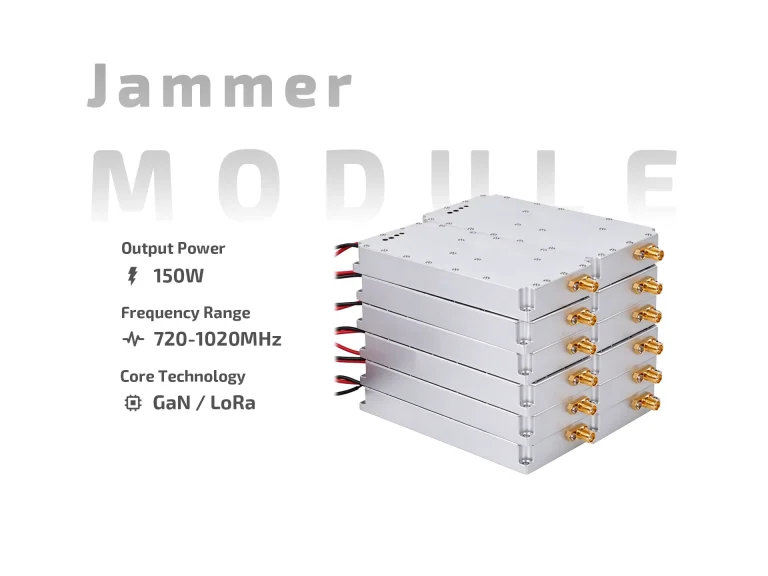
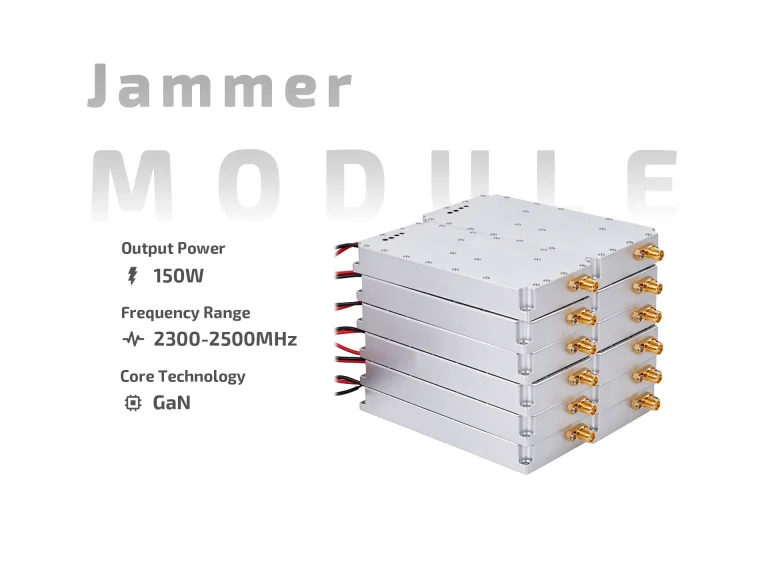
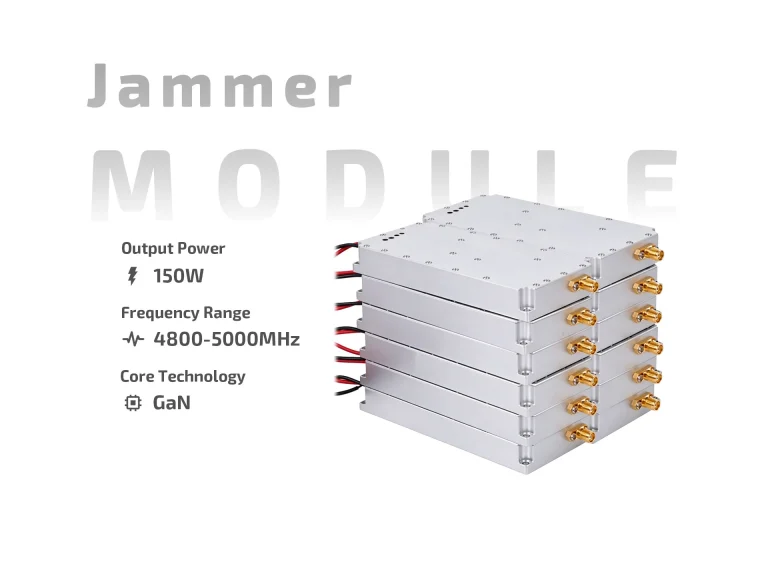
There is a temptation to treat power classes as points on a line. If 100W works, 150W should work better—more margin, more coverage, the same integration with a bigger number. A 150W GaN UAV jammer module punishes that assumption more sharply than any lower class, because several system constraints stop scaling linearly at roughly this point.
This article is organized around those constraints rather than around the module itself. It asks what changes between 100W and 150W, which changes are manageable, and which ones force a redesign of the enclosure, the supply, or the operating concept.
The scope is authorized counter-UAV work. Jamming is regulated in most markets, and deployment requires spectrum authorization, export review, and trained operators.

Where the Line Bends
Below roughly 100W, many integration problems can be solved by enlarging the heatsink or accepting a shorter duty cycle. At 150W, those workarounds start to fail. Heat output rises faster than the enclosure can dissipate it, DC current and inrush climb, and the filtering needed to keep the higher-power output clean grows heavier.
GaN helps here—the efficiency advantage discussed in our review of the 100W GaN drone jammer module is real, and it delays the point where these constraints bite. It does not remove them. The table below shows what actually changes.
| Constraint | At 100W | At 150W | Integration consequence |
|---|---|---|---|
| Heat at full duty (50% efficiency, illustrative) | ~100W | ~150W | Passive cooling usually insufficient; forced air or cold plate likely |
| DC input and inrush | Moderate | Substantially higher | Supply, cabling, and protection may need redesign |
| Heatsink mass and volume | Manageable | Grows faster than output | Enclosure envelope and mounting change |
| Filtering and shielding | Standard | Heavier to hold spurious limits | Added loss, added volume, added cost |
| Duty cycle headroom | Often flexible | Tighter without active cooling | Operating concept may need revision |
| Weight and portability | Tripod-friendly | Platform-sensitive | Mobile use cases may no longer fit |
Constraint One: Heat Stops Being Negotiable
At 150W RF output, a module at 50% efficiency dissipates roughly 150W at full duty cycle, before driver and control losses. In a sealed enclosure, natural convection cannot move that heat fast enough. The design choices narrow to forced airflow, a cold plate, or operating below the ceiling.
GaN raises efficiency, which reduces the figure, but the direction is unchanged. Integrators should recalculate the thermal budget from scratch rather than scaling a 100W design upward.
Constraint Two: The Power Chain Grows With the Module
A 150W module draws more current and produces larger inrush than a 100W unit. On vehicle-mounted or battery-powered platforms, that can force a new supply design, thicker cabling, and revised protection. On fixed installations, it may push the system toward a dedicated DC bus.
This is easy to miss when the procurement conversation focuses on the RF stage. The module is a load, and the supply is part of the system.
Constraint Three: Filtering Costs Real Power
Higher output power makes harmonic and spurious control harder. Filters that were adequate at 100W may need additional stages at 150W, and each stage introduces insertion loss. Some of the extra 50W disappears in the filter before it reaches the antenna.
Buyers should ask for spurious measurements at the full operating point and for insertion loss figures across the band. A 150W module with heavy filtering may deliver less usable power at the antenna than expected.
Constraint Four: Enclosure and Mechanical Fit
The heatsink grows, the supply grows, and the filter grows. Enclosure volume expands, mounting hardware changes, and service access has to be re-planned. On tripod or vehicle mounts, weight and center of gravity shift.
These are not fatal problems, but they change the platform budget. A 150W UAV jammer module should be planned into the enclosure and mount from the beginning, not retrofitted into a design built around 100W.
When 150W Makes Sense
The 150W class fits best in fixed installations with permanent cooling and dedicated power, where the enclosure can be designed around it. It also suits programs where a measured link-margin shortfall at lower power classes has been documented and where the engagement geometry demands more output at the antenna.
It fits poorly in portable, sealed, or battery-limited platforms unless the duty cycle is short and the operating concept accepts the thermal ceiling.
What to Validate Before Purchase
Request swept power across the band, efficiency versus output, case-temperature data in a comparable enclosure, spurious measurements at the full operating point, and DC input and inrush figures. Then run a trial in the intended enclosure at realistic ambient and duty cycle, recording sustained output at the antenna and any derating events.
For a side-by-side view of how power classes compare once these factors are included, see our analysis of 80W vs 100W drone jammer module trade-offs; the same logic applies when moving up to 150W.
Conclusion
A 150W GaN UAV jammer module is a capable component, but it is not a bigger version of a 100W unit. Heat, supply, filtering, and enclosure constraints all change at this level. GaN softens the penalties; it does not cancel them. Treat 150W as a new integration problem, validate it in the real enclosure, and confirm authorization before deployment.