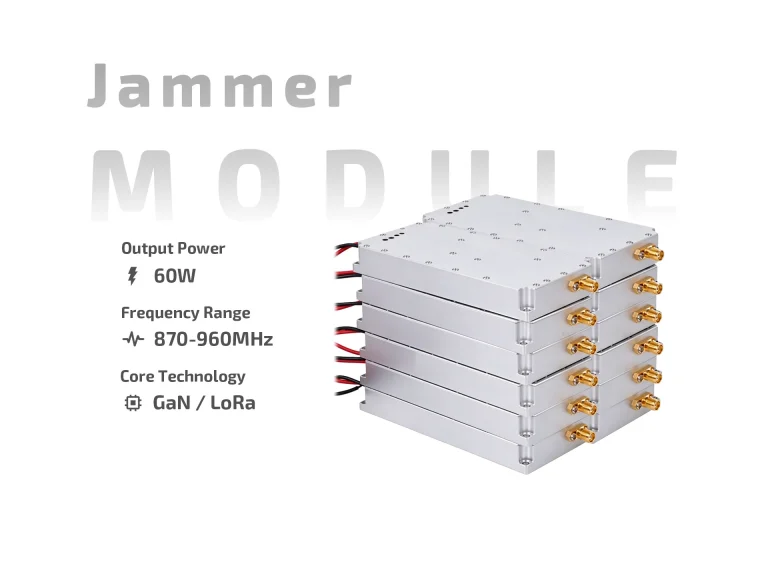
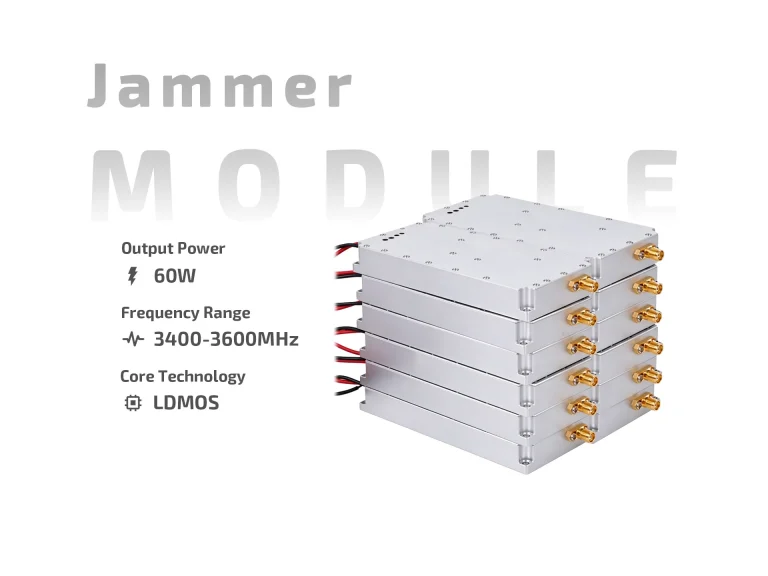
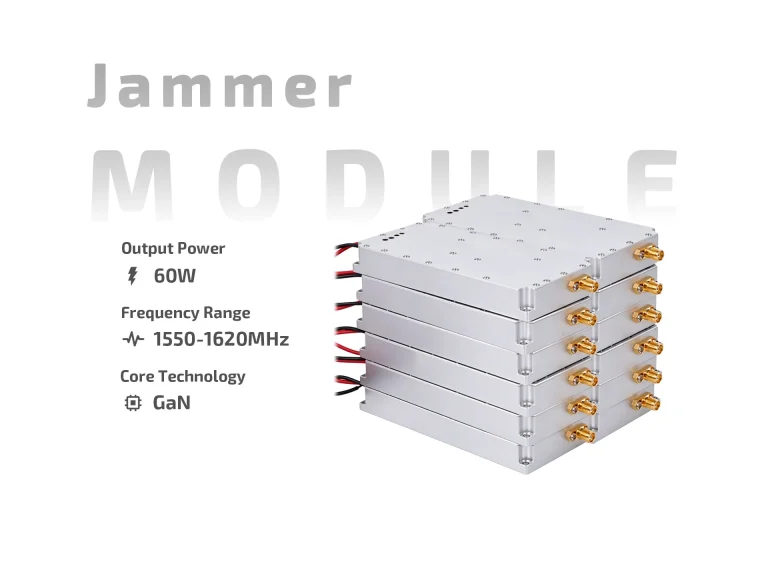
A 1.2GHz 60W anti-drone module is often shortlisted because the band and power class appear to fit a known counter-drone requirement. The procurement risk is that the headline specification hides the variables that determine whether the module works in a real system: exact frequency coverage, thermal derating, interface behavior, filtering, and authorization status.
This article takes a buyer’s view rather than a design-guide view. It is intended for authorized security and counter-drone programs. Jamming and interference are regulated in most markets, and no module should be deployed without the required spectrum authorization, export review, and trained operators.

What the 1.2GHz Label Does—and Does Not—Tell You
The 1.2GHz region is associated with various video, telemetry, and control links, but actual use varies by region, platform, and mission set. A supplier should state the operating band precisely, including center frequency, bandwidth, and any sub-band switching. “1.2GHz” alone is not a sufficient specification for integration or compliance review.
Likewise, 60W should be qualified. Is it RF output at the antenna port, at a defined duty cycle, and under a stated ambient temperature? Does the module derate in a sealed enclosure? Buyers should request test conditions, not just a wattage figure.
Procurement Evidence Table
The table below groups the questions that separate a credible module from a datasheet-only offer.
| Evaluation area | Question to ask | Evidence to request |
|---|---|---|
| Frequency plan | What exact band, bandwidth, and switching options are supported? | Measured frequency response and band-edge data |
| Power and duty cycle | Is 60W rated at the antenna port, and under what duty cycle and ambient? | Power-versus-temperature and derating curves |
| Thermal path | What heatsink, airflow, or cold-plate condition is assumed? | Case-temperature test data in the intended enclosure |
| Filtering and EMC | How are harmonics and spurious emissions controlled? | Spurious and harmonic measurements |
| Control interface | What telemetry, fail-safe, and remote-enable features are available? | Interface documentation and behavior notes |
| Compliance | Is the module authorized for the intended market and use? | Spectrum authorization, export classification, and operator requirements |
Thermal sizing deserves particular attention at the 60W class. Our guide on how much heatsink for a 60W jammer module explains why heat removal depends on efficiency and duty cycle rather than wattage alone.
Red Flags in a Shortlisting Review
Be cautious when a supplier quotes range without stating antenna gain, test conditions, or legal limits. The same applies to modules described only by band and wattage, with no filtering data or thermal derating information. A credible 1.2GHz 60W anti-drone module should come with integration documentation and clear operating restrictions.
Also check mechanical fit early. Connector placement, heatsink clearance, antenna routing, and service access can turn an otherwise suitable module into a costly integration problem.
Conclusion
The 1.2GHz 60W anti-drone module category is best evaluated as a subsystem, not a power rating. Confirm the exact band, qualify the 60W claim, review thermal and EMC evidence, and verify authorization before purchase. A checklist-led approach reduces both technical and program risk.