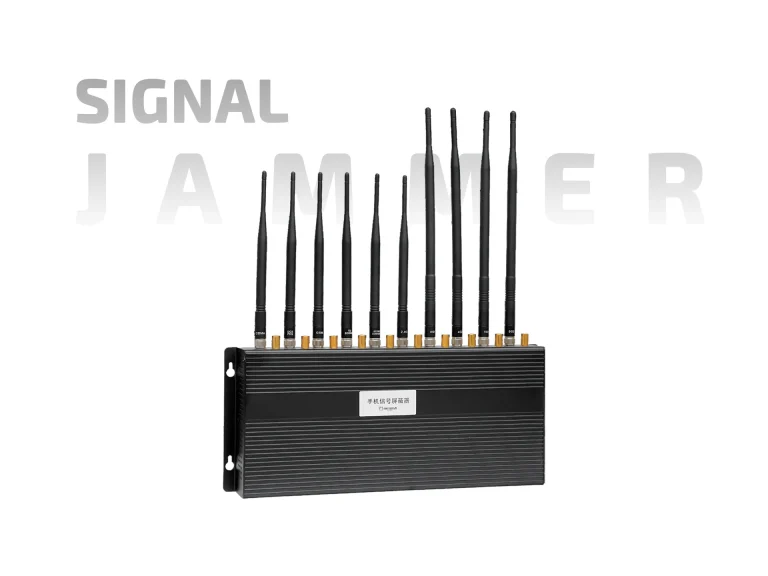
Search interest in the “best signal jammer 2026” is rising, but the phrase can be misleading. In wireless signal management and mobile signal management, “best” does not mean the most powerful box or the lowest price. It means the most appropriate, authorized, documented, and controllable approach for a specific environment. In many countries, transmitting jamming signals outside narrowly approved government, military, or laboratory settings is illegal. A credible 2026 evaluation therefore starts with compliance and signal-management goals—not with a product ranking.
For a technical foundation on how interference affects receivers, see How Does a Signal Jammer Work? RF, GPS, WiFi and Cellular Explained.

Start With Signal Management, Not “Jamming Power”
Wireless signal management is about keeping intended links reliable while controlling unwanted interference. Mobile signal management adds licensed cellular spectrum, emergency-call access, and strict regulatory oversight. In that context, a signal jammer is a denial-of-service tool at the radio layer. It may be relevant only in controlled security, research, or authorized testing scenarios—never as a general office or consumer solution.
The best signal jammer 2026, if the term is used at all, should be judged by how well it fits an authorized interference-management plan. That plan should define the protected area, the signals to be affected, the signals that must remain available, the legal basis, the test method, and the shutdown procedure.
Evaluation Scorecard for Authorized Projects
| Criterion | What to verify | Red flag |
|---|---|---|
| Legal authorization | Written approval, licensed spectrum rules, and site-specific permission | Vendor claims “legal everywhere” |
| Signal-management objective | Clear reason for interference and defined protected zone | “Block everything” as a goal |
| Frequency discipline | Precise band selection and documented emission limits | Vague “full-band” claims |
| Containment | Shielded room, Faraday enclosure, or controlled test range | Open-air use near critical infrastructure |
| Safety coordination | Emergency-service, aviation, GNSS, and hospital impact review | No collateral-interference assessment |
| Logging and control | Audit logs, operator training, and immediate shutdown | No accountability or kill switch |
| Thermal and duty-cycle design | Realistic continuous-operation limits | Unsupported power or range claims |
This scorecard matters more than a spec sheet. Two systems with similar output ratings can behave very differently because antenna patterns, bandwidth, filtering, and site conditions shape where the interference actually goes.
Wireless vs. Mobile Signal Management Priorities
| Management area | Primary concern | 2026 pressure point | Practical response |
|---|---|---|---|
| Wireless LAN and local RF | WiFi congestion, IoT reliability, channel planning | WiFi 6E/7 and dense device environments | Audit spectrum first; isolate test areas |
| GNSS-dependent operations | Position, navigation, and timing resilience | GNSS jamming and spoofing awareness | Monitor timing sources and use authorized testing |
| Mobile cellular access | Licensed spectrum, emergency calls, coverage | Regulatory scrutiny and network densification | Coordinate with carriers; never jam open-air |
| Industrial wireless | Safety links, remote control, sensors | Uptime and liability exposure | Use shielded testing and fail-safe design |
| Event or facility security | Controlled communications policy | Privacy and safety trade-offs | Prefer policy, zoning, and authorized solutions |
What 2026 Buyers Should Ask Instead
Instead of asking “Which is the best signal jammer 2026?”, authorized teams should ask:
-
Is jamming legally permitted here, and who has approved it?
-
Which exact signals must be affected, and which must remain available?
-
Can the test be contained in a shielded or licensed environment?
-
How will we measure unintended emissions and collateral interference?
-
What is the shutdown, escalation, and incident-reporting process?
-
Does the vendor provide documentation rather than only power claims?
These questions separate a defensible signal-management project from an illegal or unsafe purchase. They also align with Google’s helpful-content expectations: original, experience-based, risk-aware guidance rather than thin product hype.
Bottom Line
The best signal jammer 2026 is not a universal product. For most organizations, the better answer is an authorized signal-management program that prioritizes legal compliance, containment, safety coordination, and measurable testing. Jamming technology may have narrow authorized uses, but “best” should mean controlled, documented, and lawful—not merely powerful.