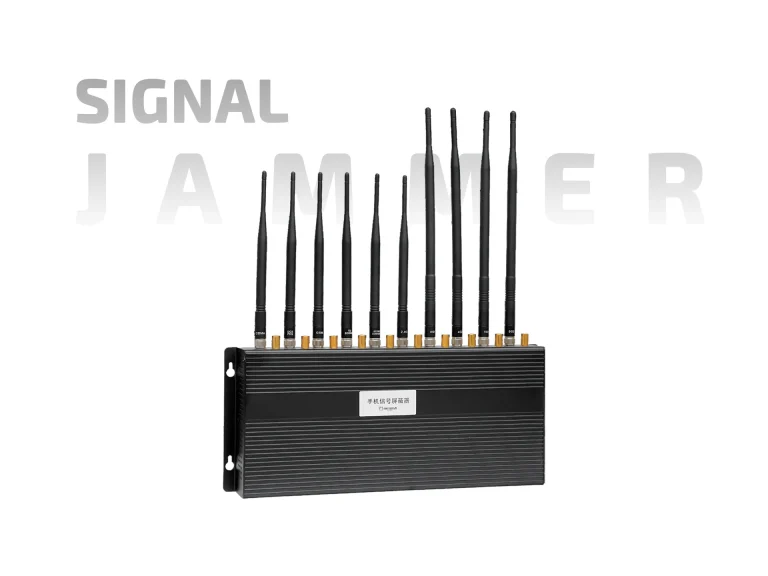
“Signal jammer range” is one of the most misunderstood terms in RF discussions. Buyers often expect a single distance figure, such as “500 meters” or “2 kilometers.” In practice, range is an outcome of the entire radio link: transmitter power, antenna gain and pattern, frequency, bandwidth, terrain, obstacles, receiver sensitivity, and the strength of the legitimate signal. A jammer that performs well in one location may deliver far less coverage in another.
For the receiver-level mechanics behind this effect, see How Does a Signal Jammer Work? RF, GPS, WiFi and Cellular Explained.

Range Is a System Result, Not a Sticker Spec
A useful way to think about signal jammer range is the “jamming margin” at the victim receiver. The interference must be strong enough at that receiver—not merely at the jammer’s antenna—to prevent the receiver from decoding the wanted signal. This is why rated output power alone tells you very little. A high-power device with a poorly matched antenna can underperform a lower-power system with better gain, filtering, and placement.
| Factor | Effect on jamming range | Practical implication |
|---|---|---|
| Output power | More energy can extend reach, but with diminishing returns | Heat, power draw, and legal limits matter |
| Antenna gain and pattern | Shapes where energy goes and how concentrated it is | Directional antennas can focus coverage |
| Frequency and bandwidth | Higher frequencies usually suffer more path loss; wide bands spread energy | Band choice changes realistic distance |
| Receiver sensitivity | More sensitive receivers can be affected at lower interference levels | Target device design matters |
| Legitimate signal strength | A strong wanted signal is harder to overwhelm | Distance to base station or access point matters |
| Terrain and obstacles | Walls, buildings, hills, and foliage absorb or shadow RF | Indoor and outdoor ranges differ sharply |
| Interference type | Barrage, spot, and sweep jamming behave differently | Coverage may be intermittent or channel-specific |
Why Frequency Changes the Picture
Lower frequencies generally propagate farther and penetrate obstacles better than higher frequencies, but the relationship is not a simple rule. Bandwidth, antenna size, licensed limits, and receiver design all intervene. A GNSS receiver, for example, works with extremely weak satellite signals, so relatively low interference can disrupt it. A WiFi receiver in a dense office may face congestion and strong local signals, changing the practical effect.
| Target environment | Range planning consideration | Common mistake |
|---|---|---|
| GNSS-dependent operations | Weak satellite signals can be disrupted at low interference levels | Assuming GNSS range equals cellular range |
| WiFi in buildings | Walls and channel plans strongly shape coverage | Quoting one open-air distance for indoor use |
| Cellular macro coverage | Licensed spectrum and strong downlinks limit practical effect | Ignoring carrier signal strength and legal status |
| Industrial wireless links | Obstacles and safety links demand contained testing | Testing in open air without coordination |
| Event or facility security | Coverage must be controlled and documented | Treating range as a guarantee |
How Authorized Teams Verify Range
Authorized teams do not rely on a brochure. They define a test area, measure the wanted signal and interference levels, document antenna placement, and check for unintended effects outside the target zone. They also confirm the legal basis and use containment such as shielded rooms or licensed test ranges where required. A range claim without test conditions is incomplete.
Common Range Myths
| Myth | Reality |
|---|---|
| “More power always means more range.” | Antenna pattern, frequency, and receiver conditions often dominate. |
| “One range figure fits all devices.” | Different receivers and protocols respond differently. |
| “Indoor and outdoor ranges are similar.” | Walls, foliage, and terrain can dramatically reduce coverage. |
| “A longer range is always better.” | Greater reach can mean more collateral interference and legal risk. |
| “A vendor label proves real-world performance.” | Documented testing and site conditions are what matter. |
Bottom Line
Signal jammer range is not a fixed number. It is the result of transmitter design, antenna behavior, frequency, receiver sensitivity, environment, and the strength of the legitimate signal. Authorized teams should verify coverage through controlled testing and documented conditions—not through marketing claims. In most cases, the smarter question is not “How far does it reach?” but “What exactly is affected, where, and under what authority?”