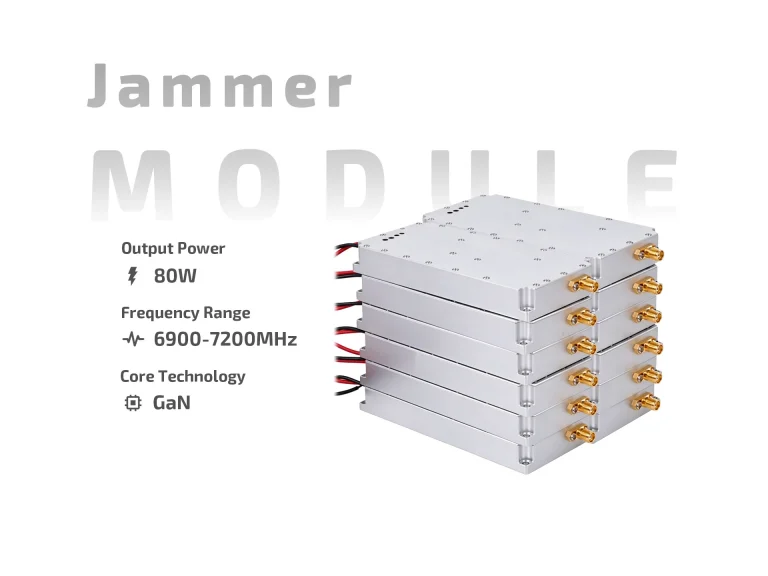
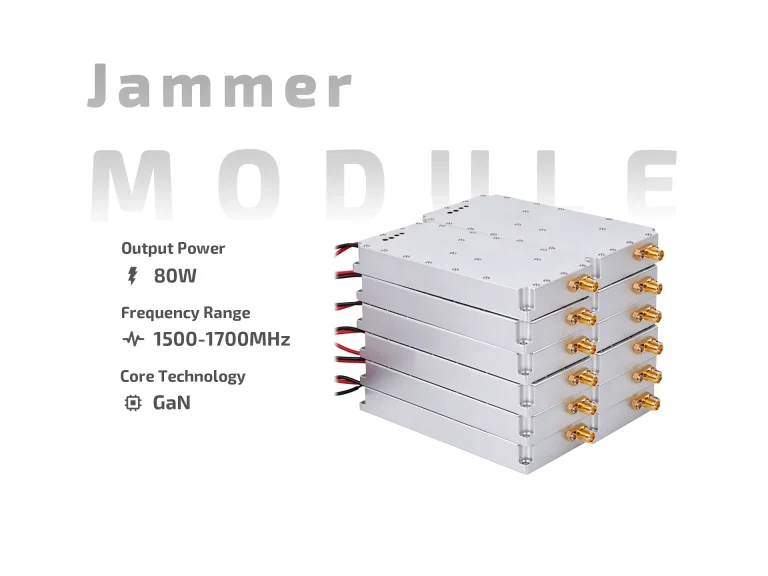
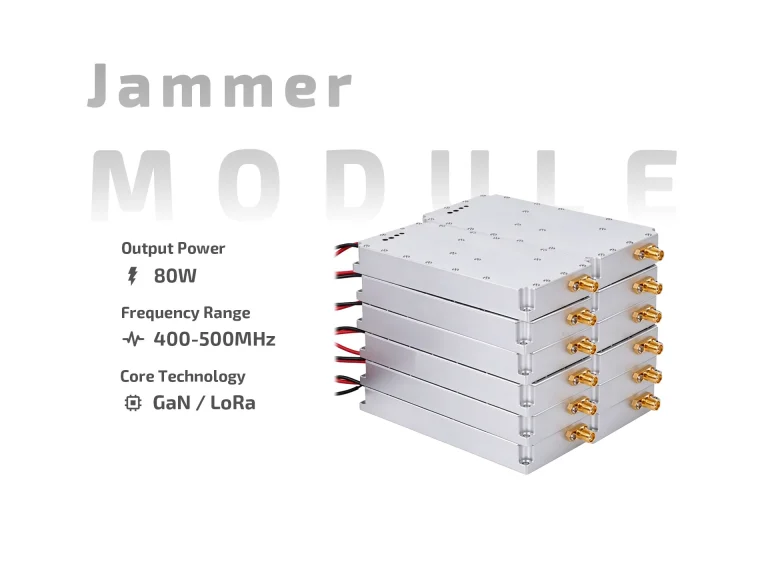
The question sounds simple, but the honest answer has two halves. An 80W jammer module is used as the RF power stage inside authorized counter-drone systems, where it disrupts specific radio links at a defined band and power level. It is not a standalone product that can be switched on anywhere, and it is not a universal drone blocker.
Understanding the second half matters as much as the first. Jamming and interference are regulated in most markets, and lawful use is typically confined to government, security, and military programs operating under explicit spectrum authorization. With that framing in place, the practical uses become easier to describe.

The Short Answer
In an authorized system, an 80W jammer module provides the transmit power needed to raise the noise floor in a chosen band, so that a drone’s control, video, or telemetry link degrades or fails. It is usually one element in a chain that includes antennas, a controller, cooling, power conditioning, and an operator interface.
The 80W class sits in the middle of the counter-drone power range. It offers more headroom than compact 20–50W units without the thermal and supply demands of 100W-class hardware. That middle position explains most of its appeal.
Typical Authorized Use Scenarios
The table below describes where the 80W class is commonly considered. Each scenario assumes authorization, trained operators, and documented rules of use.
| Scenario | What the module contributes | Integration notes |
|---|---|---|
| Fixed-site protection of a facility perimeter | Sustained band coverage over a defined sector | Directional antennas, permanent cooling, remote monitoring |
| Mobile patrol or vehicle-mounted response | Portable RF disruption capability on arrival | Vibration tolerance, DC power conditioning, compact heatsinking |
| Temporary event or VIP security | Short-notice coverage of a controlled area | Rapid deployment mounts, duty-cycle planning |
| Correctional and critical-infrastructure sites | Deterrence against contraband delivery attempts | Coordination with site communications and legal review |
| Test ranges and training environments | Controlled RF conditions for counter-drone drills | Spectrum coordination, logging, safety procedures |
| System integrator platforms | A reusable building block across product lines | Interface standardization, enclosure commonality |
Note that the module’s role is disruption, not detection. Most systems pair it with radar, RF sensors, or optical tracking that identify and classify the target before any transmitter is engaged.
What the Band Choice Actually Means
An 80W drone jammer module is only useful against links it can reach. FPV video, control, and telemetry links occupy different bands depending on platform and region, and some systems hop channels during flight. A module specified for one band will not affect a drone flying on another.
This is why procurement conversations should start with the target link profile rather than with wattage. Ask which bands the module covers, how much bandwidth it holds at rated power, and whether the antenna plan matches the intended engagement geometry. For a direct comparison of power classes, see our article on 80W vs 100W drone jammer module selection.
What Determines Whether 80W Is Enough
Three factors decide whether the 80W class suits a given program:
Link margin. If the target link is strong and the antenna gain is modest, 80W may fall short. If the engagement geometry favors the counter-drone system, 80W can be sufficient.
Duty cycle. Continuous operation stresses cooling far more than short bursts. Many deployments are burst-oriented, which favors the 80W class.
Enclosure and airflow. A sealed, passively cooled enclosure can erase the advantage of the extra power. Thermal design should be validated before purchase, not after installation.
What It Is Not Used For
An 80W jammer module is not a detection device, not a legal shortcut, and not a fixed-range guarantee. Suppliers who quote a single distance figure without stating antenna gain, target link, terrain, and test conditions are offering a number, not an engineering answer.
It is also not a substitute for procedures. Authorization, operator training, incident logging, and coordination with local spectrum authorities remain part of any responsible deployment.
Conclusion
So what is an 80W drone jammer module used for? It is used as the transmit stage in authorized counter-drone systems, chosen when a mid-range power class matches the target links, engagement geometry, and duty cycle. The wattage is a starting point; band coverage, thermal headroom, and legal authorization decide whether the module is actually fit for purpose.