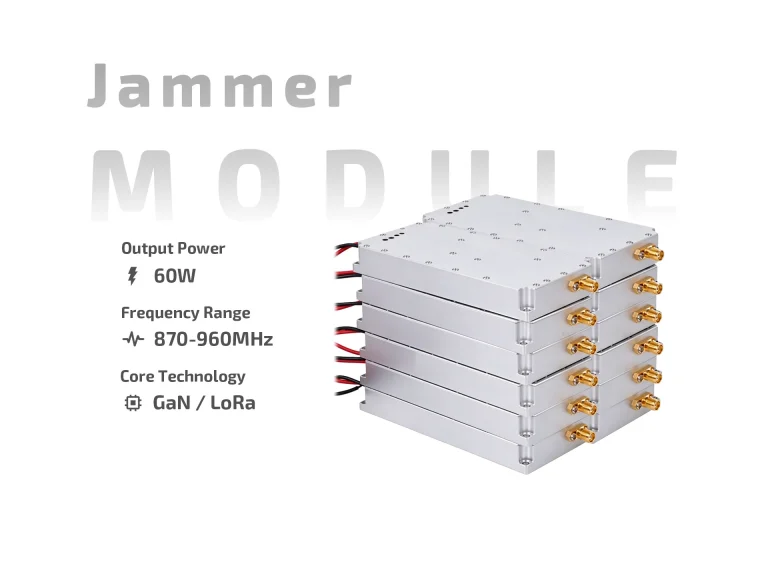
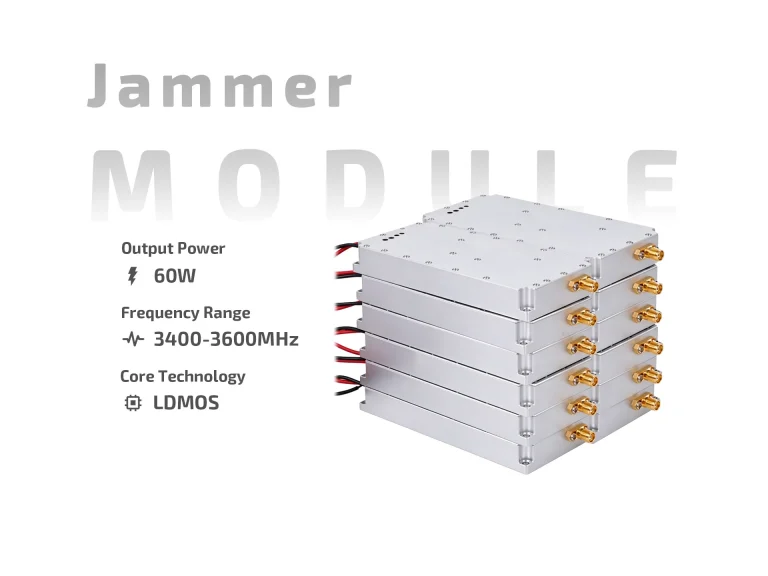
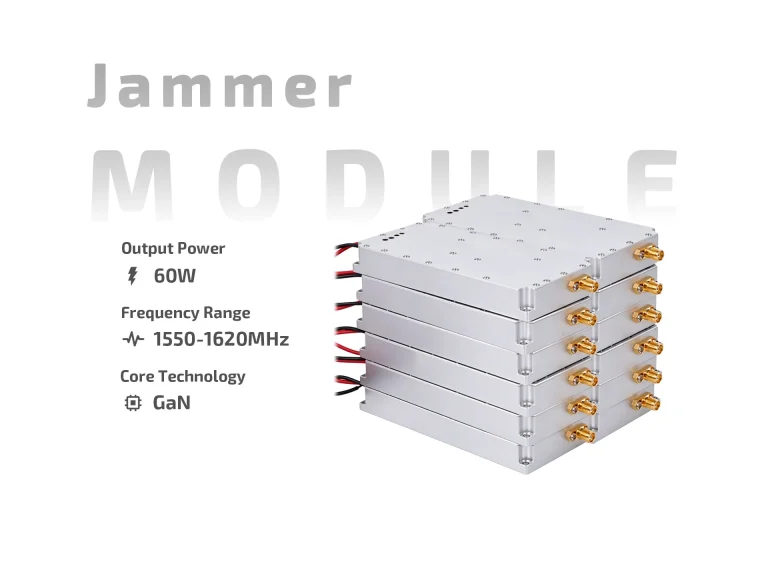
There is no reliable “one-size” answer to how much heatsink for a 60W jammer module is enough. The 60W figure usually refers to RF output, not heat. The heatsink must remove the wasted power—and that depends on amplifier efficiency, duty cycle, ambient temperature, enclosure design, and how the module is mounted.
For authorized counter-drone and security programs, thermal design should be treated as part of the integration, not an accessory. A module that looks fine on a bench can derate quickly in a sealed outdoor enclosure.

Start With Heat, Not Wattage
A simple first estimate is:
Heat to remove ≈ RF output × (1 ÷ efficiency − 1)
At 60W RF output, a 50% efficient module produces roughly 60W of heat at full duty cycle. At 40% efficiency, that rises to about 90W. At 60% efficiency, it falls to about 40W. Duty cycle then reduces the average load, but short high-power bursts still stress the thermal interface and heatsink mass.
| Assumed efficiency | RF output | Heat at 100% duty | Practical heatsink direction |
|---|---|---|---|
| 40% | 60W | ~90W | Forced-air finned heatsink or cold plate; passive sealed enclosure is usually inadequate |
| 50% | 60W | ~60W | Substantial finned heatsink with airflow; verify case temperature under enclosure conditions |
| 60% | 60W | ~40W | Larger passive heatsink may be possible only with good airflow and ambient margin |
These are illustrative figures. The module vendor should provide efficiency, maximum case temperature, duty-cycle ratings, and derating curves.
The Thermal Budget Matters More Than Heatsink Size
A useful heatsink choice starts with the allowed temperature rise. If the module case must stay below a stated limit and the ambient air is known, the required sink-to-ambient thermal resistance can be estimated. Interface material, mounting flatness, airflow, and enclosure resistance all consume part of that budget.
In practice, a 60W-class module often needs a finned aluminum heatsink with forced air, or a cold plate, especially in continuous operation. A small PCB-mounted heatsink is rarely enough. In a sealed natural-convection box, the enclosure itself becomes part of the heatsink—and often the limiting factor.
Integration Checks Before Shortlisting
Ask the supplier for test data under realistic conditions, not just a heatsink recommendation. Confirm the module’s thermal path, required airflow direction, maximum ambient, and temperature-sensor behavior. Check that the heatsink does not obstruct connectors or antenna routing. For broader module-selection criteria, see the companion article on 50W LoRa drone jammer module design and compliance.
Also confirm that deployment is authorized. Jamming and interference are regulated in most markets, and thermal design does not change spectrum, export-control, or operator-training obligations.
Conclusion
The answer to how much heatsink for a 60W jammer module is a thermal calculation, not a fixed weight or fin count. Estimate heat from efficiency and duty cycle, define ambient and case limits, then size the heatsink and airflow together. If the enclosure is sealed and passively cooled, assume the required heatsink is larger than the bench test suggests.