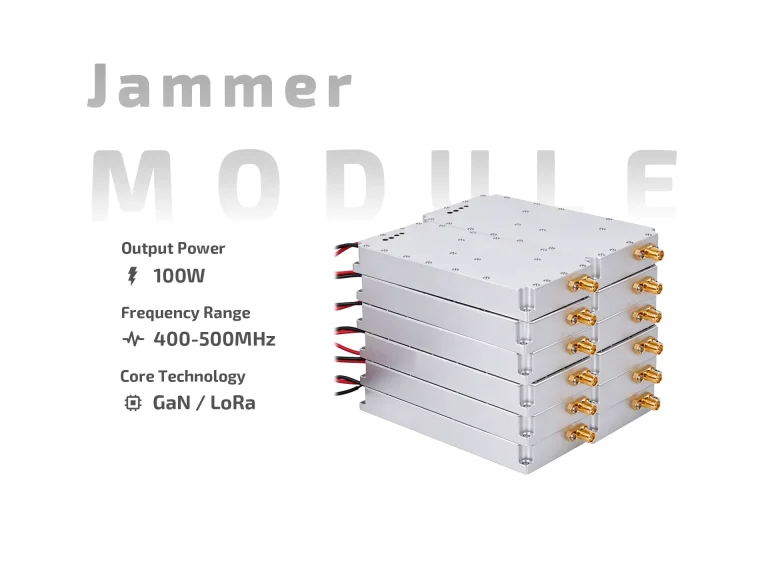
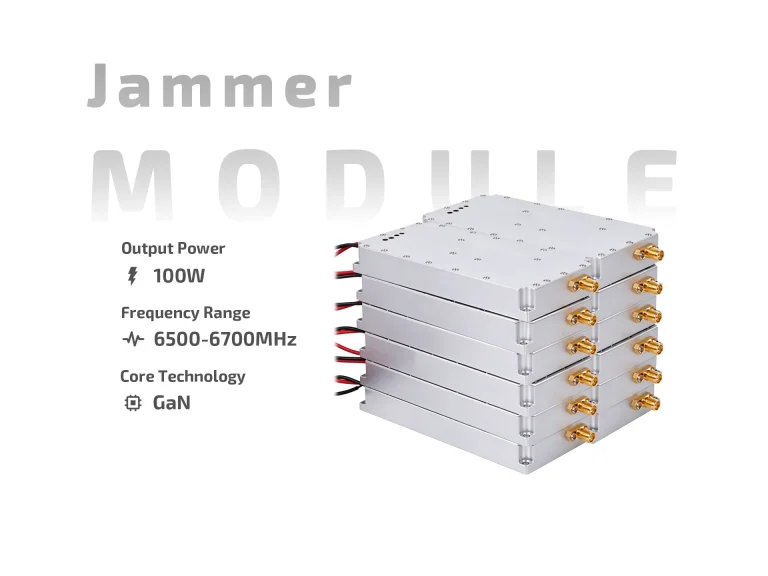
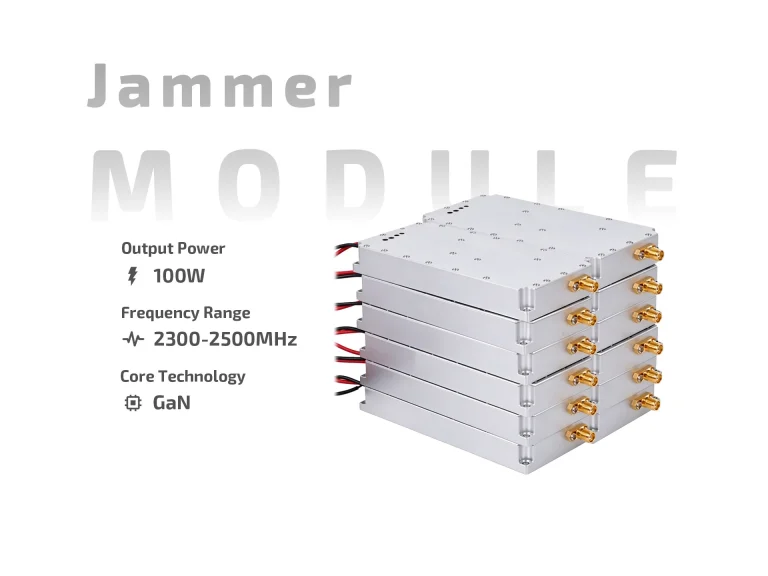
A 100W FPV jammer module is often specified late in a counter-UAV program, when the team has already decided that lower power classes are insufficient and wants a single high-power building block. That late-stage decision carries a specific risk: by the time the 100W class is selected, the enclosure, power budget, and antenna plan may already be fixed around smaller modules.
This article examines that risk directly. Rather than reviewing the technology from first principles, it follows a 100W FPV module through the procurement and integration sequence, flagging the points where the specification and the installed system tend to diverge.
The scope is authorized counter-FPV work. Jamming is regulated in most markets; deployment requires spectrum authorization, export review, and trained operators.

Stage 1: Reading the Wattage Claim
The first divergence appears on the datasheet. A 100W rating is typically measured at a single frequency, a defined duty cycle, and a controlled ambient temperature. In an FPV context, where the module may need to address a passband rather than a single channel, output at the band edges is the number that matters.
| Specification element | Typical datasheet presentation | What the integrator needs |
|---|---|---|
| Output power | 100W, center frequency | Swept power across the full FPV passband |
| Duty cycle | Rated, often unspecified duration | Continuous and burst ratings with time limits |
| Efficiency | Sometimes omitted | Heat load calculation at full output |
| Bandwidth | Nominal figure | Usable bandwidth at rated power |
| Spurious and harmonics | Compliance statement | Measured data at the intended operating points |
| Cooling assumption | Heatsink recommendation | Case temperature in the target enclosure |
If a supplier cannot provide swept power data, treat the 100W claim as a ceiling rather than an operating figure.
Stage 2: Confirming the FPV Link Profile
FPV links are not uniform. Video downlinks, control uplinks, and telemetry may sit in different bands, and racing or custom platforms sometimes switch channels mid-flight. A 100W module aimed at one band will not affect a drone operating on another.
Before committing, map the link profile the system must address: which bands, which bandwidths, and whether channel agility is expected. Then compare that map against the module’s actual coverage.
Stage 3: Rebuilding the Thermal Budget
This is where the late-stage selection problem becomes concrete. A 100W RF output at 50% efficiency implies roughly 100W of heat at full duty cycle, before driver and control losses. If the enclosure was designed around a 50W or 80W module, the cooling capacity is likely insufficient.
Three options exist: enlarge the heatsink and enclosure, add forced airflow or a cold plate, or operate the 100W module below its ceiling. The third option is often the most practical, but it should be a deliberate decision supported by the supplier’s derating data—not an accidental outcome discovered during trials.
Stage 4: Revisiting Power and Weight
A 100W FPV jammer module draws more DC current and produces larger inrush than lower classes. If the platform is vehicle-mounted or battery-powered, the supply design may need revision. Weight also rises with the heatsink and mounting hardware, which matters on mobile and tripod-based systems.
These are not reasons to reject the 100W class. They are reasons to include it in the platform budget from the start rather than treating it as a drop-in upgrade.
Stage 5: Comparing Against the 80W Alternative
Once the thermal and supply implications are visible, the 80W versus 100W question becomes clearer. If the 100W module must be derated to 80W to survive the enclosure, the two classes converge—and the lighter, cheaper option may be preferable. Our comparison of 80W vs 100W drone jammer module trade-offs sets out the decision factors in detail.
Stage 6: Validating in the Real Enclosure
The final step is a trial in the intended enclosure, with the intended antenna and cable loss, at realistic ambient temperature and duty cycle. Record sustained output at the antenna, case temperature, and any derating or shutdown events. Bench data taken on an open frame at room temperature does not substitute for this test.
Conclusion
A 100W FPV jammer module is a capable building block, but it is not a late-stage drop-in. The wattage claim, the FPV link profile, the thermal budget, and the supply design must be validated together before the class is locked in. Integrators who sequence those checks early avoid the most expensive outcome: discovering in field trials that the enclosure, not the module, sets the real power limit.