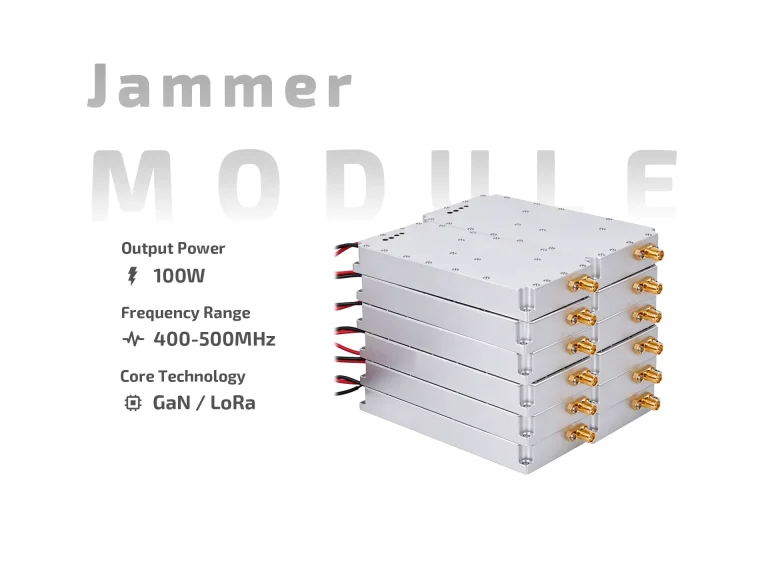
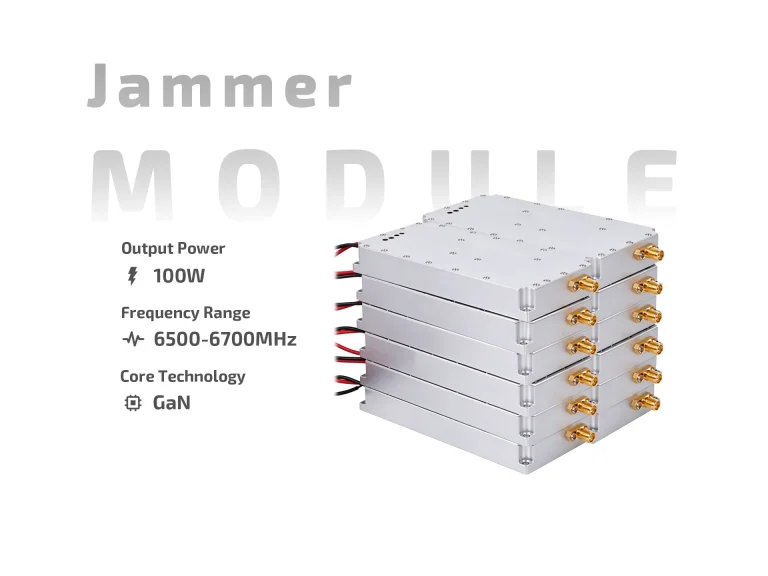
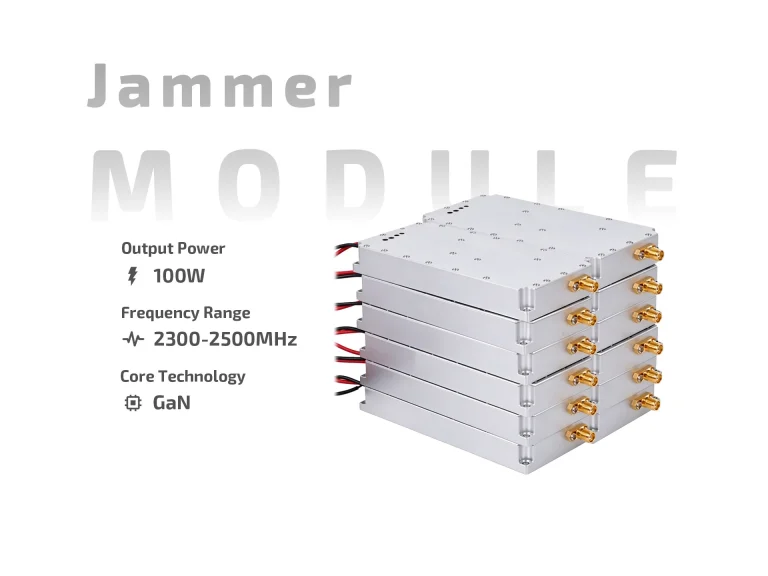
Gallium nitride has become a standard talking point in RF procurement. A 100W GaN drone jammer module is often presented as the modern choice over older silicon-based designs, with efficiency, power density, and thermal performance cited as the reasons. Some of that is genuine. Some of it is absorbed by the rest of the system before the operator ever notices.
This article takes a different angle from a band-by-band or wattage-by-wattage review. It asks a narrower question: when a supplier says “GaN” in a 100W counter-drone module, which engineering promises actually reach the installed system, and which ones need to be verified rather than assumed?
The context remains authorized counter-drone work. Jamming is regulated in most markets, and deployment requires spectrum authorization, export review, and trained operators.

The GaN Case in One Paragraph
GaN devices generally offer higher power density and higher breakdown voltage than legacy LDMOS or silicon bipolar parts, which can translate into higher efficiency at a given output and smaller amplifier stages. In a 100W module, that can mean less heat per watt delivered, a more compact RF chain, and potentially better linearity under backed-off operation. Those are real advantages—but they are device-level advantages, and systems have a way of consuming them.
Promise One: Higher Efficiency Means Less Heat
This is the most cited GaN benefit and the most frequently overstated. A GaN-based 100W module may run at higher efficiency than an older design, which reduces the heat that must be removed. But the system still has to remove the remaining heat, and the enclosure, heatsink, and airflow assumptions still set the ceiling.
| GaN promise | Where it holds | Where it shrinks |
|---|---|---|
| Higher drain efficiency | At the device and amplifier stage | Cable, filter, and combining losses sit downstream |
| Lower heat per RF watt | At full duty cycle, compared with older silicon | Efficiency falls at band edges and under back-off |
| Smaller amplifier footprint | Inside the module | Heatsink and enclosure may not shrink proportionally |
| Better thermal conductivity | Die-level heat spreading | Interface material and mounting dominate system thermal path |
| Improved linearity | At backed-off operating points | Wideband operation may still force power derating |
The practical implication: GaN can improve the thermal budget, but it does not remove the need to calculate it.
Promise Two: Power Density Shrinks the Module
GaN stages can be physically smaller for the same output, which helps in space-constrained integrations. But a smaller amplifier does not automatically mean a smaller installed system. The heatsink, the DC supply, the filtering, and the antenna interface often dominate the mechanical envelope.
Integrators who budget enclosure volume around a smaller GaN module sometimes find that the thermal solution re-expands it. The module shrank; the system did not.
Promise Three: Linearity Improves Under Back-Off
This is a subtler benefit and a genuinely useful one. A GaN module operated below its ceiling can offer better linearity and thermal margin than a comparable silicon design pushed near its limit. In practice, that means a 100W GaN drone jammer module run at 80W may deliver cleaner output and more stable behavior than a 100W legacy module at the same output.
That operating strategy only works if the supplier supports it and publishes derating data. It also changes the wattage comparison: a derated 100W GaN module may be functionally equivalent to a well-designed lower-power unit, as discussed in our 80W vs 100W drone jammer module comparison.
What “GaN” Does Not Tell You
The word GaN describes a semiconductor technology, not a system specification. It says nothing about the exact band coverage, the filtering quality, the control interface, or the thermal design of the enclosure. A poorly integrated GaN module can underperform a well-integrated silicon-based one.
Buyers should ask for the same evidence regardless of device technology: swept power across the band, efficiency versus output, case-temperature data in a comparable enclosure, and measured spurious performance.
A Note on Reliability and Supply
GaN has matured considerably, but procurement teams should still confirm qualification data, operating lifetime assumptions, and supply continuity for the specific device family used. These questions matter more in long-life fixed installations than in short-duty mobile platforms.
Conclusion
A 100W GaN drone jammer module can be a strong choice, but GaN is an enabler, not a guarantee. The efficiency and density gains are real at the device level; whether they survive into the installed system depends on filtering, back-off strategy, thermal integration, and enclosure design. Verify the system, not the acronym.