October 22, 2026
100W GaN Drone Jammer Module: Does GaN Deliver?
GaN promises efficiency and power density in 100W drone jammer modules. Here is where the gains are real, where they shrink, and what to verify.


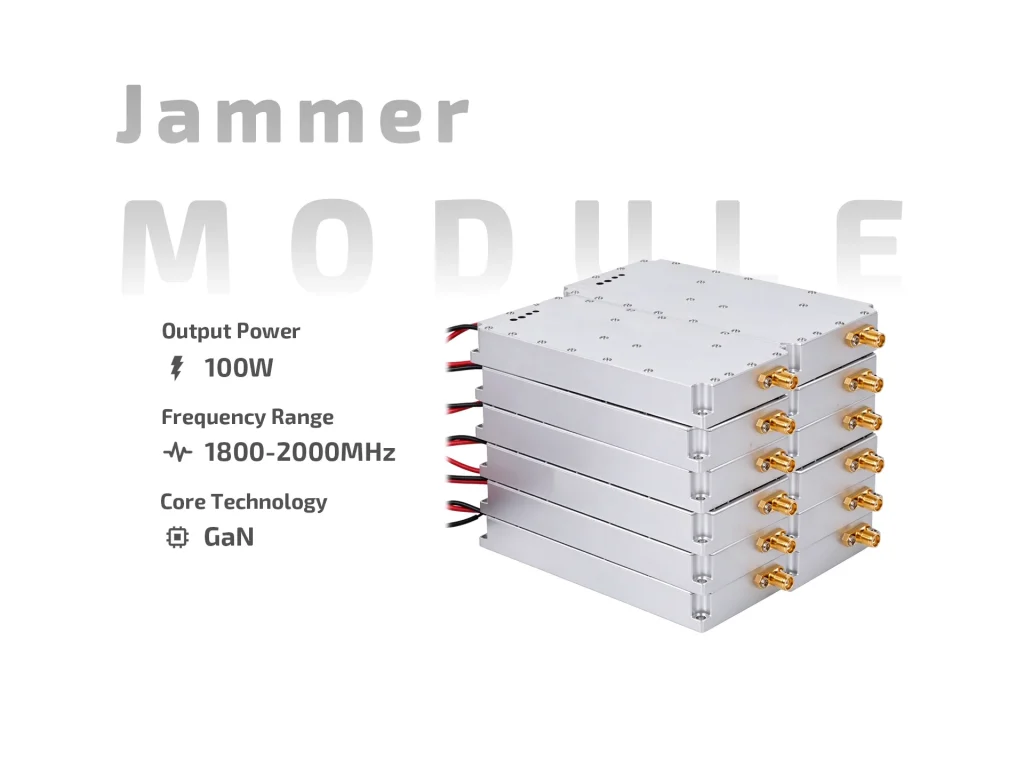
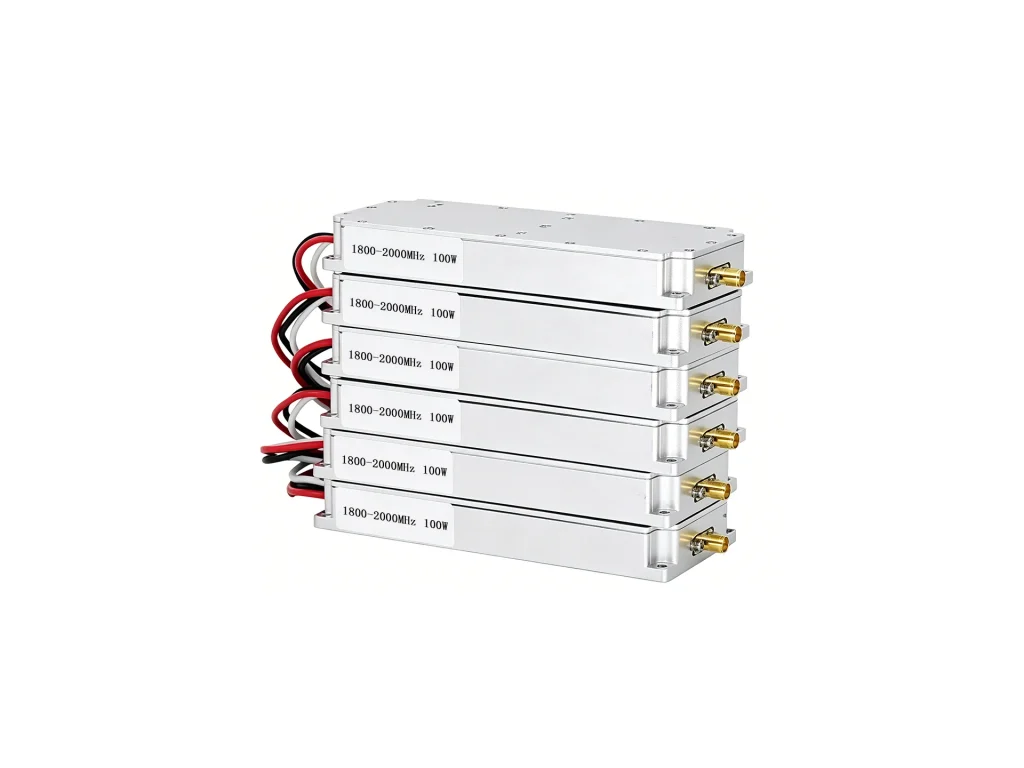

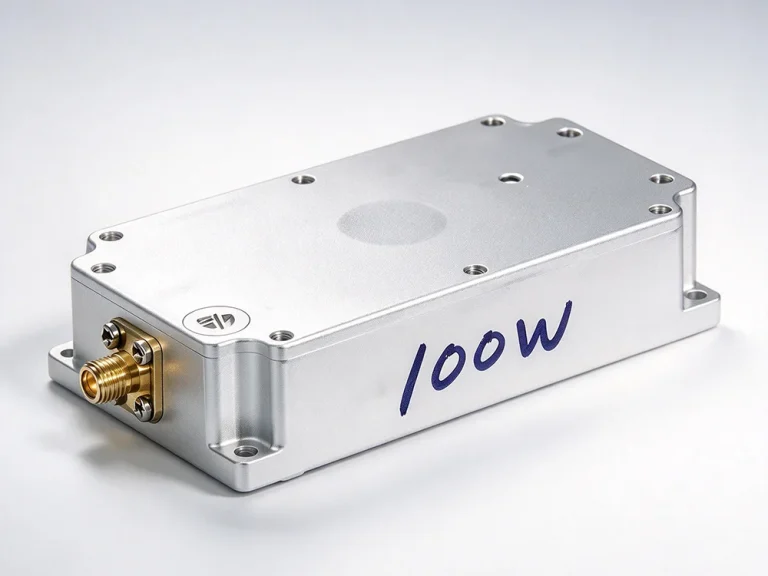
100W GaN UAV jammer module ETLD-JM1820G100: 1800–2000MHz, 100W, DC24–29V, 12A max, ≥40% efficiency, SMA female, built-in sweep source and VSWR protection.
The ETLD-JM1820G100 is a 100W GaN UAV jammer module built for 1800–2000 MHz counter-drone work. It combines a high-speed sweep source, GaN output stage, and protection circuits in a compact metal housing. Instead of acting like a plain amplifier, it is an all-in-one analog jamming module. That makes integration faster for system builders who need reliable RF pressure in a narrow, commonly used UAV band.

This band covers many control, video, and telemetry links used by small UAVs. A focused 200 MHz window lets the module concentrate energy where it matters. The built-in sweep source moves across the range at high speed, so the output is not fixed on one frequency. For users, that means broader coverage without adding an external signal generator.
The output stage uses gallium nitride devices. GaN handles high power density and higher junction temperatures better than many older technologies. In this module, the result is 100W output with efficiency of at least 40%. The design keeps the size at 168.5 × 84.5 × 23 mm and weight at 0.55 kg, which is practical for vehicle, backpack, or fixed installations where space is tight.
Output VSWR is specified at ≤2.0. The module includes an absorption-type VSWR protection device. If the antenna match worsens, the protection helps absorb reflected energy and reduces stress on the GaN stage. This is useful in real deployments, where antennas may be close to metal, walls, or other objects. A clean 50-ohm path still gives the best results, but the built-in protection adds a layer of safety.
The 100W GaN UAV jammer module runs on DC 24V to 29V and draws up to 12.0A. That range fits common industrial and vehicle power buses. Switching is simple: +5V or floating means on; grounding means off. This logic can be driven by a microcontroller, relay board, or manual switch. The SMA female output connector is standard for lab and field RF assemblies.
At 100W, heat is not optional. The housing should be mounted to a metal plate or heatsink with good contact. Airflow helps, especially during long transmissions. The compact 168.5 × 84.5 × 23 mm body leaves little room for internal fans, so the installation surface becomes part of the thermal design. Use short, low-loss coax on the output and keep the antenna away from the operator.
Place the module close to the antenna to reduce cable loss. Use a stable 24–29V supply that can deliver more than 12A during peak current. Avoid running control lines near high-power RF cables. Check the antenna match before long operation. If the system needs higher ERP, a directional antenna can add gain, but the module itself remains a 100W source.
Keep the RF path clean. A damaged cable or poor connector can waste power and raise VSWR. Label the on/off control line clearly, because a floating pin turns the module on. During bench tests, use a dummy load rated above 100W.
This 100W GaN UAV jammer module suits counter-UAV testing, border monitoring, prison security, event protection, and RF research. It can be used as a standalone analog jamming unit or as a building block in a larger multi-band system. Because it already contains the sweep source, developers do not need to design that part from scratch.
The ETLD-JM1820G100 is not a general-purpose amplifier. It is a focused 1800–2000 MHz jamming module with GaN output, fast sweeping, and practical protection. For teams that need a ready RF block with clear power and control specs, it offers a direct path from prototype to field use. Proper cooling, antenna matching, and power supply design will decide the final result.
| Parameter | Specification | Notes |
| Operating Frequency | 1800–2000 MHz | Narrow UAV-related band |
| Output Power | 100 W | GaN output stage |
| Output VSWR | ≤2.0 | 50-ohm system recommended |
| Operating Voltage | DC 24 V–29 V | Regulated supply advised |
| Maximum Operating Current | 12.0 A | Allow margin for peak draw |
| Efficiency | ≥40% | Typical value |
| Switch Control | +5V or floating = ON / grounding = OFF | Simple logic control |
| Output Connector | SMA female | Standard RF interface |
| Jamming Source | Built-in high-speed sweep source | No external generator needed |
| VSWR Protection | Built-in absorption-type VSWR protection device | Helps absorb reflected power |
| Dimensions | 168.5 × 84.5 × 23 mm | Compact metal housing |
| Weight | 0.55 kg | Module only |
GaN promises efficiency and power density in 100W drone jammer modules. Here is where the gains are real, where they shrink, and what to verify.
A procurement-focused review of 100W FPV jammer modules: where the extra power helps, where it costs, and what to validate before purchase.
Comparing 80W vs 100W drone jammer module: real thermal gaps, efficiency trade-offs, bandwidth costs, and when the extra 20W is worth it.