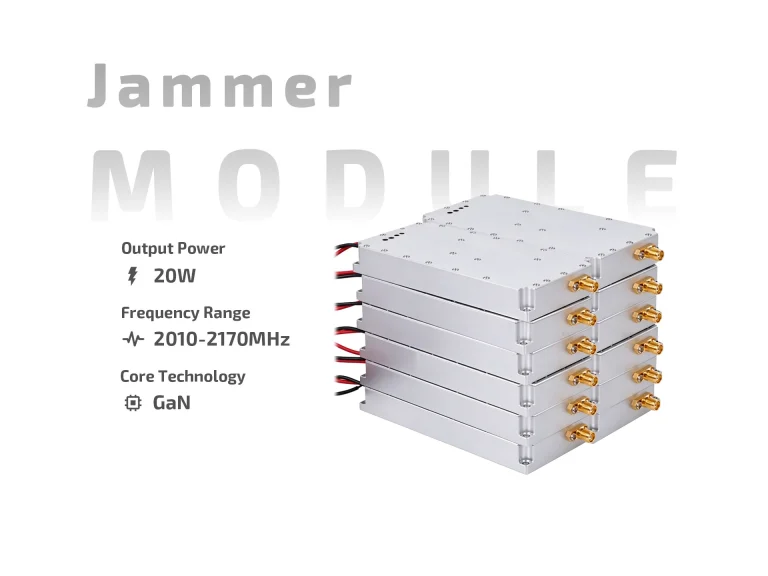
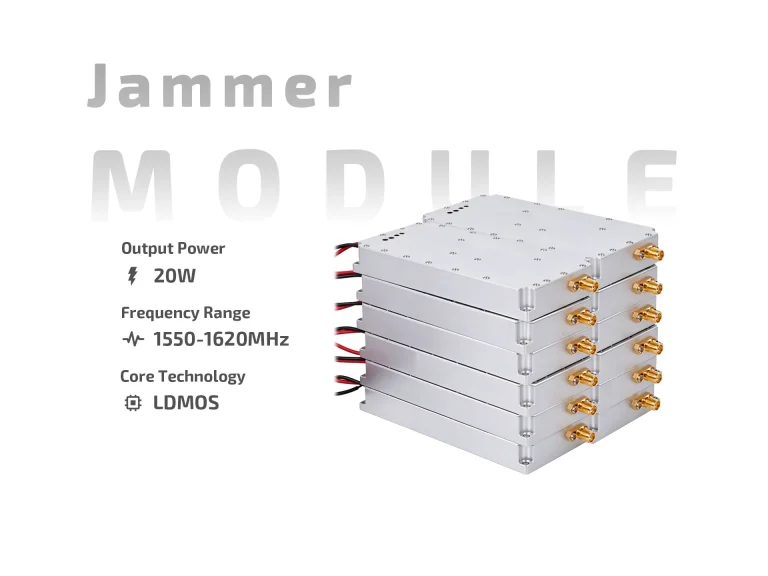
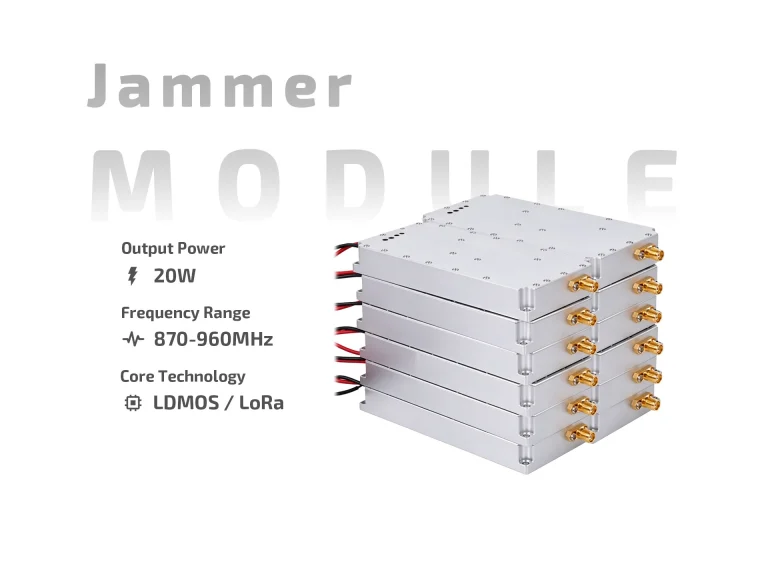
The 20W anti-drone module price is rarely a single, comparable number. Two modules can share the same 20W label and still differ by several times in quotation, because the buyer is not only purchasing RF output. The quote usually bundles frequency coverage, filtering, thermal design, enclosure, control interface, testing, documentation, compliance support, and order volume.
That is why a useful price comparison starts with the configuration—not the wattage. For a plain-language overview of where this power class is typically used, see What Is a 20W Jammer Module Used For?.

Why the same 20W rating produces different quotes
A 20W module can be a bare RF board, a shielded module with connectors, or a ruggedized unit ready for system integration. Each step adds cost. A single-band module with a simple heatsink is not priced like a multi-band module with per-band monitoring, VSWR protection, wide input voltage, and an IP-rated enclosure.
The buyer should therefore ask what is included in the quoted price. “Module only” and “module plus heatsink, cable set, control board, and test report” are different products.
Cost structure at a glance
| Cost element | What it covers | Effect on 20W anti-drone module price |
|---|---|---|
| RF amplification | Transistors, drivers, matching network | Higher for wider bandwidth and tighter linearity |
| Frequency bands | Single-band vs multi-band coverage | Each additional band adds hardware and testing |
| Filtering | Band-pass filters, harmonic suppression | More complex filtering raises unit cost |
| Thermal design | Heatsink, fan, conduction path | Continuous-duty designs cost more than intermittent |
| Control and monitoring | Interface board, sensors, firmware | Smart modules carry a premium |
| Enclosure and connectors | Housing, RF connectors, sealing | Rugged or weatherproof designs add cost |
| Testing and documentation | Factory test, reports, calibration | Traceable test data increases price but reduces risk |
| Compliance support | Certification preparation, labeling | Varies by market and application |
| Order volume | Tooling, setup, purchasing scale | Low-volume orders carry higher unit pricing |
Key price drivers buyers should examine
| Price driver | Lower-cost end | Higher-cost end | Procurement implication |
|---|---|---|---|
| Band count | One narrow band | Multiple bands or wideband | Confirm whether 20W is total or per band |
| Duty cycle | Intermittent use | Continuous operation | Continuous duty usually needs better cooling |
| Cooling | Passive heatsink | Active fan or liquid-assisted | Adds cost, size, and maintenance |
| Control | Basic on/off | Software monitoring and fault reporting | Integration value may justify premium |
| Mechanical build | Open-frame | Sealed rugged enclosure | Match to deployment environment |
| Testing | Basic functional test | Full RF characterization | Better data supports system-level validation |
| Volume | Prototype or small batch | Production quantity | Ask for price breaks and tooling terms |
Indicative budget tiers, not fixed prices
The table below uses budget tiers rather than exact figures, because quotations change with specification, quantity, and region. It is intended for early-stage planning only.
| Configuration tier | Typical composition | Price positioning | Common use |
|---|---|---|---|
| Bare module | RF board, basic heatsink, connectors | Entry level | OEM evaluation, authorized lab testing |
| Integrated module | Shielded housing, monitoring, protection circuits | Mid range | Portable counter-drone equipment |
| Rugged multi-band unit | Multiple bands, active cooling, sealed enclosure | Upper range | Vehicle or fixed-site integration |
| System-ready assembly | Module plus antenna, cabling, controller, testing | Project-specific | Complete authorized deployment kit |
A low headline price can be misleading if the module needs extra cooling, filtering, or rework. A higher quote may be cheaper over the project life if it includes test data, protection features, and integration support.
Hidden costs that affect the real price
-
Antenna and cable loss: A cheaper module may require more expensive antennas or higher-gain designs to meet coverage goals.
-
Power supply upgrades: Higher current draw can force a larger PSU or battery pack.
-
Thermal rework: Insufficient cooling can lead to derating, downtime, or enclosure redesign.
-
Filtering and shielding: Poor harmonic performance may require additional filters or shielding.
-
Integration engineering: Non-standard control interfaces can add software and wiring effort.
-
Compliance testing: Market-specific approval work can outweigh the module price difference.
-
Spares and support: Warranty terms, repair turnaround, and spare-part pricing matter for long deployments.
How to compare 20W anti-drone module quotations
Use a like-for-like checklist. Ask each supplier to state:
-
RF output per band and total output.
-
Supported frequency ranges and instantaneous bandwidth.
-
Duty cycle and recommended cooling method.
-
Input voltage, current draw, and connector type.
-
Protection features: VSWR, over-temperature, over-current.
-
Control interface and monitoring capabilities.
-
Mechanical dimensions, weight, and enclosure rating.
-
Included accessories: heatsink, cables, controller, software.
-
Test report and calibration data.
-
Compliance documentation and authorized-use limitations.
-
Minimum order quantity, lead time, warranty, and spare-part terms.
A quotation that answers these points is easier to compare than a one-line price. It also reduces the risk of selecting a module that appears inexpensive but requires costly integration changes.
FAQ
Does a 20W module always cost less than a 50W module?
Not always. A rugged multi-band 20W module can cost more than a basic single-band 50W module. Configuration, testing, and enclosure often matter more than wattage.
Why do quotes for the same 20W module vary so much?
Differences usually come from band count, filtering, cooling, control features, testing, enclosure, volume, and compliance support.
Should I choose the lowest price?
Only after comparing total integration cost. A cheap module with poor documentation or inadequate cooling can increase project cost later.
Bottom line
The 20W anti-drone module price should be evaluated as a system cost, not a wattage price. Focus on per-band output, duty cycle, thermal design, filtering, control interface, test data, and compliance support. A structured comparison will usually save more money than negotiating on the headline unit price alone.