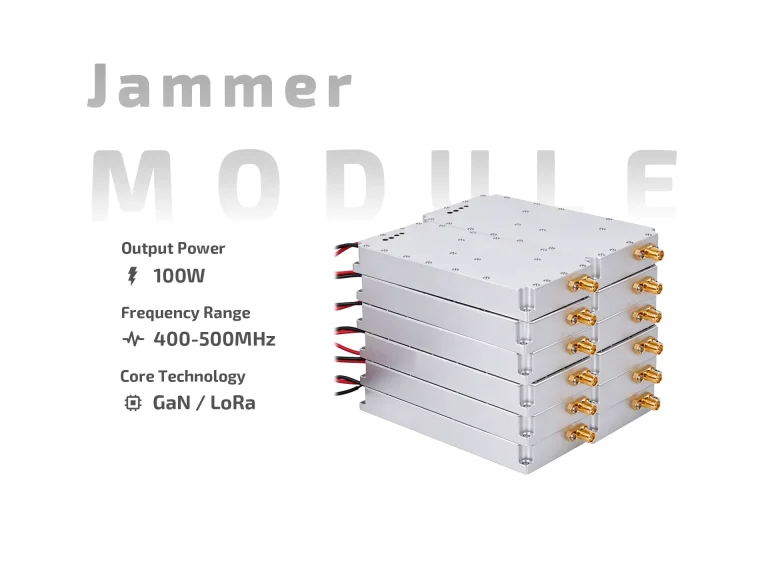
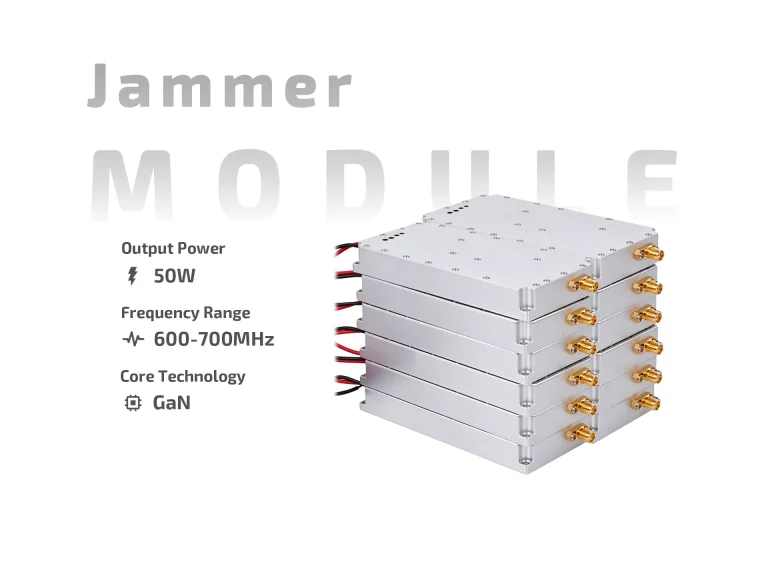
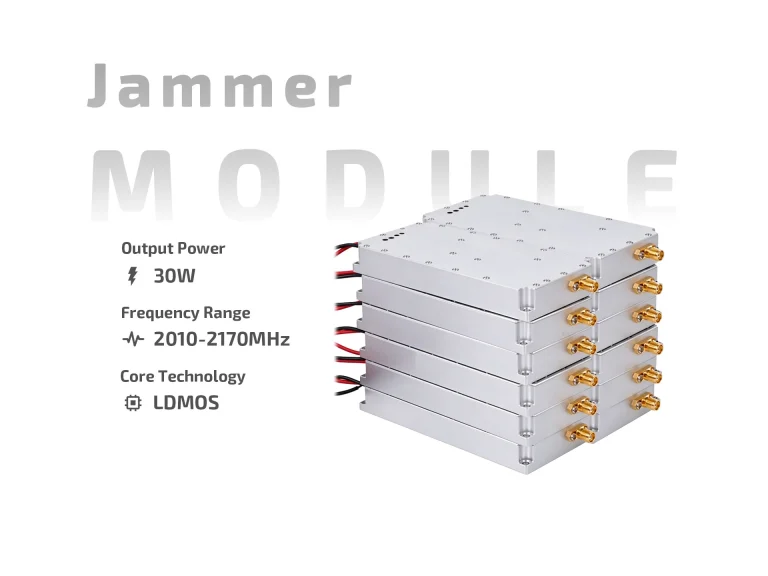
A drone jammer module is not a device that magically “takes over” a drone. It is a radio-frequency transmitter designed to compete with the wireless links a drone depends on. When it succeeds, the drone’s receiver can no longer clearly hear its controller, video transmitter, telemetry system, or satellite navigation signals.
The core idea is simple: raise the noise floor at the drone’s receiver until the desired signal becomes unreadable. The engineering behind that idea, however, involves frequency selection, power, antennas, filtering, cooling, and timing.
Legal note: In many countries, operating a jammer is illegal unless it is done by an authorized government, military, or law enforcement agency. This article explains the general technology for educational and industry awareness. It does not provide build instructions or legal advice.

The Basic Principle: Competing for the Receiver
A drone link works because a receiver can detect a weak radio signal and separate it from background noise. A jammer module transmits additional RF energy in the same frequency range. If the jammer’s signal is strong enough at the drone’s antenna, the receiver’s signal-to-noise ratio drops. Once that ratio falls below a certain threshold, the link fails.
Engineers often describe this as the jamming-to-signal ratio, or J/S. A high J/S at the drone receiver means the jammer is winning. A low J/S means the drone link still works.
What happens next depends on which link is disrupted:
| Target Link | Typical Bands | Possible Effect |
|---|---|---|
| Command and control | 2.4 GHz, 5.8 GHz, 433/868/915 MHz | Loss of steering, failsafe, hover, or return-to-home |
| Video downlink | 5.8 GHz, 2.4 GHz, 1.2 GHz | Lost FPV feed or degraded situational awareness |
| Telemetry | 2.4 GHz, 433/868/915 MHz | Lost flight data, status, or payload control |
| GNSS | L1, L2, L5 | Lost position, timing, or return-to-home reference |
Inside a Jammer Module: The Signal Chain
A module may be transmit-only, or it may be part of a larger counter-drone system that includes detection and direction finding. In general, the RF chain includes several stages.
| Stage | What It Does | Why It Matters |
|---|---|---|
| Signal source | Generates the carrier, noise, or modulation | Sets the frequency and waveform |
| Modulation or sweeping | Moves or spreads the jamming energy | Helps cover frequency-hopping or wideband links |
| Driver and power amplifier | Boosts the signal to usable power | Determines range, heat, and power draw |
| Filtering | Limits out-of-band emissions | Reduces interference with other systems |
| Antenna | Radiates energy toward the target | Gain, beamwidth, and polarization affect performance |
| Control and thermal system | Manages duty cycle, cooling, and protection | Prevents overheating and unstable output |
The signal source and antenna are especially important. A perfectly powerful module connected to the wrong antenna, or aimed at the wrong frequency, may have little practical effect.
Common Jamming Methods
Not all modules work in the same way. Some use simple broadband noise, while others are more selective.
| Method | How It Works | Strengths | Limits |
|---|---|---|---|
| Barrage jamming | Transmits noise across a wide band | Covers many frequencies at once | Low power density per frequency |
| Spot jamming | Focuses energy on one narrow frequency | Efficient use of power | Requires accurate target frequency |
| Sweep jamming | Moves a narrow signal across a range | Can catch some hopping links | May miss fast or encrypted links |
| Protocol-aware jamming | Targets specific signal features | Can be more efficient | Complex and less universal |
| GNSS jamming | Disrupts satellite navigation bands | Can break positioning and timing | Does not always stop control or video |
Barrage jamming is like flooding a room with noise. Spot jamming is like blocking one conversation. Neither approach is automatically better. The right choice depends on the drone’s communication method, the environment, and the rules governing the operation.
Why Frequency Matching Matters
For a jammer module to work, its energy must reach the drone receiver inside the receiver’s passband. If the module transmits at 2.4 GHz but the drone is using 915 MHz for control, the control link may be unaffected. If the drone uses 5.8 GHz for video, a 2.4 GHz jammer may not disrupt the video feed.
Frequency matching also involves bandwidth. A drone link may use a wide channel, frequency hopping, or spread-spectrum techniques. A narrow jammer may cover only part of that activity. A wideband jammer may cover more, but its power is spread thinner.
Antenna design follows the same logic. Lower frequencies generally need larger antennas. Higher frequencies allow smaller antennas but are more directional and more easily blocked by buildings, terrain, and vegetation. Polarization also matters: if the jammer antenna and the drone antenna are cross-polarized, performance can drop significantly.
Power Is Not the Whole Story
It is tempting to assume that a higher-power jammer module always works better. In practice, effective jamming depends on effective radiated power, antenna gain, distance, obstacles, receiver sensitivity, and the drone’s own link margin.
A high-power module can also create problems for the operator:
-
It may interfere with nearby communications, navigation, or emergency systems.
-
It may overheat and reduce its own duty cycle.
-
It may be larger, heavier, and more power-hungry.
-
It may violate emissions or radio regulations.
In many real deployments, the goal is not maximum power. The goal is enough power at the right frequency, at the right time, with the right antenna.
Real-World Limits
Modern drones are not passive targets. Many use frequency hopping, encrypted links, spread-spectrum modulation, and autonomous flight modes. Some can switch to inertial navigation, visual positioning, or pre-programmed routes when GNSS or control links are disrupted.
That is why counter-drone systems rarely rely on jamming alone. A complete system may combine:
-
RF detection and direction finding
-
Radar or acoustic sensors
-
Electro-optical and infrared cameras
-
RF jamming modules
-
Command-and-control software
Jamming may be one layer of mitigation, not a guaranteed solution.
Frequently Asked Questions
What is the main principle behind a drone jammer module?
It transmits RF energy in the same band as the drone’s receiver, lowering the signal-to-noise ratio until the link can no longer be decoded.
Does a jammer physically damage a drone?
Usually no. It interferes with radio communication rather than causing physical damage.
Can one module jam every drone?
No. Different drones use different frequencies, protocols, and anti-jamming methods.
Which frequencies are most common?
2.4 GHz, 5.8 GHz, GNSS L1, and sub-GHz bands such as 433 MHz, 868 MHz, and 915 MHz.
Is jamming legal?
In most countries, no, except for authorized government or law enforcement use. Regulations vary by jurisdiction.
Final Thoughts
A drone jammer module works by transmitting RF energy that competes with a drone’s control, video, telemetry, or navigation signals. The most effective modules match the target frequency, use appropriate antennas, manage power and heat, and operate within the law.
The technology is only one part of the counter-drone picture. Detection, identification, rules of engagement, and legal authorization are just as important as the RF hardware itself.