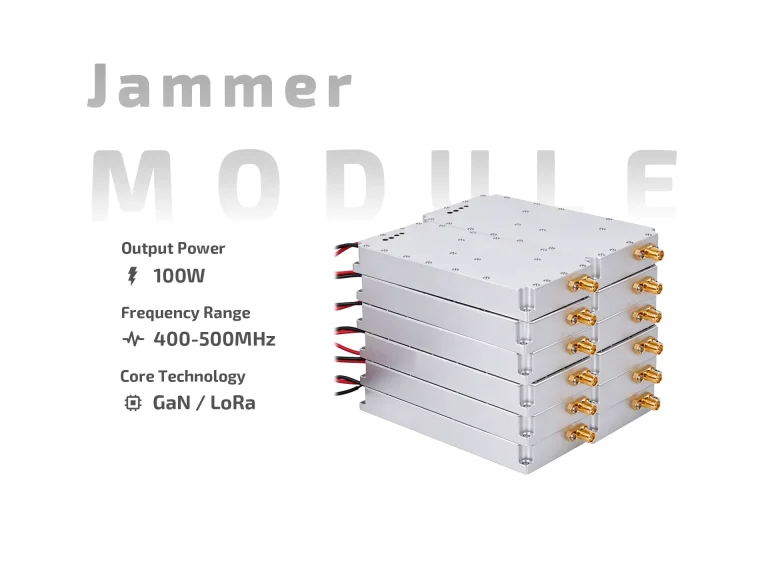
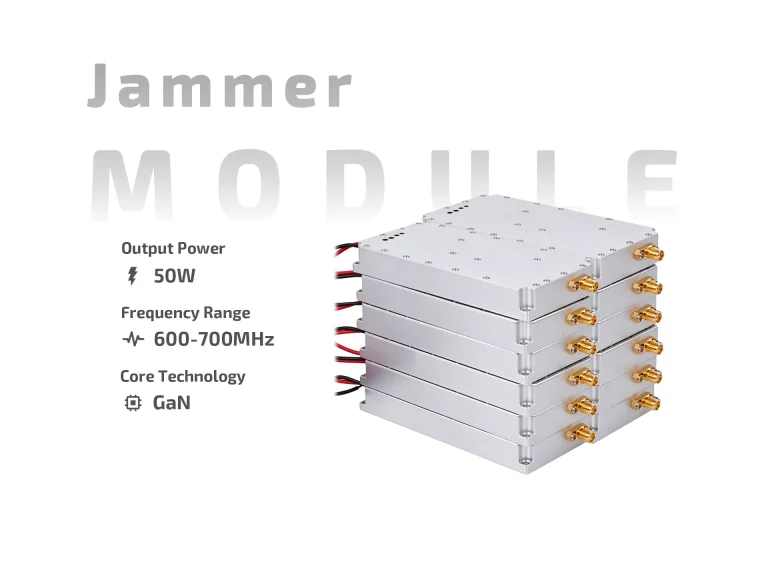
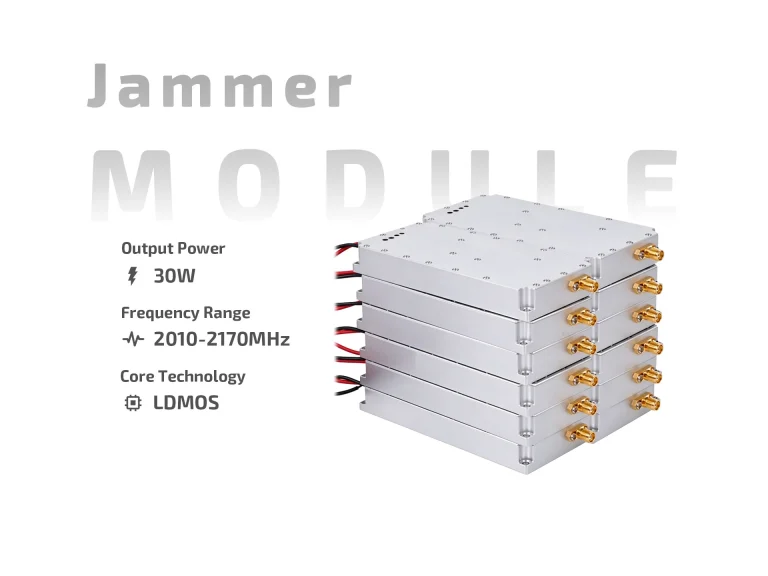
If you ask, what frequency does a drone jammer module use, the most accurate answer is: it depends on the drone links you need to disrupt. A drone jammer module is rarely built around one universal frequency. Most modules target one or more common radio bands used by drone control, video, telemetry, and navigation systems.
That said, a small number of bands appear again and again in counter-drone RF modules: 2.4 GHz, 5.8 GHz, GNSS L1, and sub-GHz bands such as 433 MHz, 868 MHz, and 915 MHz.
Important: Radio jamming is illegal in many countries unless carried out by authorized government, military, or law enforcement agencies. This article is for educational and industry awareness only. It does not provide build instructions or legal advice.

The Short Answer
Most drone jammer modules use one or more of the following frequency ranges:
-
2.4 GHz — 2.400–2.4835 GHz
-
5.8 GHz — 5.150–5.850 GHz, often split into 5.2, 5.4, 5.6, and 5.8 GHz sub-bands
-
433 MHz — 433.05–434.79 MHz
-
868 MHz — 863–870 MHz
-
915 MHz — 902–928 MHz
-
1.2/1.3 GHz — 1.15–1.3 GHz
-
GNSS L1 — 1559–1610 MHz
-
GNSS L2/L5 — 1176–1227 MHz
A single-band module may cover only 2.4 GHz. A multi-band module may combine 433 MHz, 915 MHz, 1.2 GHz, GNSS, 2.4 GHz, and 5.8 GHz in one enclosure.
Core Bands at a Glance
| Band | Typical Range | Common Drone Use | Why It Matters |
|---|---|---|---|
| 2.4 GHz ISM | 2.400–2.4835 GHz | RC control, telemetry, Wi-Fi video | Used by many consumer and prosumer drones |
| 5.8 GHz ISM | 5.150–5.850 GHz | FPV video, high-rate data links | Common for video downlink and some control |
| 433 MHz | 433.05–434.79 MHz | Long-range RC, telemetry | Better penetration in some environments |
| 868/915 MHz | 863–870 / 902–928 MHz | Long-range RC, telemetry | Regional sub-GHz links |
| 1.2/1.3 GHz | 1.15–1.3 GHz | Analog FPV, video/data | Long-range video and telemetry |
| GNSS L1 | 1559–1610 MHz | GPS, GLONASS, Galileo, BeiDou | Position, timing, return-to-home |
| GNSS L2/L5 | 1176–1227 MHz | High-precision GNSS | Industrial and survey drones |
Why 2.4 GHz and 5.8 GHz Dominate
The 2.4 GHz and 5.8 GHz bands are popular because they are used by many unlicensed wireless devices, including drone remote controllers, Wi-Fi modules, and FPV video transmitters. They also allow relatively small antennas, which makes them practical for portable and vehicle-mounted counter-drone systems.
A 2.4 GHz drone jammer module usually focuses on a narrow ISM range. A 5.8 GHz module may need wider coverage because drone video links can hop across several sub-bands. In multi-band systems, 2.4 GHz and 5.8 GHz often have separate RF chains, antennas, amplifiers, and filtering.
GNSS Is a Different Jamming Target
GNSS jamming is not the same as control-link jamming. GNSS signals arrive at the receiver at very low power, so even low-power interference can disrupt positioning. A drone jammer module may include GNSS bands to prevent a drone from knowing its location or returning to home.
However, GNSS disruption is not always enough. Many drones can switch to inertial navigation, visual positioning, or other sensors. Some also use encrypted or frequency-hopping control links that are harder to jam with simple broadband noise.
Module Architecture Across Bands
| Parameter | Low Band: 433/868/915 MHz | Mid Band: 1.2–1.6 GHz | High Band: 2.4/5.8 GHz |
|---|---|---|---|
| Antenna size | Larger | Medium | Smaller |
| Propagation | Better through obstacles | Moderate | More line-of-sight |
| Bandwidth | Narrower | Moderate | Wider |
| Typical role | Telemetry and long-range RC | Video and GNSS | Control and video |
| Design challenge | Antenna efficiency | Filtering and heat | Wideband amplification |
Power, Antenna, and Bandwidth Trade-offs
Effective jamming depends on the jamming-to-signal ratio at the drone’s receiver. That ratio is shaped by output power, antenna gain, distance, polarization, bandwidth, and the drone’s own link budget. A higher-power module is not automatically more effective. If the energy is spread across too much bandwidth, the power per frequency may be too low. If the antenna is poorly matched, much of the energy is reflected rather than radiated.
Low-band modules generally need larger antennas. High-band modules can use smaller antennas but are more directional and more affected by obstacles. Multi-band modules must also manage heat, isolation, and filtering so that one transmitter does not interfere with another inside the same unit.
Regulatory and Operational Reality
In the United States, the FCC generally prohibits jamming devices. Similar restrictions exist in the European Union, the United Kingdom, Australia, and many other jurisdictions. Authorized use is typically limited to specific government or law enforcement operations. Unauthorized jamming can interfere with public networks, aviation, emergency communications, and GNSS-dependent infrastructure.
For industry buyers, the key question is not only “what frequency does a drone jammer module use,” but also whether the module can be legally deployed, certified, and operated in the target country.
How to Specify a Module
When evaluating a drone jammer module, consider:
-
Which drone links must be covered: control, video, telemetry, or GNSS?
-
Which regional bands are relevant: 433 MHz, 868 MHz, or 915 MHz?
-
How wide is each band, and does the module cover the full range?
-
What antenna type is required: omni, directional, or sector?
-
What cooling and duty cycle are needed?
-
What filtering and isolation are provided?
-
What compliance markings and documentation are available?
Conclusion
A drone jammer module typically uses a combination of 2.4 GHz, 5.8 GHz, GNSS, and sub-GHz frequencies. The exact choice depends on the drone’s control, video, telemetry, and navigation links. For authorized counter-drone programs, frequency coverage is only one part of the design. Power, antenna gain, bandwidth, filtering, cooling, and legal compliance matter just as much.