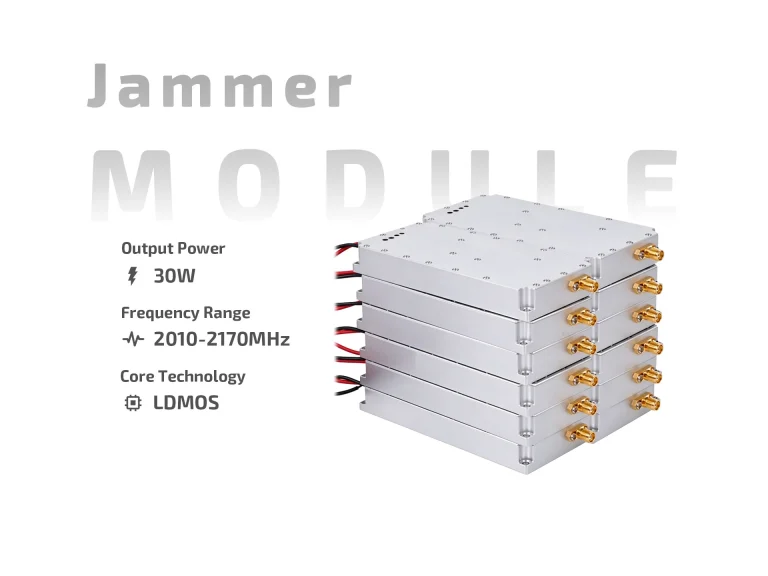
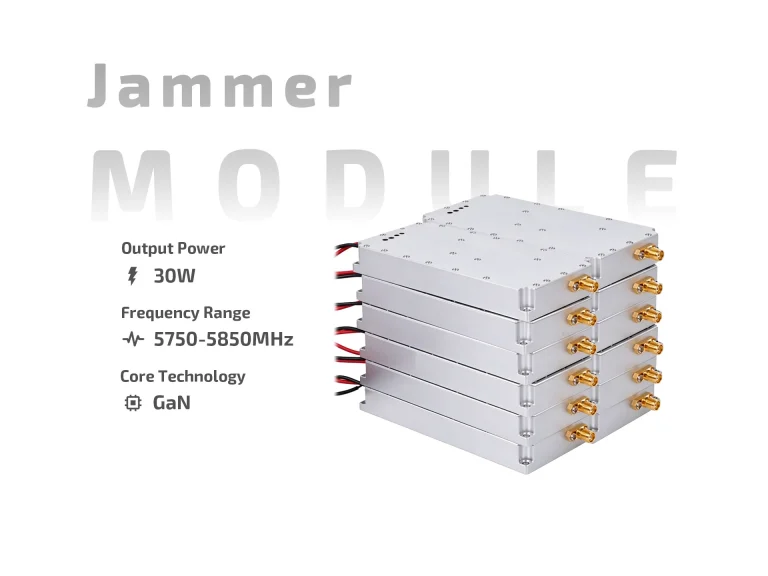
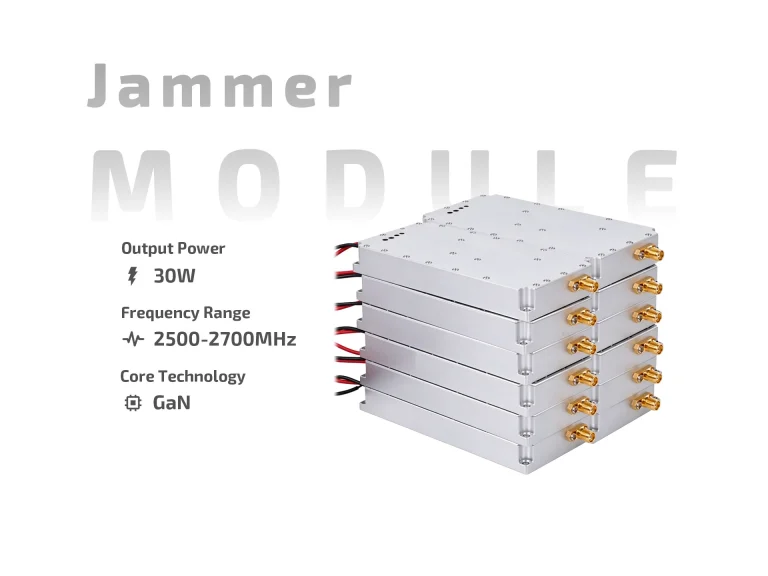
A multi-band 30W drone jammer module looks straightforward on a datasheet: one module, several frequency bands, 30W of output. In practice, multi-band design is where most integration surprises appear. The way power is distributed across bands, the way heat concentrates around the amplifier stage, and the way filtering and antenna systems interact all determine whether the module performs as expected.
This article focuses on what changes when a module covers multiple bands instead of one. For the electrical side of integration, see our guide on 30W drone jammer module power supply.

What “multi-band” actually means
The term covers several different architectures, and buyers should identify which one is being quoted:
-
Parallel multi-band: separate amplifier chains for each band, combined into one enclosure.
-
Switched multi-band: one or more amplifiers shared across bands through switching.
-
Wideband single-chain: one amplifier covering a broad frequency range.
-
Modular multi-band: individual band modules housed in a common chassis with shared control.
Each architecture has different implications for power distribution, heat, filtering, and cost. A parallel design is often easier to characterize band by band; a switched design may reduce component count but introduces switching transients and timing considerations.
The first question: 30W total or 30W per band?
This is the single most consequential ambiguity in multi-band procurement. A module described as “30W multi-band” could mean:
| Interpretation | What it means | Practical consequence |
|---|---|---|
| 30W total across all bands | Power is shared or time-multiplexed | Per-band output may be well below 30W |
| 30W per band | Each band has its own 30W amplifier | Much higher total DC draw and heat |
| 30W nominal, derated in multi-band mode | Full power only in single-band operation | Real-world output depends on operating mode |
| 30W peak, lower continuous | Short bursts at full power | Duty cycle limits must be respected |
Always request the per-band output table and the test conditions behind it. A module that claims 30W across four bands but delivers only a few watts per band is a different product from one with four independent 30W chains.
Common band combinations
Multi-band modules are usually configured around the frequency ranges of common drone control and video links. The table below is illustrative and does not represent a recommendation for any specific deployment.
| Combination type | Typical band count | Design focus | Integration note |
|---|---|---|---|
| Dual-band | 2 | Compact size, simple control | Often the easiest multi-band entry point |
| Tri-band | 3 | Balanced coverage | Filtering between adjacent bands becomes important |
| Quad-band | 4 | Broader coverage | Heat and current draw rise noticeably |
| Five-band and above | 5+ | Wide coverage or redundancy | Chassis size and cooling dominate design |
| Custom set | Project-specific | Matching specific threat profiles | Requires clear requirements and testing plan |
Engineering trade-offs
Multi-band design is a series of compromises. Adding bands is not simply adding amplifiers; it changes the thermal map, the filtering requirements, and the physical layout.
| Design factor | Single-band 30W | Multi-band 30W (total) | Multi-band 30W (per band) |
|---|---|---|---|
| Heat concentration | One hot zone | Shared across bands | Multiple hot zones |
| DC input power | Moderate | Moderate | Significantly higher |
| Filtering complexity | Manageable | Higher | Highest |
| Enclosure size | Compact | Moderate | Large |
| Antenna count | One | One or more | Often one per band |
| Control complexity | Simple | Moderate | Higher |
| Test and validation effort | Focused | Broader | Extensive |
The key insight is that “multi-band 30W” is not a single performance class. It spans a wide range from compact shared-power modules to large independent-chain units.
Filtering and antenna considerations
When multiple bands sit close together, filtering becomes critical. A filter that is adequate for a single-band module may not provide enough isolation in a multi-band unit, allowing harmonics or intermodulation products to leak between chains.
Antenna design follows the same logic. Some multi-band modules use a single broadband antenna; others require separate antennas per band. Separate antennas improve isolation but increase size, wind load, and mounting complexity. A shared antenna reduces physical footprint but demands careful diplexing or multiplexing.
Buyers should ask whether the quoted performance assumes a specific antenna configuration. Module output at the connector and radiated performance at the antenna are different figures, and cable loss between them can be significant in multi-band installations.
Matching the module to the platform
| Platform | Recommended multi-band approach | Why |
|---|---|---|
| Manpack or backpack | Dual-band or tri-band, total-power design | Weight and battery life dominate |
| Briefcase kit | Dual-band or tri-band | Enclosure space and cooling are limited |
| Vehicle roof node | Tri-band or quad-band | Vehicle power and airflow support higher loads |
| Fixed site | Quad-band or custom | Mains power and space allow independent chains |
| Shelter system | Custom multi-band with active cooling | Continuous duty and service access matter |
| OEM product | Modular multi-band | Flexibility across product variants |
A common mistake is to specify the highest band count for a portable platform. The result is often a module that must be operated at reduced duty cycle because the enclosure cannot dissipate the combined heat.
Procurement checklist for multi-band modules
-
Is 30W total, per band, or nominal with derating?
-
What is the output for each band under stated test conditions?
-
Which architecture is used: parallel, switched, wideband, or modular?
-
What filtering is included, and what isolation is achieved between bands?
-
What antenna configuration is assumed in the quoted performance?
-
What is the DC input power in multi-band operation?
-
What cooling method is required for continuous multi-band use?
-
Does the control interface support per-band monitoring and enable/disable?
-
What protection features are included per band?
-
Is the full band set authorized in the target jurisdiction?
Bottom line
A multi-band 30W drone jammer module is defined less by its wattage label than by its architecture, per-band output, filtering, and thermal design. Clarify whether 30W is total or per band, confirm the antenna and filtering assumptions, and match the band count to the platform’s power and cooling capacity. Treated this way, multi-band integration becomes a predictable engineering exercise rather than a source of field surprises.