When teams begin comparing portable vs fixed drone jammers, the conversation often starts with power output or price. That is usually the wrong starting point. The better question is: what kind of protection do you actually need—mobile response or permanent coverage?
Portable and fixed drone jammers solve different problems. One gives you flexibility in the field. The other gives you persistent coverage over a defined area. Choosing between them is less about which is “better” and more about matching the tool to the mission, the site, and the legal framework you operate under.

Portable Drone Jammers: Flexibility on the Move
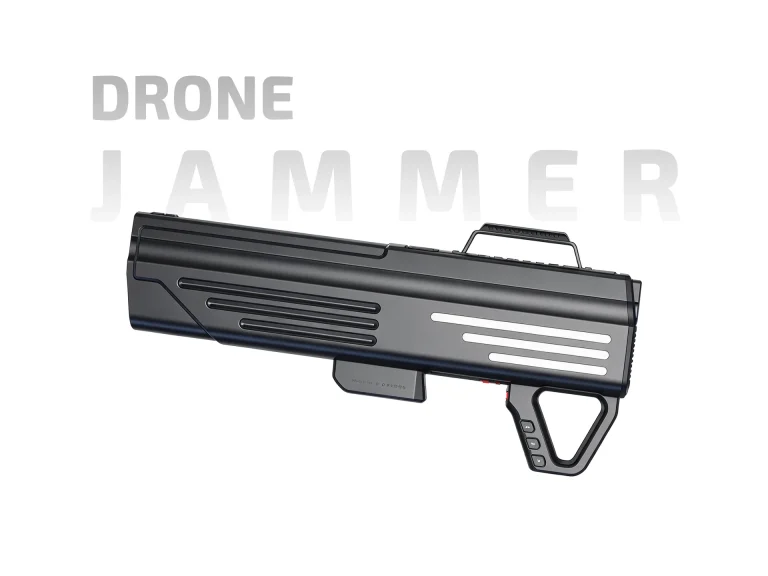
A portable drone jammer is built for mobility. It may be handheld, backpack-mounted, or vehicle-mounted. These systems are often used by patrol teams, tactical units, and event security crews that need to respond quickly to a drone sighting.
Portable jammers typically trade raw power and continuous coverage for speed and maneuverability. They are easier to deploy, but they usually depend on batteries and may require the operator to aim a directional antenna at the target.
| Portable Jammer Strengths | Portable Jammer Limits |
|---|---|
| Fast deployment and relocation | Lower continuous power |
| Useful across multiple sites | Battery runtime constraints |
| Can be vehicle-mounted for mobile patrols | Operator skill affects effectiveness |
| Good for temporary events or rapid response | Harder to integrate with fixed sensors |
| Lower installation cost | Limited 24/7 coverage |
Portable systems are a strong fit when the threat is intermittent, the protected area changes, or the response team needs to move with the mission. They are less ideal when you need uninterrupted coverage over a large perimeter.
Fixed Drone Jammers: Always-On Site Protection
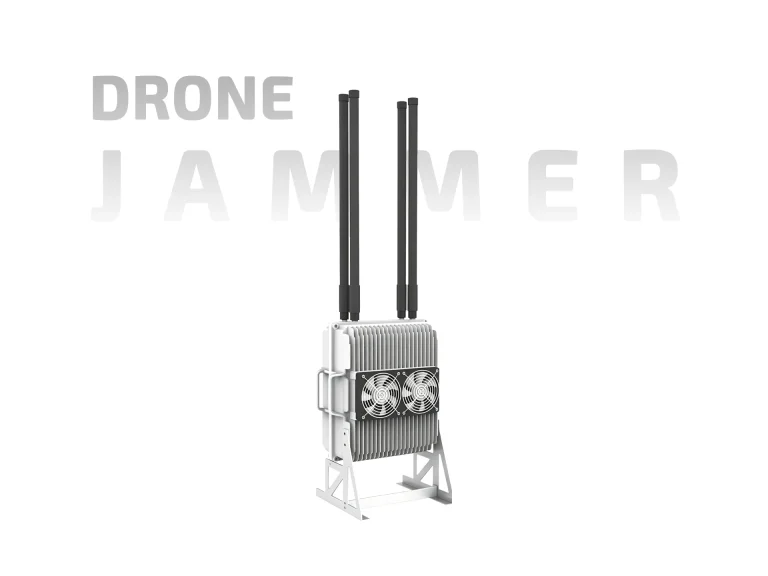
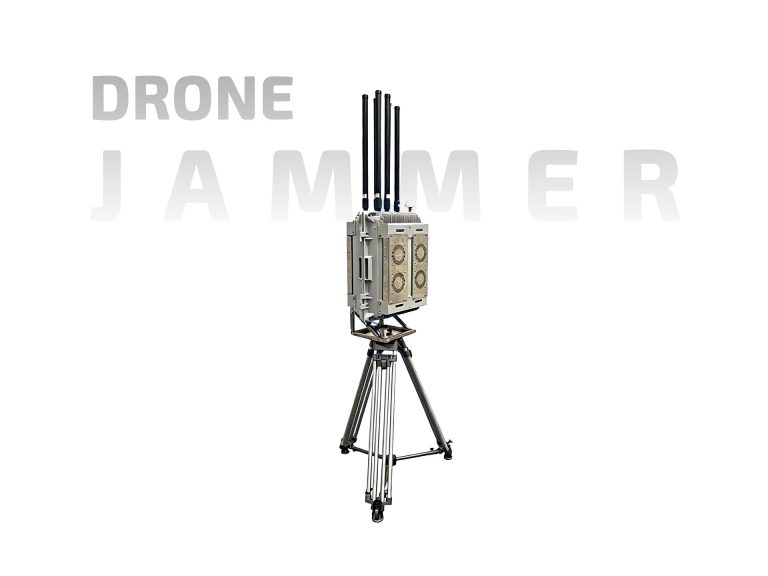
A fixed drone jammer is installed at a specific location. It may be mounted on a tower, rooftop, pole, or perimeter structure. Fixed systems can use higher power, larger antennas, and permanent power and network connections.
The main advantage is persistence. A fixed jammer can operate continuously and be integrated with radar, RF detection, cameras, or a command-and-control platform. That integration matters because jamming without detection is like locking a door without knowing who is outside.
| Fixed Jammer Strengths | Fixed Jammer Limits |
|---|---|
| Continuous 24/7 coverage | High installation and infrastructure cost |
| Higher power and larger antenna options | Not easily relocated |
| Easy integration with detection systems | Requires power, backhaul, and maintenance |
| Consistent performance in known sectors | Site planning and licensing complexity |
| Can cover multiple approach corridors | Overkill for small or temporary sites |
Fixed jammers are best for critical infrastructure, prisons, airports, military bases, data centers, and other high-value sites where drone intrusion is a standing risk.
Head-to-Head Comparison
The table below summarizes the practical differences between portable and fixed drone jammers.
| Criteria | Portable Drone Jammer | Fixed Drone Jammer |
|---|---|---|
| Mobility | High | None after installation |
| Coverage | Localized and operator-dependent | Wide and consistent |
| Power source | Battery or vehicle power | Mains or generator with backup |
| Deployment time | Minutes | Days to weeks |
| Integration | Limited | Strong with sensors and C2 |
| Maintenance | Low to moderate | Ongoing and technical |
| Best use case | Patrols, events, rapid response | Perimeters, critical sites, 24/7 defense |
| Cost profile | Lower upfront | Higher upfront, higher lifecycle |
| Operator demand | High | Lower once configured |
| Scalability | Limited | High across multiple sites |
Which One Fits Your Mission?
The right choice depends on the scenario. Here are common examples:
| Scenario | Better Fit | Why |
|---|---|---|
| Temporary stadium event | Portable | Short duration; multiple entry points |
| Prison perimeter | Fixed | Constant threat; known approach paths |
| Military convoy | Portable or vehicle-mounted | Moves with the unit |
| Airport boundary | Fixed | Large area; integration with ATC and security |
| VIP protection detail | Portable | Follows the principal and adapts to routes |
| Data center campus | Fixed with portable backup | Permanent coverage plus mobile response |
| Border patrol | Hybrid | Fixed sensors plus mobile interdiction |
In many real deployments, the answer is not either/or. A layered approach uses fixed jammers for known corridors and portable units for gaps, rapid response, and temporary operations.
Key Selection Factors
Before choosing a system, evaluate these points:
-
Threat profile: What drone types, frequencies, and tactics are likely?
-
Protected area: Is it a fixed perimeter or a moving asset?
-
Response time: How quickly must mitigation begin after detection?
-
Integration needs: Will the jammer connect to radar, RF detection, or a security operations center?
-
Power and connectivity: Is reliable power and network backhaul available?
-
Operator training: Can staff safely and legally operate the system?
-
Regulatory approval: Is jamming permitted for your organization in your jurisdiction?
-
Budget: Consider installation, licensing, maintenance, and training—not just purchase price.
Legal and Operational Reality
In most countries, drone jamming is heavily regulated. Private citizens generally cannot operate jammers. Authorized military, law enforcement, and some critical infrastructure operators may use counter-drone mitigation under specific legal frameworks.
Even for authorized users, jamming can disrupt GPS timing, WiFi, cellular service, and public safety communications. That makes site planning, power control, and antenna direction critical. A fixed system may offer more control, while a portable system may create more unintended interference if used carelessly.
Final Verdict
So, which one should you choose?
-
Choose a portable drone jammer if you need mobility, rapid response, temporary coverage, or protection across multiple locations.
-
Choose a fixed drone jammer if you need continuous coverage, higher power, deep integration, and a permanent defense layer around a known site.
-
Choose a hybrid approach if your threat model includes both fixed assets and mobile operations.
The best decision is not based on raw specifications alone. It comes from matching the jammer type to the mission, the environment, the legal rules, and the team that will operate it.