October 22, 2026
What Is an 80W Jammer Module Used For?
An 80W jammer module is used in authorized counter-drone systems to disrupt specific RF links. Here is where it fits, and how to scope one.


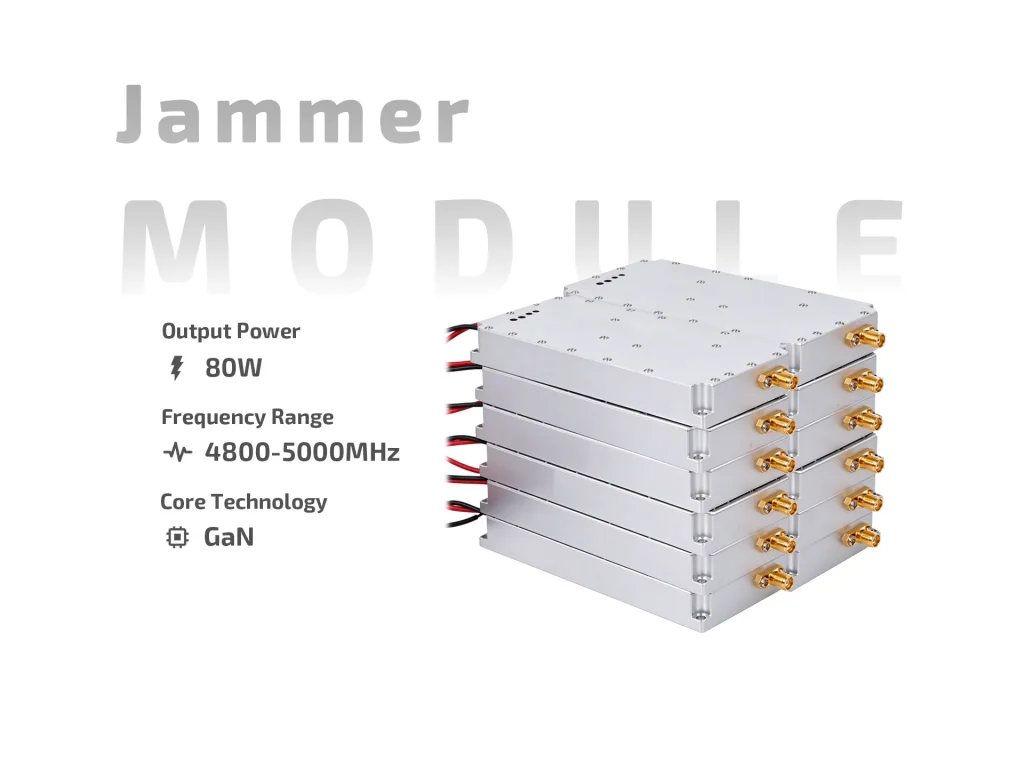
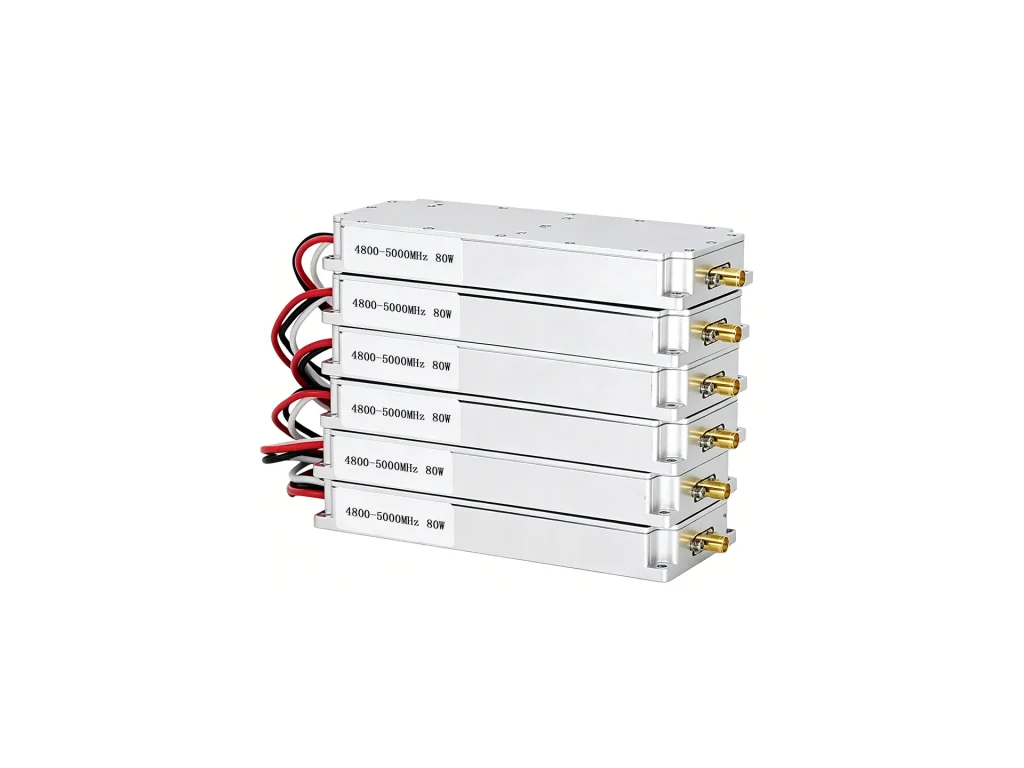

80W GaN anti-drone module, 4800–5000 MHz, DC24–29V, 10A, ≥35% efficiency, SMA female, built-in sweep source and VSWR protection.
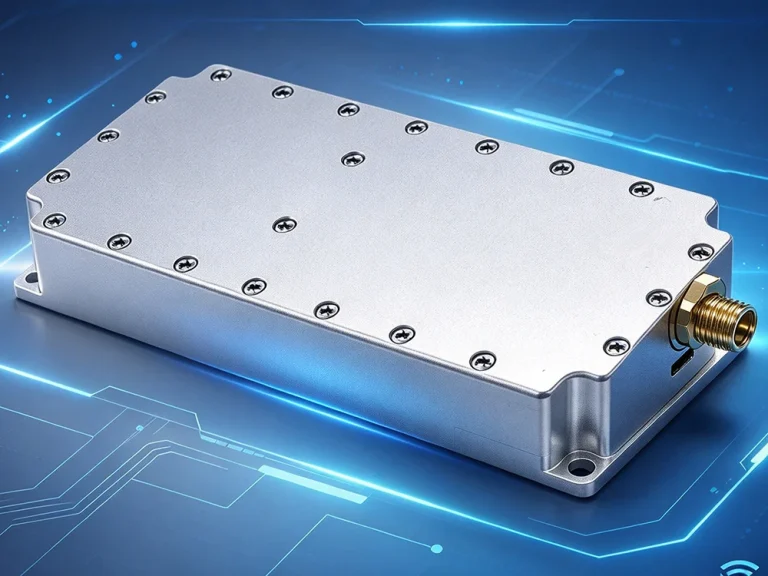
The ETLD-JM4850G80 is an 80W GaN anti-drone module built for systems that need reliable RF power in the 4800–5000 MHz band. It is more than a bare amplifier. The module pairs a GaN output stage with an internal high-speed sweep source, so it works as an analog jamming integrated module for counter-UAV, force protection, and controlled RF testing. It suits builders who want a ready RF core rather than a full finished jammer. If power, cooling, and antenna planning are already in place, this module can shorten the RF chain.

Many UAV video links, telemetry channels, and remote-control signals sit around 4.8 GHz and 5.0 GHz. Covering the full 4800–5000 MHz range gives integrators one module for several threats instead of switching between narrowband units. The built-in sweep source also removes the need for an external signal generator in many layouts. That can reduce cabling, save space, and simplify field maintenance. For fixed sites and mobile payloads alike, fewer external parts usually mean fewer failure points.
GaN devices are chosen for high power density and thermal ruggedness. In this module, typical output is 80W, with output VSWR specified at ≤2.0. Real output can vary with input voltage, load match, temperature, and duty cycle. Do not expect 80W at any input voltage; stay within DC 24–29V. For best results, keep the antenna well matched and avoid running continuously into a poor load. The anti-drone module draws up to 10.0A, and efficiency is ≥35%, so power budgeting and heat removal should be planned from the start.
Switch control is simple: +5V or floating turns the module on, while grounding turns it off. That makes it easy to drive from a microcontroller, relay, or manual switch. The switch line is not an RF enable; it controls the module’s operation. A built-in absorptive VSWR protection device helps absorb reflected energy when the antenna match is not ideal. This is not a substitute for a good antenna, but it adds a useful layer of protection during real-world use. The RF output uses an SMA female connector, a common choice for compact 50-ohm systems.
At 168.5 × 84.5 × 23 mm and 0.57 kg, the module is small enough for payloads where every gram and millimeter counts. Still, 80W is real power. Mount it on a metal surface when possible, use short and thick DC leads, and leave room for airflow. If the module is used in a sealed enclosure, a heatsink or cold plate is strongly recommended. The power source must handle the 10A peak current without large voltage drops. A stable supply also helps keep the sweep source and output stage behaving predictably.
Engineers use this class of module in counter-UAV systems, border monitoring, prison security, VIP protection, and RF immunity testing. It can also serve as a bench amplifier when a controlled 4.8–5.0 GHz jamming signal is needed. In testing, use attenuators and shielded loads to avoid interference. Because laws vary by country, the final system must be designed, licensed, and operated according to local regulations. This module is a component, not a finished consumer device.
Check the frequency plan, antenna gain, cable loss, cooling, and power source. Confirm that the control logic matches the +5V/ground switching scheme. Remember that the output connector is SMA female, so the mating cable should be SMA male. If you need long cable runs, use low-loss coax; otherwise, output power and VSWR may suffer. If in doubt, start with a lower duty cycle and monitor temperature. With the right RF and thermal design, the ETLD-JM4850G80 offers a compact 80W GaN anti-drone module for demanding 4.8–5.0 GHz projects.
| Parameter | Specification | Notes |
| Working Frequency | 4800–5000 MHz | Covers common 4.8 GHz and 5.0 GHz UAV links; built-in sweep source. |
| Output Power | 80 W | Typical RF output; actual power depends on voltage, load, and temperature. |
| Output VSWR | ≤2.0 | Keep antenna match within range for stable operation. |
| Operating Voltage | DC 24–29 V | Regulated DC input range. |
| Maximum Current | 10.0 A | At full load; use adequate wiring and cooling. |
| Efficiency | ≥35% | Typical under specified conditions. |
| Switch Control | +5 V or floating = ON; ground = OFF | Logic-friendly control. |
| Output Connector | SMA female | Standard 50-ohm RF interface. |
| Jamming Source | Built-in high-speed sweep source | No external source needed for basic operation. |
| VSWR Protection | Built-in absorptive VSWR protection | Helps protect the module under poor antenna match. |
| Dimensions | 168.5 × 84.5 × 23 mm | Compact chassis for payload integration. |
| Weight | 0.57 kg | Lightweight. |
An 80W jammer module is used in authorized counter-drone systems to disrupt specific RF links. Here is where it fits, and how to scope one.
Comparing 80W vs 100W drone jammer module: real thermal gaps, efficiency trade-offs, bandwidth costs, and when the extra 20W is worth it.
An integration-focused review of 80W FPV jammer modules: band coverage, thermal load, power claims, field testing, and authorized use.