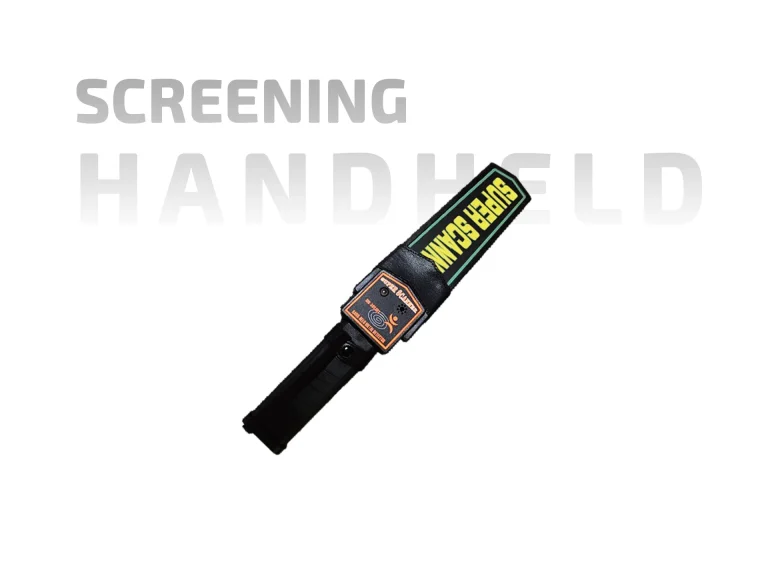
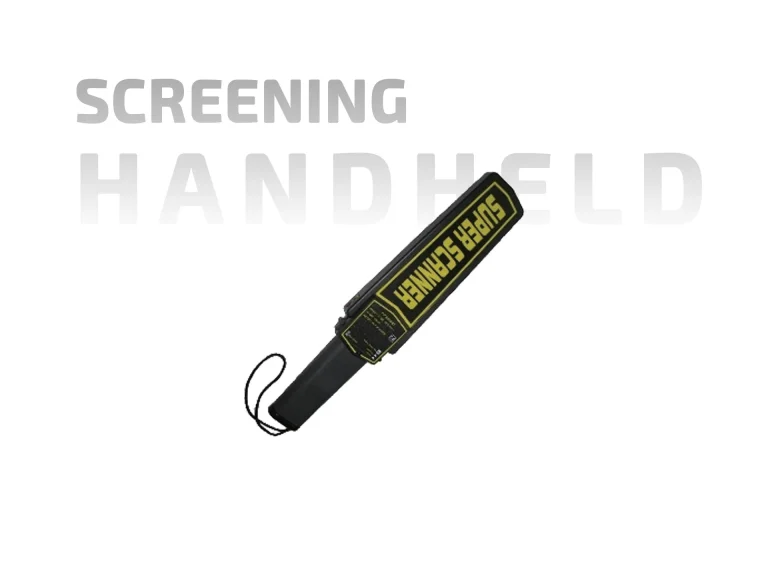
A security handheld detector is often purchased as an accessory to a walk-through gate, yet in daily operation it frequently becomes the tool that decides whether an alarm is cleared quickly or turns into a long secondary search. The unit itself is simple; the way it is selected, positioned, and used is not.
This article looks at the handheld detector as an operational instrument rather than a catalogue item. It covers where the device fits in a layered checkpoint, which selection criteria matter in the field, and how to keep it effective after deployment. Detailed sensitivity settings and testing routines are covered in our handheld metal detector sensitivity guide; this article focuses on role, selection, and field practice.

Define the detector’s role before comparing models
A common procurement error is to compare handheld detectors before deciding what the device is expected to do. At one site, the detector may be used mainly to resolve alarms from a walk-through gate. At another, it may be the primary tool for screening attendees who cannot pass through a standard gate, or for targeted searches after a bag check.
The table below outlines common operational roles and the features that matter for each.
| Operational role | What the operator does | Features that matter | Risk if poorly matched |
|---|---|---|---|
| Gate alarm resolution | Rechecks a person after a walk-through detector alarm | Clear alarm indication, fast response, comfortable grip | Slow resolution; queue buildup at secondary screening |
| Exception screening | Screens people using wheelchairs, medical devices, or other exceptions | Adjustable sensitivity, stable response at close range | Inconsistent procedure; dignity and accessibility concerns |
| Targeted search | Checks a specific area, item, or person after an intelligence lead | Directional response, precise search head, durable housing | Missed items; operator uncertainty |
| Event roaming or standby | Provides flexible screening at temporary sites | Battery life, weight, rugged construction | Device failure mid-event; operator fatigue |
| Secondary bag or package check | Confirms whether a bag or package contains metal items | Sensitivity control, audio/vibration alerts | Unnecessary manual searches; false confidence |
A detector that suits event roaming may not be the best choice for a fixed checkpoint with high daily volume. Defining the role first prevents buyers from paying for features they will not use—or missing features they will.
Selection criteria that matter after delivery
Product listings tend to highlight detection performance. In practice, several other criteria determine whether the detector remains useful over months of operation.
| Selection criterion | Field question to ask | Why it matters |
|---|---|---|
| Sensitivity adjustment | Can the setting be changed easily and recorded? | The detector must match the site’s threat profile, not a generic maximum |
| Alarm mode | Is audio, vibration, or both available? | Noisy event sites and quiet checkpoints have different requirements |
| Battery system | How long does a charge last, and are batteries replaceable? | Battery failure is a common cause of mid-shift downtime |
| Ergonomics | Is the unit comfortable for a full shift? | Operator fatigue affects sweep consistency and courtesy |
| Build quality | Will the housing survive transport and daily handling? | Fragile units increase repair costs and downtime |
| Environmental tolerance | Is the unit suitable for dust, rain, or outdoor use? | Event and perimeter work often exposes equipment to weather |
| Test piece and documentation | Are a test piece and test procedure supplied? | Daily function checks depend on both |
| Service and spares | How quickly can a replacement or repair be arranged? | A detector out of service can close a lane |
Buyers comparing market segments and indicative price bands can use our handheld metal detector for sale guide for a procurement-focused view. The point here is that the lowest-priced unit is rarely the lowest-cost unit once downtime and replacement are considered.
Position the handheld detector as a secondary tool
In most checkpoints, the handheld detector should not be the primary screen for high-volume flow. It is slower per person than a walk-through gate and depends heavily on operator technique. Its strength is resolving specific questions: did the gate alarm on a phone or something else, and is there a metal item that requires further attention?
A workable lane sequence is:
-
Primary screen. A walk-through gate or other primary technology screens the person.
-
Alarm handoff. The attendee is directed to a marked resolution point outside the main flow.
-
Handheld check. The operator uses a consistent sweep pattern and the approved procedure.
-
Decision. The alarm is cleared, an item is removed, or the attendee is escalated to a private secondary search.
-
Record. Significant alarms and outcomes are logged for review.
The detector’s position matters. If the resolution point is too close to the gate, the queue blocks the lane. If it is too far, staff cannot monitor both areas. A short, marked path usually works better than an open area with no defined flow.
Keep the detector effective with a short routine
A handheld detector can drift out of useful service without anyone noticing. Batteries weaken, settings get changed, and test pieces go missing. A short routine prevents most of these problems.
-
Start of shift: check battery, test with the approved test piece, confirm the sensitivity setting, and record the result.
-
During use: keep the search head close to the body, sweep slowly, and use the same pattern across operators.
-
After an alarm: follow the written resolution script rather than improvising.
-
End of shift: return the unit to its charger, report damage, and note any recurring alarm patterns.
-
After any repair or battery change: re-test before returning the unit to service.
The routine should be simple enough to complete during a busy shift change. A detector that is tested and recorded is easier to trust than one that is assumed to be working.
Common field failures
| Field failure | Typical cause | Practical fix |
|---|---|---|
| Detector alarms constantly | Sensitivity set too high or interference nearby | Recheck setting and move away from metal structures |
| Detector misses small items | Sensitivity too low or sweep too fast | Test with representative items and brief a slower sweep |
| Inconsistent results between staff | No standard sweep pattern or procedure | Brief and practise a common technique |
| Mid-shift failure | Battery not checked or charged | Add battery checks to the shift routine |
| No record of settings | Verbal handover only | Use a simple log for setting, test piece, and result |
| Unit damaged in storage | No case or designated storage point | Provide a case and a named storage location |
Final takeaway
A security handheld detector earns its place when it is selected for a defined operational role, positioned as a secondary resolution tool, and supported by a short testing routine. Define the role before comparing models, check the criteria that affect daily use rather than only detection claims, and treat battery, technique, and documentation as part of the equipment’s performance. Used that way, the handheld detector becomes a dependable part of the checkpoint—not an accessory that sits in a drawer until an alarm occurs.