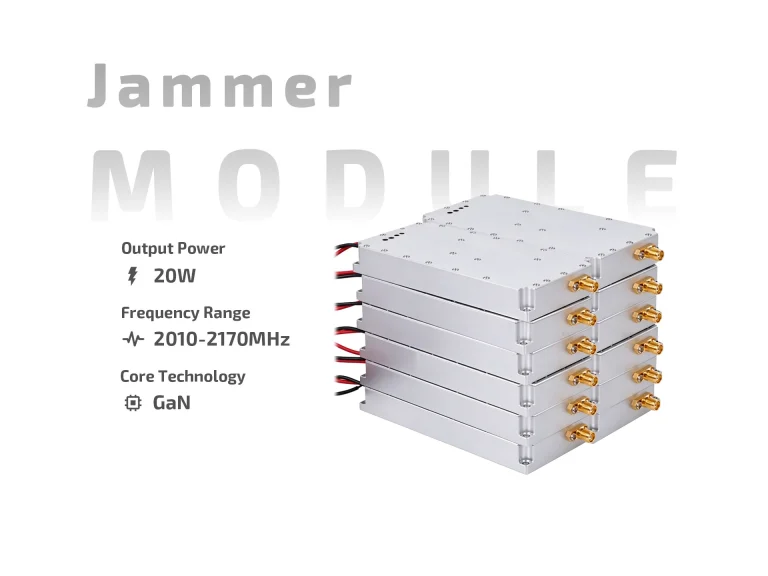
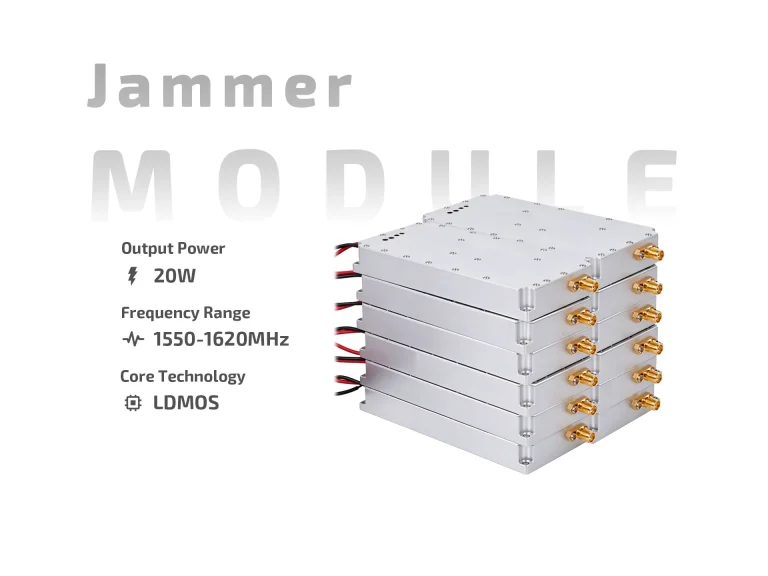
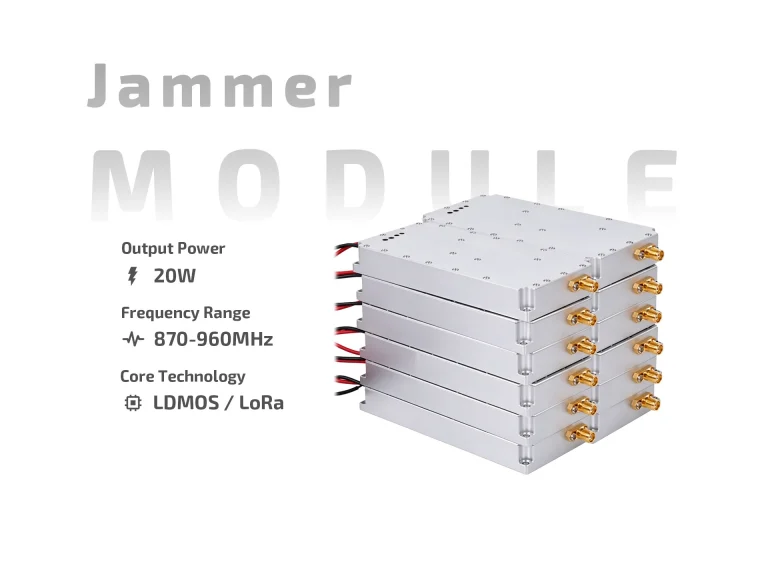
A 20W jammer module is generally used where RF output needs to be compact, power-efficient, and easier to manage thermally. It is not simply a “lower-power” version of a larger module. In many systems, 20W is chosen because the platform cannot support the heat, current draw, or physical size of a higher-power unit.
For teams comparing power classes directly, see our related article: 20W vs 50W Drone Jammer Modules: Which Fits?.
Regulatory note: Jammer modules are controlled or prohibited in many jurisdictions. This article discusses product selection and authorized deployment only. Users must confirm local spectrum rules and obtain required approvals.

Quick answer
A 20W jammer module is typically used in:
-
Portable or manpack counter-drone equipment
-
Briefcase-style or short-duration deployment kits
-
Small fixed-site nodes with limited power and cooling
-
Authorized RF testing and training environments
-
Multi-band systems where each band has its own power budget
-
OEM integration projects where size and battery life matter more than maximum output
The key point is that 20W describes RF output, not necessarily total system power. Buyers should confirm whether the rating is total power or per-band power.
Application map
| Use case | Typical role of a 20W module | Why 20W often fits | Watch-outs |
|---|---|---|---|
| Portable counter-drone kit | Provides RF output in a carryable enclosure | Lower current draw and heat | Battery runtime still depends on duty cycle |
| Manpack or backpack system | Integrated into a wearable or mobile unit | Smaller size and lighter thermal load | Antenna placement and operator safety matter |
| Briefcase-style deployment | Short-term or temporary authorized operation | Easier to power from portable sources | Continuous operation may require thermal limits |
| Small fixed site | Localized RF coverage in a constrained area | Simpler cooling and power design | Site planning and antenna isolation are critical |
| Authorized RF testing | Controlled test or training scenario | Lower interference footprint than higher power | Must be conducted in a legally authorized environment |
| Multi-band OEM system | One band within a larger module stack | Power can be distributed across bands | Confirm per-band vs total power rating |
| Vehicle auxiliary node | Secondary or localized RF function | Reduces demand on vehicle power | Vibration, airflow, and cable loss need review |
Why choose 20W instead of a higher-power module?
The main reasons are usually practical rather than theoretical. A 20W module can reduce thermal design complexity, simplify power supply sizing, and make the overall product smaller. For battery-powered equipment, lower RF power can translate into longer runtime or less aggressive cooling requirements.
There is also an interference-management argument. A lower-power module with a well-designed antenna can be easier to contain within the intended area. That does not automatically make it safe or legal, but it can reduce integration challenges in authorized deployments.
In short, 20W is often selected when the system needs a balanced RF building block rather than the highest possible output.
What a 20W module does not solve
A 20W module will not compensate for poor antenna design, high cable loss, bad site planning, or an inadequate power system. It also does not guarantee a specific range. Range depends on frequency, antenna gain, receiver sensitivity, terrain, obstacles, and the overall link budget.
Buyers should also avoid assuming that a 20W module is always “safer” or “less regulated.” Regulatory status depends on frequency, output power, application, and jurisdiction—not wattage alone.
Procurement questions
Before selecting a 20W jammer module, ask:
-
Is 20W the total RF output or the output per band?
-
What is the supported duty cycle?
-
What cooling method is required for continuous operation?
-
What are the input voltage and current requirements?
-
Does the module include VSWR, over-temperature, and over-current protection?
-
What antenna gain and cable loss are assumed in the quoted performance?
-
Which control interface does the system controller require?
-
Is the intended frequency band and deployment scenario authorized?
FAQ
Is a 20W jammer module only for drone applications?
No. The term describes an RF power class. It can be integrated into different authorized RF systems, though counter-drone equipment is a common industry context.
Does 20W mean 20W at the antenna?
Not necessarily. Module output, cable loss, connectors, and antenna gain all affect the final radiated performance.
Is 20W enough for fixed-site use?
It can be, but it depends on the site, antenna system, required coverage, and legal limits. A fixed site should be designed around the full RF link budget, not wattage alone.
Bottom line
A 20W jammer module is best understood as a compact RF building block for portable, power-limited, or thermally constrained systems. It is commonly used in authorized counter-drone equipment, testing environments, and multi-band OEM designs. The right choice depends on the platform, antenna system, duty cycle, and compliance requirements—not just the wattage label.