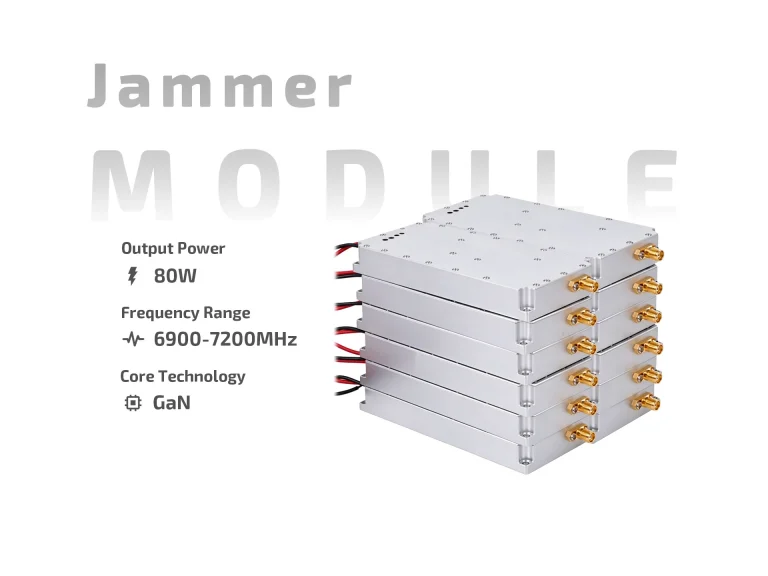
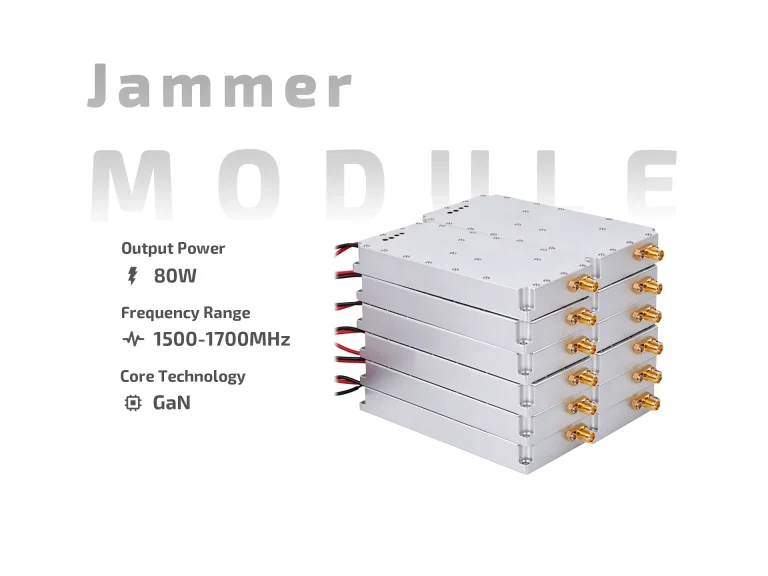
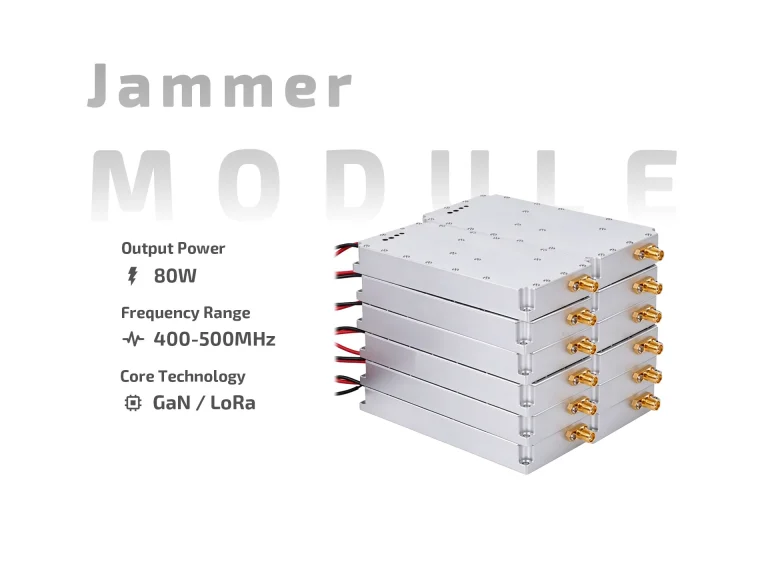
An 80W FPV jammer module is often pitched as a simple upgrade over lower-power units: more output, more coverage, fewer modules per system. In real integrations, the 80W figure changes the thermal, power, and filtering burden at the same time. Buyers who treat it as a drop-in replacement usually discover the trade-offs during field trials rather than during procurement.
This article is written for authorized counter-drone programs and integrators. Jamming and interference are regulated in most markets, and deployment should only proceed with the required spectrum authorization, export review, and trained operators.

Where 80W Fits—and Where It Doesn’t
FPV links are not a single frequency. Depending on the platform and region, video and control links may appear in several bands, and some systems change frequency or channel during operation. A module’s usefulness therefore depends on band coverage, bandwidth, switching behavior, and antenna plan—not on output power alone.
An 80W module can be attractive where a single unit must cover a wider passband or support higher link margins. It can be a poor fit where the enclosure is sealed, airflow is limited, or the operational duty cycle is long. In those cases, a lower-power module with better thermal integration may deliver more reliable results.
The Three Numbers Behind an 80W Claim
Before comparing suppliers, separate three figures: RF output, DC input power, and heat to remove. An 80W RF output at 50% efficiency implies roughly 80W of heat at full duty cycle, plus driver and control losses. That heat must leave the module, the heatsink, and the enclosure.
| Integration question | Why it matters at 80W | Evidence to request |
|---|---|---|
| Is 80W rated at the antenna port? | Output at the connector is not the same as at the antenna | Test setup, cable loss assumptions, and power-versus-frequency data |
| What duty cycle and ambient are assumed? | Short bursts and continuous operation create different thermal loads | Derating curves and case-temperature data |
| What bandwidth is supported at 80W? | Wideband operation may reduce efficiency or require power back-off | Power across the band, not just at center frequency |
| How are harmonics and spurious emissions controlled? | Higher power raises filtering and shielding requirements | Spurious and harmonic measurements |
| What heatsink and airflow are required? | A sealed enclosure changes the entire thermal budget | Recommended mounting, airflow, and enclosure test data |
Thermal planning should start early. For a related power class, the discussion in our guide on how much heatsink for a 60W jammer module shows why heatsink sizing follows efficiency and duty cycle rather than wattage alone.
Integration Questions That Decide Success
Mechanical fit deserves as much attention as RF performance. An 80W module may need a larger heatsink, a cold plate, or forced airflow, all of which affect enclosure size, connector placement, and service access. Antenna routing and isolation also become more demanding as output power rises.
Control behavior matters in the field. Integrators should confirm telemetry, fail-safe states, remote enable/disable, and logging. A module that cannot report temperature or status is harder to diagnose during a pilot.
Procurement teams comparing power classes may also find it useful to review the 1.2GHz 60W anti-drone module buyer’s checklist, which covers band planning, test evidence, and authorization questions from a complementary angle.
Field Validation Beats Bench Numbers
A bench test at room temperature with a short duty cycle says little about sealed-enclosure performance. Require a trial in the intended enclosure, with the intended antenna and cable loss, at realistic ambient temperature and duty cycle. Record case temperature, output behavior, and any derating or shutdown events.
Range claims should be treated cautiously unless test conditions are stated. Antenna gain, terrain, link type, and the target’s behavior all affect outcomes. A credible supplier will document assumptions rather than quote a single distance.
Compliance and Program Fit
An 80W FPV jammer module is not a consumer component. Authorization, export classification, operator training, and rules of use should be confirmed before purchase. Thermal design and RF performance do not substitute for legal permission.
Conclusion
The 80W class can be a practical building block for authorized counter-FPV systems, but only when band coverage, thermal design, filtering, and control behavior are validated together. Treat the wattage as one specification among many—and test the module in the enclosure and duty cycle it will actually face.