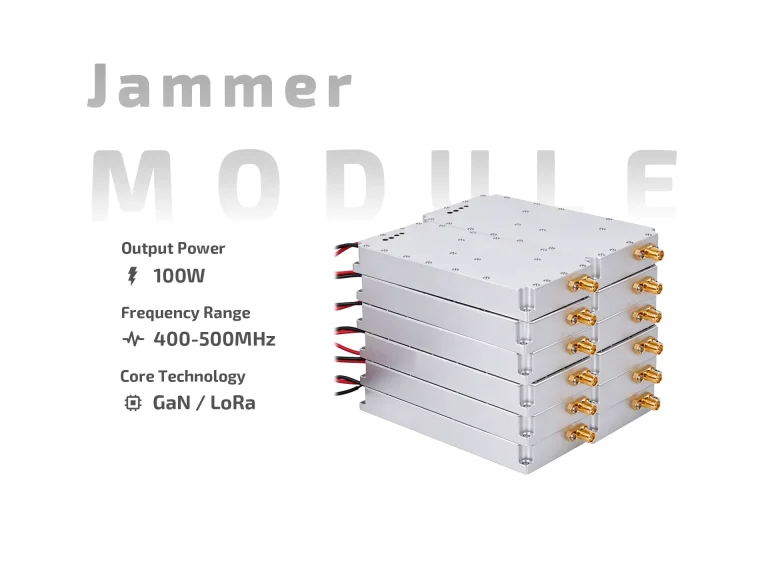
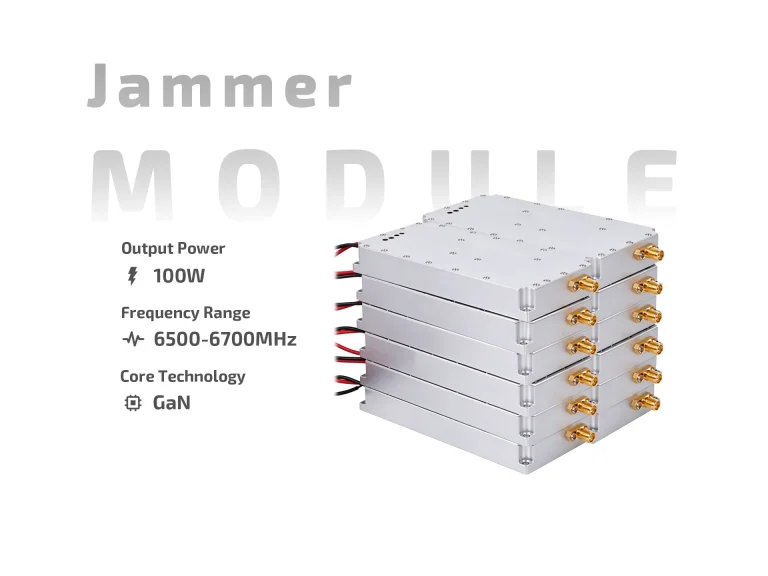
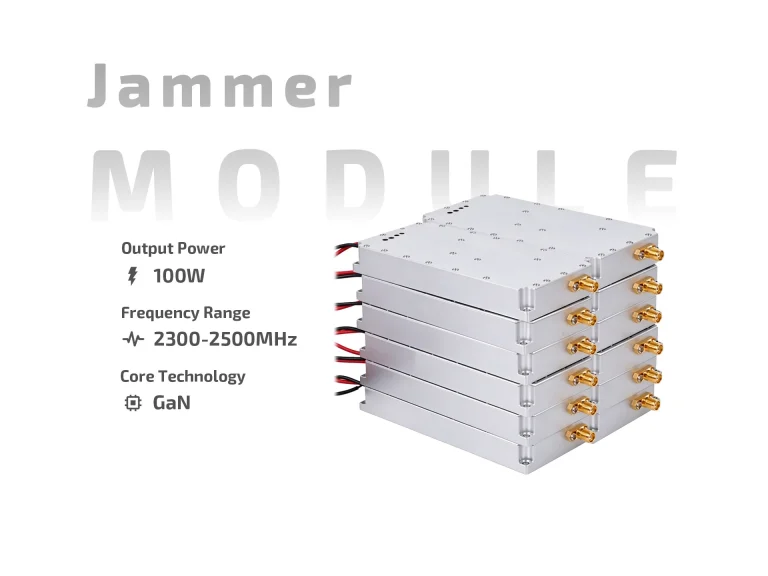
Put an 80W vs 100W drone jammer module side by side on a datasheet and the gap looks almost like a rounding error. Twenty watts, a slightly bigger heatsink, a marginally higher price. That impression rarely survives the first sealed-enclosure test. The two power classes behave differently in ways the headline numbers never show.
This comparison is written for authorized counter-drone programs and integrators weighing an upgrade or a first purchase. Jamming and interference are regulated in most markets; no module should be deployed without spectrum authorization, export review, and trained operators.

The 20W Difference Is Mostly a Thermal Story
Twenty extra watts of RF output does not mean twenty extra watts of heat. It means a new thermal operating point. If both modules run at similar efficiency, the 100W unit dissipates noticeably more heat at full duty cycle, and it usually reaches its derating threshold sooner inside a sealed box.
That is why the two classes often converge in real systems. An 80W drone jammer module with generous heatsinking and good airflow can hold its rated output longer than a 100W module squeezed into the same enclosure. The question is not which number is larger, but which module can sustain its number under your conditions.
Side-by-Side Comparison
The table below frames the decision around operational consequences rather than brochure specs.
| Decision factor | 80W class | 100W class | What to verify |
|---|---|---|---|
| Heat at full duty (50% efficiency, illustrative) | ~80W | ~100W | Actual efficiency and derating curves |
| Enclosure impact | More forgiving in passive or low-airflow designs | Often needs forced air or a cold plate | Case-temperature data in the target enclosure |
| Bandwidth at rated power | Easier to hold across the band | May require back-off at band edges | Power-versus-frequency sweep |
| Power supply headroom | Lower DC draw | Higher DC draw and inrush | Input current, surge, and protection specs |
| Weight and size | Lighter, easier to mount | Heavier heatsink and mounting hardware | Mechanical drawings and service access |
| Cost per system | Lower module cost | Higher module and integration cost | Total installed cost, not unit price |
| Diminishing returns | Adequate where link margins already hold | Worth it only where extra margin changes outcomes | Field trial at realistic range and duty cycle |
For a deeper look at the 80W class specifically—band coverage, thermal load, and field validation—see our article on 80W FPV jammer module integration realities.
When the 80W Module Is the Better Buy
The 80W option tends to win when the enclosure is sealed, airflow is limited, or the platform is weight-sensitive. It also makes sense when the system already meets its link-margin targets and the extra 20W would not change mission outcomes. In those cases, the 100W module adds thermal complexity without adding capability.
Integrators should also consider duty cycle. A short-burst mission profile may never stress either module, which makes the cheaper, lighter option the rational choice.
When 100W Earns Its Place
The 100W class becomes defensible when a genuine link-margin shortfall has been measured, not assumed. If trials show that additional output at the antenna produces a meaningful operational difference—against the specific links, antennas, and terrain in scope—then the thermal cost may be justified.
It also helps when the 100W drone jammer module can be operated below its ceiling. Running a 100W unit at 80W output can improve linearity and thermal margin, provided the supplier supports that operating point and the efficiency penalty is acceptable.
Two Traps to Avoid
The first trap is comparing wattage without comparing efficiency. A less efficient 100W module can generate more heat than a well-designed 80W unit while delivering less usable margin after cable and antenna losses.
The second trap is ignoring antenna and cable losses. Twenty extra watts at the connector can shrink to very little at the antenna if the feed line is lossy. Measure at the antenna, not just at the module.
Validate Before You Commit
Ask both suppliers for power-versus-temperature data, derating curves, and spurious measurements taken under the same conditions. Then run both candidates in the intended enclosure with the intended antenna and duty cycle. Record sustained output, case temperature, and any shutdown events.
Conclusion
The 80W vs 100W drone jammer module choice is not settled by subtracting watts. It is settled by efficiency, thermal headroom, bandwidth behavior, and measured link margin. Pick the class that sustains its rated output in your enclosure—and only pay for the extra 20W when a field trial proves it changes the outcome.