October 22, 2026
50W LoRa Drone Jammer Module: Design & Compliance
A practical industry overview of 50W LoRa drone jammer modules: RF design, thermal management, EMC, compliance, and authorized deployment.

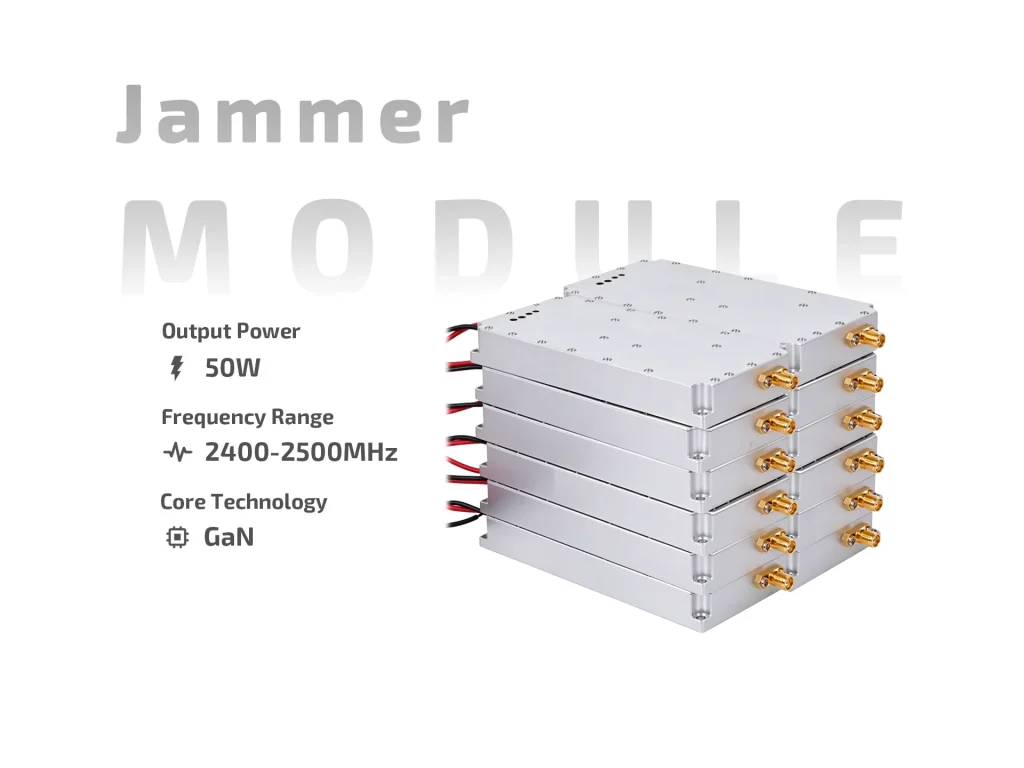
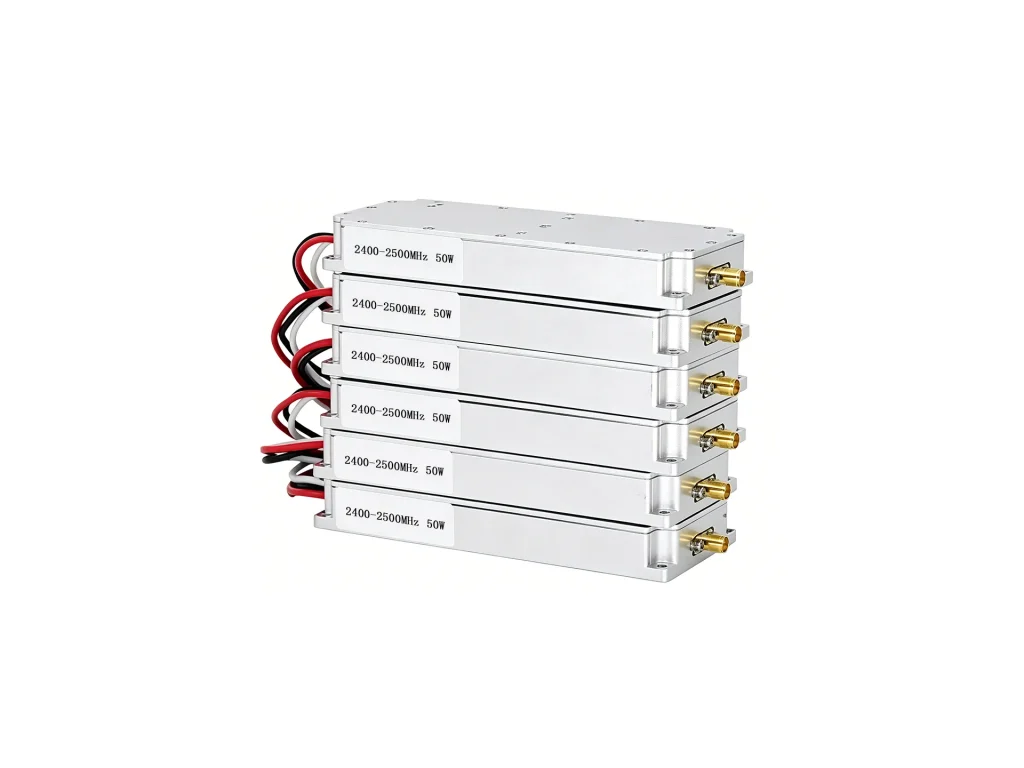

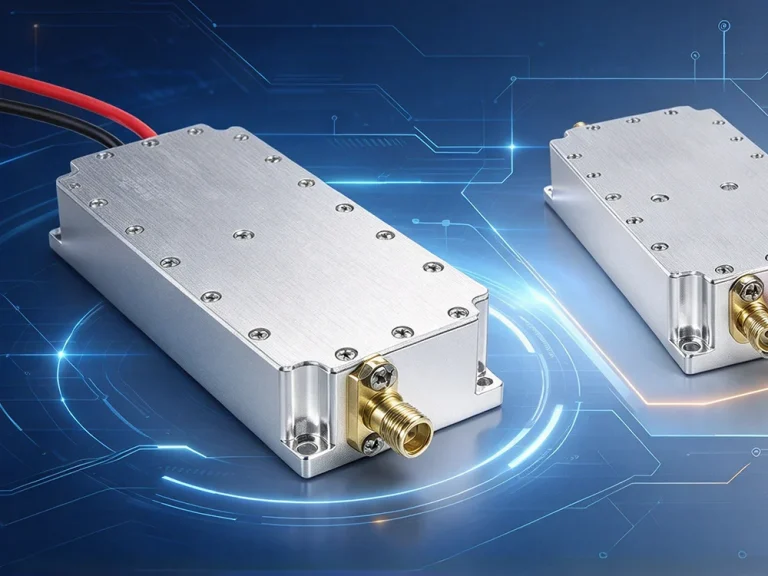
50W GaN anti-drone module ETLD-JM2425G50: 2400–2500MHz, 47±1dBm, 24–28V, 3.2–4.5A, built-in noise source, GaN-on-SiC, SMA female.
The ETLD-JM2425G50 is a 50W GaN anti-drone module that covers 2400–2500 MHz. This is one of the busiest bands for small UAV control, video, and telemetry links. The module uses an AB-class GaN design with GaN-on-SiC technology. It is mounted on a copper heat spreader, which helps move heat away from the transistors. The result is a compact, rugged RF block that fits into vehicle, backpack, or fixed-site systems.

Unlike a simple amplifier, this unit includes a high-speed noise modulation source. It produces analog jamming across the band without an external signal generator. The scan speed is 270 kHz as standard, with 100–500 kHz available on request. The output is rated at 47±1 dBm, or about 50W. Instantaneous wideband behavior means the module can cover the full 2400–2500 MHz range without retuning.
GaN-on-SiC offers high power density and good thermal performance. That matters at 50W, where heat is the main limit. The copper base spreads heat into the housing or heatsink. The design is small and light: 117 × 58 × 18 mm and 300 g. It uses 50-ohm input and output impedance, so it works with common RF chains. The SMA female connector is standard and easy to mate.
The module runs on 28V nominal, with a range of 24–28V. Current draw is ≤3.2–4.5A at 50W output. LED indicators show power, overvoltage, and overtemperature status. That gives operators a quick view of module health. The switch logic and protection features are built in, so integration is simpler than building a discrete RF chain. For systems that need different source types, VCO, DDS, and SDR options can be customized.
Operating temperature is -20 to +65°C. The housing must be attached to a metal surface for proper heat transfer. At 50W, even short transmissions can warm the module quickly if airflow is poor. Use a thin layer of thermal compound between the module and the heatsink. Keep the output cable short and rated for the power level. A poor match will reduce radiated power and increase heat. Do not block the mounting surface with insulation or plastic.
Place the 50W GaN anti-drone module close to the antenna. Use a regulated 24–28V supply that can deliver at least 4.5A. Avoid running control lines parallel to high-power RF cables. Check VSWR before long operation. If the antenna is not matched, the module may protect itself, but performance will drop. For higher effective radiated power, use a directional antenna rather than pushing the module beyond its rating. Use a dummy load rated above 50W for bench tests.
The platform supports customization. Scan speed can be set from 100 to 500 kHz. The signal source can be a built-in noise modulator or a custom VCO, DDS, or SDR design. Dimensions can also be adjusted for specific enclosures. This makes the module useful for OEMs that need a base RF block but want to match their own control and mechanical layout.
Typical uses include counter-UAV testing, prison security, border control, event protection, and RF research. The module can work as a standalone jammer or as part of a multi-band system. Because it focuses on 2400–2500 MHz, it is often paired with modules for other UAV bands.
The ETLD-JM2425G50 is a practical 50W GaN anti-drone module. It combines GaN-on-SiC output, a built-in noise source, and a small copper-based package. With proper cooling and a good antenna, it delivers stable RF power for 2.4 GHz counter-drone tasks. Users must follow local regulations and operate only where authorized.
| Parameter | Specification | Notes |
| Operating Frequency | 2400–2500 MHz | Instantaneous wideband |
| Output Power | 47±1 dBm (50W) | AB-class GaN |
| Operating Voltage | 28V nominal (24–28V) | Regulated supply |
| Operating Current | ≤3.2–4.5A | At 50W output |
| Scan Speed | 270 kHz | Custom 100–500 kHz |
| Input Signal Source | Built-in high-speed noise modulation source | VCO, DDS, SDR customizable |
| Operating Temperature | -20 to +65°C | Normal operation |
| Connector | SMA female | 50-ohm input/output |
| LED Indicators | Power switch, overvoltage, overtemperature | Status display |
| Dimensions | 117 × 58 × 18 mm | Customizable |
| Weight | 300 g | Module only |
| Impedance | 50 ohm | Input/output |
A practical industry overview of 50W LoRa drone jammer modules: RF design, thermal management, EMC, compliance, and authorized deployment.
Explore 5.8GHz 50W drone jammer module design: band physics, EIRP, thermal challenges, antenna matching and integration checkpoints.
Compare 20W vs 50W drone jammer modules by range, heat, power and deployment. Choose the right counter-drone module with practical tips.