October 22, 2026
Multi-Band 30W Drone Jammer Modules Explained
Understand multi-band 30W drone jammer modules: band combinations, total vs per-band power, thermal trade-offs, filtering and antenna design.


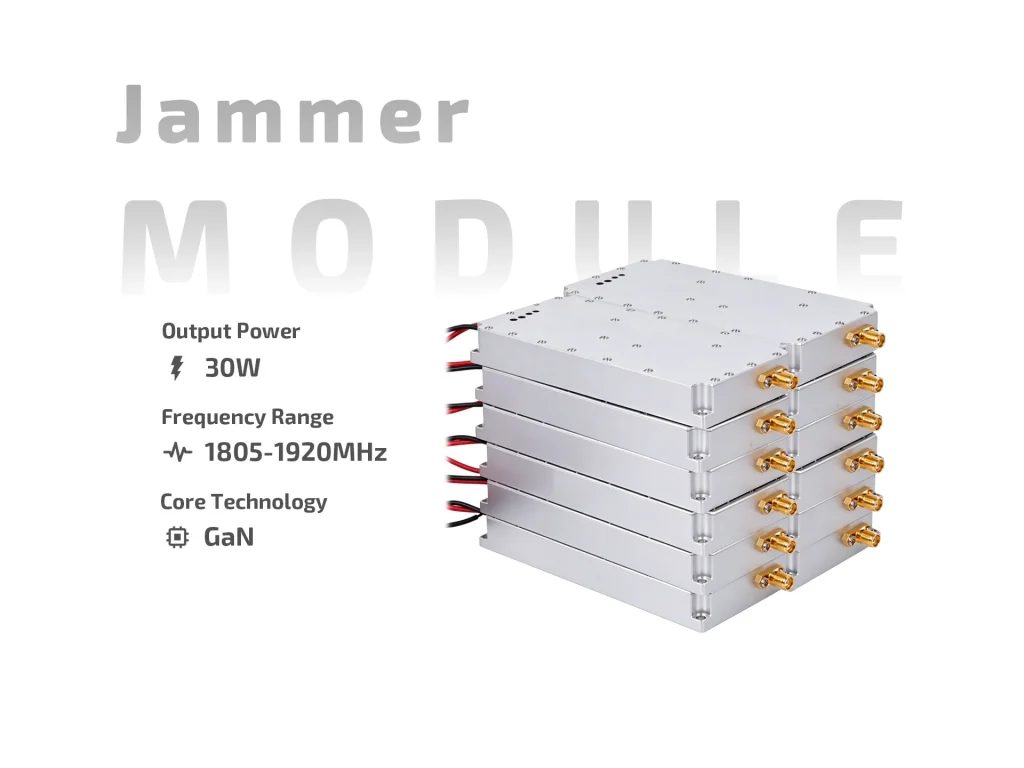
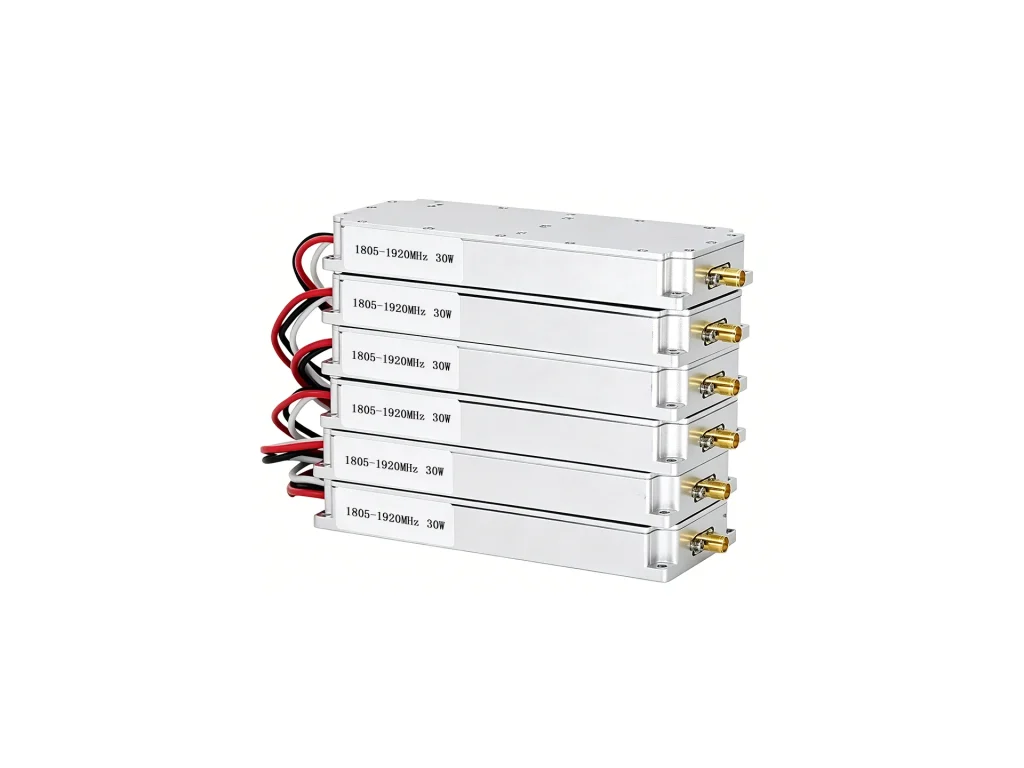

ETLD-JM1819G30 30W GaN UAV jammer module: 1805–1920MHz, DC24–29V, 3.2A max, ≥40% efficiency, SMA female, built-in high-speed sweep source.
The ETLD-JM1819G30 is a compact 30W GaN UAV jammer module built for 1805–1920 MHz counter-drone and RF control tasks. It combines a GaN power stage with an internal high-speed sweep source, so system builders do not need to add a separate signal generator in many layouts. The module is aimed at OEMs, integrators, and test teams that need a ready RF block with simple switching and a standard SMA female output. Its small 115.5 × 46.5 × 21 mm body and 0.21 kg weight help with dense enclosures and airborne or portable platforms.

GaN devices handle high power density and thermal stress better than many older silicon options. In this 30W design, that translates into stable output across the 1805–1920 MHz band and useful efficiency at a 24–29 V DC supply. The module does not need a complex external driver chain. It is a practical building block for UAV jamming, drone detection systems, and protected-site RF denial. The output stage is designed for a 50-ohm path, and the specified VSWR of ≤2.0 gives integrators a clear antenna matching target.
The 1805–1920 MHz range covers common UAV control and video links, including many 1.8 GHz and 1.9 GHz bands. The built-in high-speed sweep source moves energy across the band instead of sitting on one narrow tone. That makes the module suitable for wideband barrage-style jamming and for systems that need a fast, repeating sweep profile. Users can treat the module as a finished RF source and focus on antennas, power, cooling, and mechanical integration.
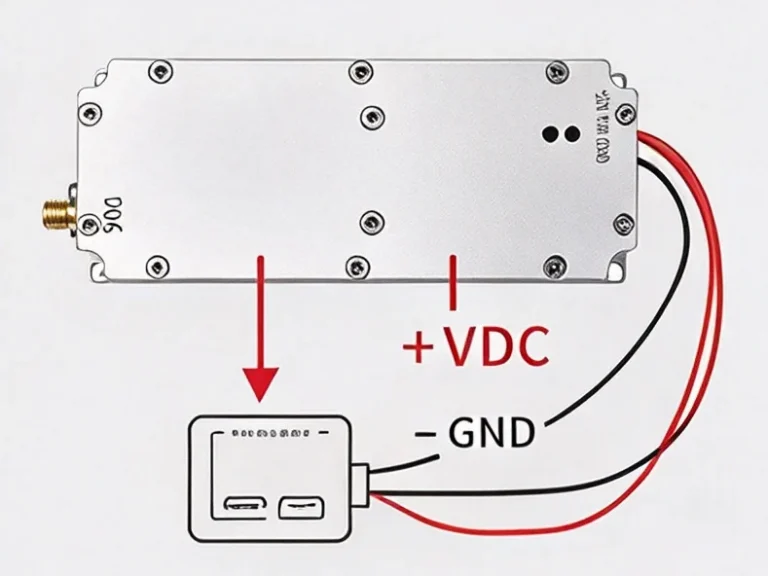
With 30W output, the ETLD-JM1819G30 offers a strong balance between range and power draw. It runs from DC24V to DC29V and draws a maximum of 3.2A. Efficiency is ≥40%, which reduces heat compared with lower-efficiency amplifiers. Even so, a metal mounting surface or heatsink is recommended. The module should be powered from a clean supply with enough current headroom. Reverse polarity, over-voltage, and poor grounding can damage RF amplifiers, so protection belongs in the host system.
Switching is simple. A +5V input or an open pin turns the module on; grounding the control pin turns it off. This logic is easy to drive from a microcontroller, relay, or remote control board. The RF output uses an SMA female connector, a common choice for lab and field assemblies. Keep the RF cable short and use a matched antenna. If the antenna is disconnected or badly matched, reflected power can rise and reduce reliability.
The UAV jammer module measures 115.5 × 46.5 × 21 mm and weighs 0.21 kg. That size fits many handheld, vehicle, and fixed-site housings. Mount it with the baseplate coupled to a heat spreader. Avoid placing sensitive receivers or GPS antennas directly beside the output path unless the host design includes filtering and isolation. Shielding and cable routing matter in multi-band systems.
For best results, verify the antenna VSWR before full power. Start with a dummy load during first tests. Check current, temperature, and output power after 10–15 minutes of operation. The 1805–1920 MHz range may require band filtering in some countries. The integrator is responsible for complying with local RF regulations, output limits, and drone countermeasure rules. This 30W GaN UAV jammer module is not a consumer device; it is an RF component for professional systems.
Typical uses include UAV jamming payloads, border and prison protection, VIP convoy protection, drone detection plus mitigation, and RF test benches. It also works as a 30W GaN source for academic or industrial research where a swept 1.8–1.9 GHz signal is needed. Because the sweep source is internal, the host controller only needs to manage power and on/off logic.
The ETLD-JM1819G30 packs a 30W GaN amplifier and high-speed sweep source into a small module. It is not a finished jammer; it is a core RF block for engineers who want predictable power, simple control, and a compact mechanical footprint in the 1805–1920 MHz band.
| Parameter | Specification | Notes |
| Working frequency | 1805–1920 MHz | Covers common UAV control and video bands |
| Output power | 30W | Typical RF output |
| Output VSWR | ≤2.0 | Designed for 50-ohm systems |
| Working voltage | DC24V–29V | Regulated supply recommended |
| Maximum current | 3.2A | At full load |
| Efficiency | ≥40% | Lower heat load |
| Switch control | +5V or floating = ON; grounding = OFF | Simple logic interface |
| Output connector | SMA female | Standard RF interface |
| Jammer source | Built-in high-speed sweep source | No external source required |
| Dimensions | 115.5 × 46.5 × 21 mm | L × W × H |
| Weight | 0.21 kg | Approx. |
Understand multi-band 30W drone jammer modules: band combinations, total vs per-band power, thermal trade-offs, filtering and antenna design.
Powering a 30W drone jammer module: current draw, PSU sizing, cabling, battery runtime, inrush and thermal derating tips.
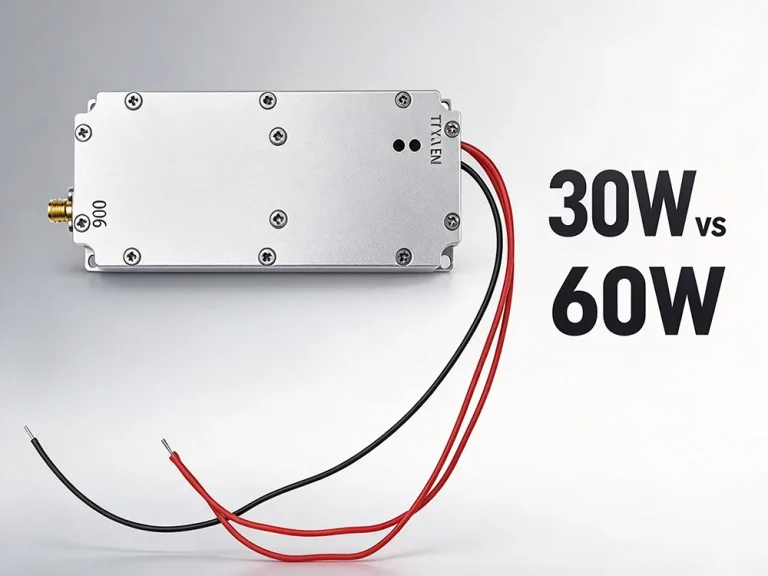
Compare 30W vs 60W drone jammer module by deployment scenario, thermal load, power budget and lifecycle cost. Choose the right tier.