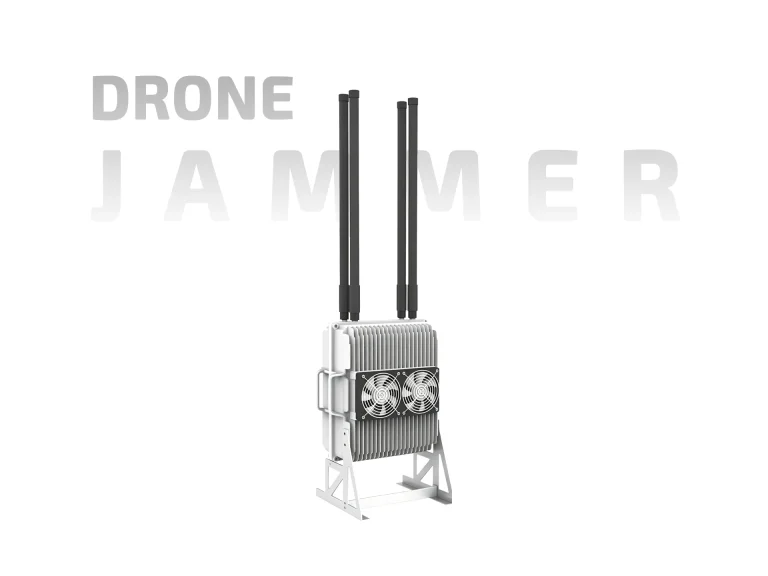
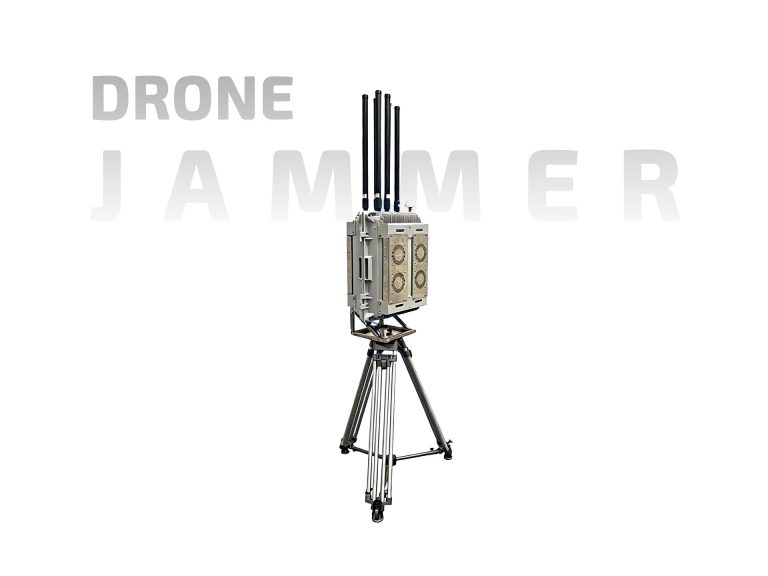
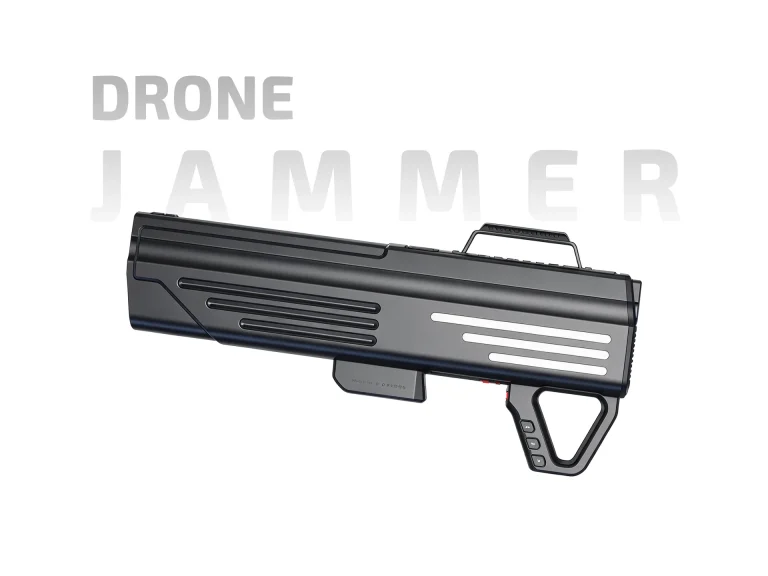
Let’s clear up a common misunderstanding. A drone jammer is not a gun, a net, or a laser. It is an electronic device that floods the radio frequencies a drone uses to communicate or navigate. The goal is not to destroy the aircraft. The goal is to break the link between the drone and its operator, or to confuse its sense of position, so it can no longer complete its mission.
That sounds simple. In practice, jamming is a complex, legally sensitive, and often misunderstood technology. This article explains what a drone jammer is, how it works, what it can and cannot do, and why most people are not allowed to use one.

The Basic Idea: Overpowering a Conversation
Imagine two people talking across a room. A drone jammer is like a loudspeaker that plays noise at the same time, on the same frequency. The original conversation is still happening, but the listener cannot hear it.
A drone typically relies on two types of signals:
-
Control and telemetry links – the radio channel between the drone and its pilot. This carries commands, video, and flight data.
-
GNSS signals – satellite navigation from GPS, GLONASS, Galileo, or BeiDou, used for positioning and autonomous waypoint flight.
A jammer targets one or both. If the control link is blocked, the drone may hover, return to home, or land. If GNSS is blocked, the drone may drift, lose its hold position, or fail to navigate. The exact outcome depends on the drone’s programming and how badly the signal is disrupted.
What a Drone Jammer Actually Does
A jammer does not “take over” a drone. It does not hack it. It does not always make it fall from the sky. It simply raises the noise floor on a chosen frequency until the drone’s receiver can no longer distinguish the real signal.
| Target | What gets disrupted | Typical drone response |
|---|---|---|
| Control link | Pilot commands and telemetry | Hover, return-to-home, or land |
| Video link | Live camera feed | Loss of operator situational awareness |
| GNSS | Satellite positioning | Drift, unstable hover, navigation failure |
| Multiple bands | Control, video, and navigation | Combined disruption, unpredictable behavior |
This is why jamming is often called “soft kill” or “non-kinetic” countermeasure. It avoids falling debris, but it also avoids certainty. A jammed drone may behave in ways the operator cannot control.
Types of Drone Jammers
Not all jammers are built the same. They range from handheld devices to vehicle-mounted systems and fixed installations. The table below outlines the main categories.
| Type | Form factor | Typical use | Key limitation |
|---|---|---|---|
| Portable handheld | Pistol-grip or briefcase | Close-in protection, convoys | Short range, limited battery |
| Vehicle-mounted | Roof or trunk installation | Mobile patrols, border units | Power and cooling demands |
| Fixed-site | Mast or building-mounted | Airports, prisons, bases | High cost, regulatory hurdles |
| Multiband | Combined frequencies | Comprehensive disruption | Complexity, interference risk |
| GNSS-only | Targeted satellite bands | Anti-navigation, drift | Does not stop manually flown drones |
Some jammers are directional, focusing energy in a narrow beam. Others are omnidirectional, spreading energy in all directions. Directional systems are more efficient and create less collateral interference, but they require accurate tracking to stay pointed at the target.
Frequency Bands: Where the Battle Happens
Most consumer and commercial drones operate in a few well-known bands. A jammer must match those bands to be effective.
| Band | Common use | Notes |
|---|---|---|
| 2.4 GHz | Control, video, telemetry | Most widely used by consumer drones |
| 5.8 GHz | Video, high-bandwidth links | Common on racing and camera drones |
| 433 MHz / 868 MHz / 915 MHz | Long-range control | Used by some fixed-wing and custom builds |
| GPS L1 / L2 | Navigation | Jamming affects other GPS users nearby |
| GLONASS / Galileo / BeiDou | Navigation | Multiband GNSS jamming is more complex |
A jammer that covers only 2.4 GHz may stop a toy drone but fail against a drone using 5.8 GHz or a cellular link. This is why serious counter-drone systems use broadband or multiband jamming, often combined with detection sensors to identify which frequencies are in use.
Power, Range, and Real-World Performance
Marketing materials often promise impressive range. Reality is more complicated. Jamming range depends on:
-
Transmitter power
-
Antenna gain and direction
-
Frequency
-
Terrain and obstacles
-
The drone’s receiver sensitivity
-
The drone’s resistance to interference
A handheld drone jammer might claim 1 km, but in a city with buildings and radio noise, effective range could be a few hundred meters. A fixed high-power system may reach several kilometers, but it also risks interfering with legitimate communications over a wide area.
| Factor | Effect on jamming range |
|---|---|
| Higher power | Longer range, more interference risk |
| Directional antenna | Focused energy, better efficiency |
| Open terrain | Longer range |
| Urban environment | Shorter range, more reflections |
| Frequency-agile drone | Harder to jam consistently |
Modern drones are increasingly resistant to jamming. Some use frequency hopping, spread spectrum, or autonomous flight that continues even when the control link is lost. A jammer that worked well five years ago may be less effective today.
Legal Status: Why You Probably Can’t Own One
This is the part many buyers overlook. In most countries, transmitting jamming signals is illegal for private citizens. Radio spectrum is regulated because interference can disrupt emergency services, aviation, and public safety.
| Region | Private ownership | Government use |
|---|---|---|
| United States | Illegal to operate | Federal agencies under strict rules |
| European Union | Illegal in most member states | Authorized agencies only |
| United Kingdom | Illegal to use | Police and military with authorization |
| Australia | Prohibited | Limited government use |
| Middle East / Asia | Varies widely | Often restricted to security forces |
Even possessing a jammer can be illegal in some jurisdictions. A cheap jammer bought online may work, but using it can lead to fines, confiscation, or criminal charges. For most private organizations, the legal path is detection, tracking, and coordination with law enforcement, not active jamming.
Common Myths About Drone Jammers
Myths spread quickly online. Here are a few corrections.
| Myth | Reality |
|---|---|
| “A jammer makes any drone fall instantly.” | Many drones hover, return home, or land. Behavior varies. |
| “Jamming is a precise, targeted tool.” | Radio waves spill over and can affect other devices. |
| “You can legally use one to protect your property.” | In most countries, no. Jamming is reserved for authorities. |
| “One jammer covers all drones.” | Different drones use different frequencies and resist interference. |
| “Jamming is always better than kinetic options.” | It avoids debris but may fail against autonomous drones. |
Alternatives to Jamming
Because jamming is legally restricted and technically uncertain, many organizations rely on other counter-drone measures.
-
Detection and tracking – radar, RF, and cameras to know what is in the air.
-
Protocol takeover – using known communication protocols to control a drone, where legal.
-
GNSS spoofing – sending false navigation signals to redirect a drone, also tightly regulated.
-
Net capture – physical interception with nets or interceptor drones.
-
Directed energy – high-power microwave or lasers, still largely military.
For most commercial sites, the realistic stack is detection plus coordination. Jamming is a government tool, not a private security gadget.
FAQ
Is a drone jammer the same as a signal blocker?
Yes, in most contexts. A drone jammer blocks radio or GNSS signals used by a drone.
Can a drone jammer stop a fully autonomous drone?
Not reliably. If the drone does not depend on a control link or GNSS, jamming may have little effect.
Do jammers work on all frequencies?
No. They must match the frequencies the drone uses. Multiband jammers cover more, but not everything.
Are drone jammers legal for private security?
In most countries, no. Detection and reporting are usually allowed; jamming is not.
What happens to a jammed drone?
It may hover, return to home, land, drift, or crash. The outcome depends on the drone’s design and failsafe settings.
The Bottom Line
A drone jammer is an electronic countermeasure that disrupts the radio or satellite signals a drone relies on. It can be effective, but it is not a magic button. It has limited range, uncertain results, and serious legal restrictions.
If you are considering anti-drone protection, start with detection and tracking. Understand your legal authority before you even think about jamming. In most cases, the right answer is not a jammer at all. It is a layered system that sees the threat early and gives trained operators time to respond appropriately.