Project Background
A district police station in Nanchang required mobile drone defense equipment to strengthen airspace security during patrols, public events, and rapid response operations. The station covers a mixed urban and peri-urban area with multiple sensitive locations, including government buildings, transport hubs, and crowded public spaces. The procurement project focused on portable and vehicle-based countermeasures rather than a fixed installation. The selected defense strategy combined vehicle-mounted jamming, backpack jamming, and a handheld drone jammer gun. The objective was to give officers flexible tools for detecting and disrupting unauthorized drone activity across different operational scenarios.

Operational Challenge
Police stations face unpredictable drone threats. A device that works well at a fixed checkpoint may not suit a patrol car, a foot patrol, or a temporary event security detail. The Nanchang station needed equipment that could be deployed quickly, operated by trained officers, and coordinated with existing response procedures. The system also had to support layered coverage: vehicle-mounted jammers for mobile patrols, backpack jammers for dismounted operations, and a handheld gun for precise close-range intervention. Reliability, portability, and ease of use were therefore central to the project.
Solution Overview
The project deployed three complementary products in different quantities to match operational roles.
Vehicle-Mounted Anti-Drone Jammer ETLD-V044 — 4 units
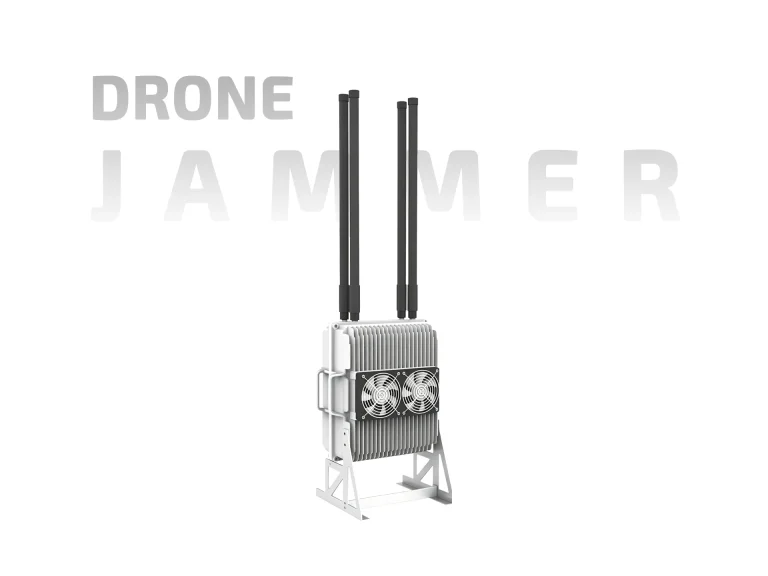
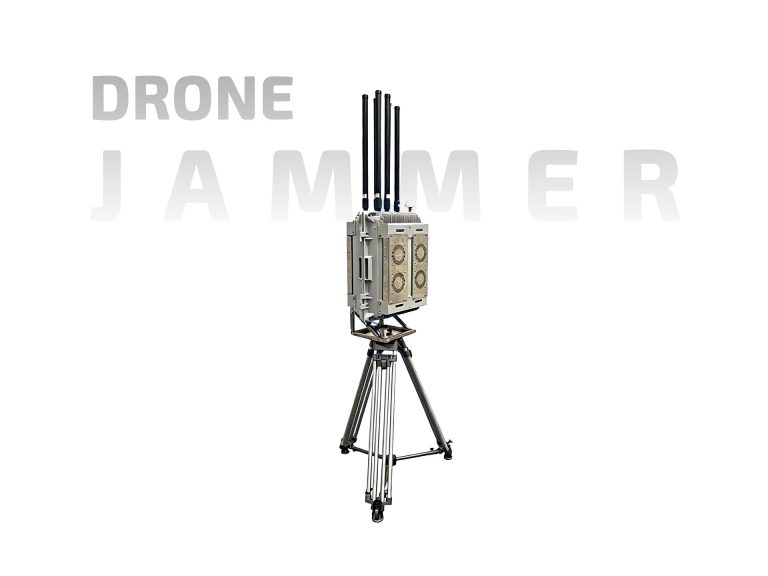
The ETLD-V044 is a jammer box designed for vehicle installation. It covers four standard bands: 900M, 1.5G, 2.4G, and 5.8GHz, with 50W output per band and four independent channels. The omnidirectional jamming radius is 0–300 meters, so officers do not need to aim the system. It accepts DC12V or DC28V vehicle power and includes a 3-meter control handle for operation from inside or near the vehicle. The housing is waterproof for outdoor patrol duty. The four units were assigned to patrol cars for mobile protection along routes and at temporary checkpoints.
Backpack Drone Jammer ETLD-TCM304 — 8 units
The ETLD-TCM304 is a portable backpack-style jammer with a counter range of up to 1km. It weighs 16kg and uses omnidirectional antennas to provide coverage without blind spots. The system jams RC and VTX signals and covers more than 98% of drone models on the market. Power consumption is around 500W, supplied by AC220V or a built-in 20A battery that provides over one hour of continuous use. It includes intelligent heat dissipation, temperature monitoring, and standing wave protection. Operating temperature ranges from -20°C to +50°C. The eight units were issued to foot patrol teams and event security details for rapid deployment.
Drone Jammer Gun ETLD-HA02-8 — 8 units
The ETLD-HA02-8 is a handheld directional jamming system. It covers 433M, 900M, 1.2G, 1.4G, 1.5G, 2.4G, 5.2G, and 5.8GHz, with customizable 4-channel or 8-channel configurations. The jamming range is 0–1500 meters, providing standoff distance for operators. It uses directional high-gain antennas and active cooling, and is powered by a removable battery for extended field use. The eight guns were distributed to trained officers for precision engagement when a specific drone threat was confirmed.
Deployment and Integration
The deployment was organized around the station’s daily patrol and response routines. The project team reviewed patrol routes, likely drone approach paths, and event security requirements before assigning equipment. Vehicle-mounted jammers were installed on patrol cars with attention to antenna placement, power wiring, and grounding. Backpack jammers were prepared for quick issue to foot patrols and temporary details. Jammer guns were stored at the station and issued to trained officers when needed.
Training focused on simple, repeatable procedures. Officers learned to identify suspicious drone activity, communicate with the command element, and select the appropriate countermeasure. The equipment was tested under realistic conditions to confirm start-up speed, portability, and operational coordination. Legal compliance was emphasized, since jamming is regulated in most countries.
Operational Results
The Nanchang project delivered a flexible mobile drone defense capability for the police station. The combination of vehicle-mounted, backpack, and handheld equipment gave officers multiple response options across different scenarios. Field tests showed reliable performance during patrols and temporary deployments. The vehicle-mounted jammers provided continuous mobile coverage, while backpack units allowed dismounted teams to establish protection zones quickly. The jammer guns offered precise intervention at longer range. The layered approach improved operational confidence and supported faster, more coordinated responses to unauthorized drone activity.
Conclusion
The Nanchang police station drone defense equipment project demonstrates how mobile countermeasures can strengthen local airspace security. By deploying the ETLD-V044 vehicle-mounted drone jammer, ETLD-TCM304 backpack drone jammer, and ETLD-HA02-8 drone jammer gun, the station established a practical, layered defense strategy. The solution supports rapid response, flexible deployment, and operational continuity—key requirements for modern police counter-drone operations.