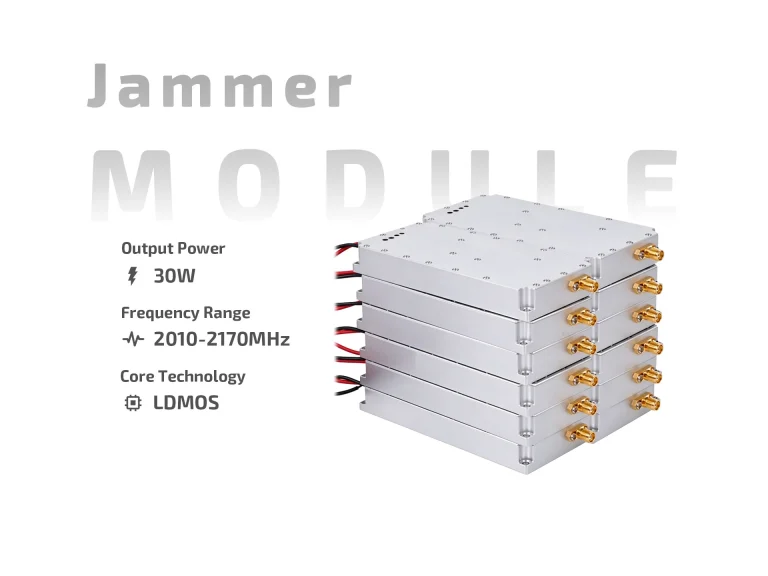
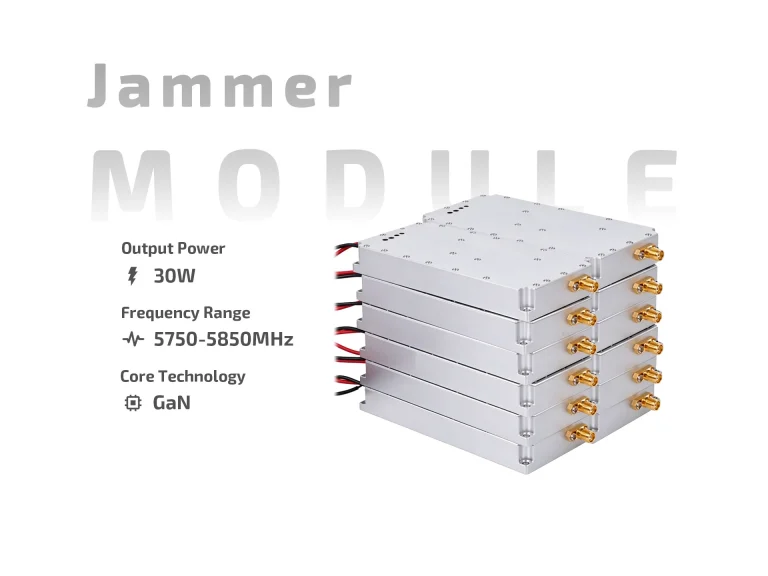
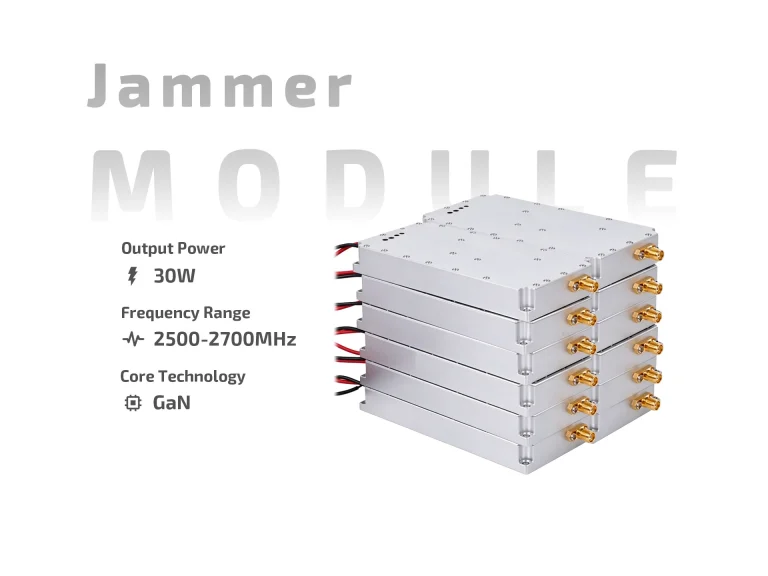
Choosing between a 30W vs 60W drone jammer module is often framed as a simple power question. In reality, the decision sits at a useful midpoint in the RF power range. Thirty watts is large enough for many portable and vehicle-adjacent systems, while 60W opens the door to fixed installations and higher-margin scenarios—provided the platform can handle the heat and current.
This article approaches the comparison from deployment scenarios and lifecycle cost rather than raw specification. For a broader look at how power tiers relate, see 20W vs 50W Drone Jammer Modules: Which Fits?.

The 3 dB gap in plain terms
A 30W module outputs roughly 44.8 dBm. A 60W module outputs roughly 47.8 dBm. The difference is about 3 dB—one doubling of power. In free-space terms, 3 dB does not double range; it increases the link margin by a modest amount. That margin can matter for penetration, reliability at the edge of coverage, or operation in cluttered environments.
The practical takeaway is that 60W is not “twice the range” of 30W. It is a one-step increase in link budget. Whether that step is worth the added heat, weight, and cost depends on the deployment.
Scenario-first comparison
Rather than comparing parameters in isolation, it helps to start with where each module is likely to be used.
| Deployment scenario | 30W suitability | 60W suitability | Decision notes |
|---|---|---|---|
| Manpack or backpack kit | Strong fit | Possible but heavy | 30W keeps weight and battery demand lower |
| Briefcase-style kit | Good fit for short missions | Less common due to heat | Confirm duty cycle before choosing 60W |
| Vehicle roof or auxiliary node | Good for localized roles | Strong fit for wider coverage | 60W benefits from vehicle power and airflow |
| Fixed site with mains power | Adequate for small zones | Better for larger perimeter roles | Site planning matters more than wattage |
| Shelter or container system | Workable with careful cooling | Natural fit | 60W continuous use demands real thermal design |
| Multi-band OEM stack | Good per-band building block | Useful for high-margin bands | Confirm total vs per-band power |
| Temporary authorized testing | Good for controlled trials | Useful when higher margin is needed | Keep interference footprint in mind |
| Mobile command vehicle | Good secondary module | Primary module candidate | Check alternator and battery headroom |
This scenario view often resolves the choice faster than a specification sheet. If the platform is portable and battery-limited, 30W usually wins. If the platform has stable power and airflow, 60W becomes practical.
Thermal and electrical realities
| Factor | 30W module | 60W module | Engineering impact |
|---|---|---|---|
| Heat dissipation | Moderate | Substantial | 60W typically needs a larger heatsink or forced air |
| Current draw | Lower | Higher | PSU, cabling, and battery sizing must be reviewed |
| Continuous duty | Easier to support | Requires deliberate design | Derating may be needed without adequate airflow |
| Enclosure size | Compact | Larger or externally cooled | Affects portability and mounting options |
| Cable and connector rating | Standard | Needs verification | Higher current and RF power stress connectors |
| Monitoring needs | Basic protection often sufficient | Temperature and VSWR monitoring strongly advised | Protects module and surrounding electronics |
A common integration mistake is to select 60W for its output and then operate it at reduced duty cycle because the enclosure cannot dissipate the heat. In that case, a well-cooled 30W module may deliver more consistent real-world performance.
Lifecycle cost angle
| Cost category | 30W tendency | 60W tendency | Notes |
|---|---|---|---|
| Module unit price | Lower | Higher | Configuration still dominates |
| Cooling hardware | Simpler | More complex | Fans, ducts, or larger heatsinks add cost |
| Power system | Smaller | Larger | Battery or PSU upgrades can be significant |
| Installation effort | Lower | Higher | Mounting, airflow, and cabling take more work |
| Maintenance | Less cooling-related service | More attention to fans and thermal paths | Active cooling introduces wear items |
| Spares strategy | Simpler | More varied | Higher-power systems often need matched spares |
The headline module price is only one line in the budget. Cooling, power, and installation often decide whether 60W is truly cost-effective.
When 30W is the smarter engineering choice
Thirty watts is often the right answer when the system must remain portable, when battery runtime is a constraint, or when the enclosure has limited airflow. It is also a sensible choice for multi-band designs where several bands share a total power budget. A 30W module paired with a well-matched antenna can meet many localized coverage goals without the thermal penalties of 60W.
When 60W earns its place
Sixty watts makes sense when the platform has stable mains or vehicle power, sufficient cooling, and a genuine need for additional link margin. Fixed sites, shelter systems, and larger vehicle installations are typical candidates. The extra 3 dB should be justified by a link-budget analysis—not by a preference for higher numbers.
Selection questions to settle early
-
Is the power rating total or per band?
-
What duty cycle is required, and what cooling supports it?
-
What are the peak and average current demands?
-
Does the enclosure allow sufficient airflow or conduction paths?
-
What antenna gain and cable loss are assumed?
-
Are VSWR, over-temperature, and over-current protections included?
-
Does the control interface match the system controller?
-
Is the frequency band and deployment scenario authorized?
FAQ
Is 60W twice as powerful as 30W?
Yes in linear power terms—about 3 dB—but that does not translate to twice the range. Range depends on the full link budget.
Can a 30W module replace a 60W module?
Sometimes. If the application is portable or thermally constrained, a well-integrated 30W module may perform more reliably than an under-cooled 60W unit.
Which is better for fixed sites?
60W is often preferred for larger fixed perimeters, but 30W can serve smaller zones. Site planning and antenna design usually matter more than the wattage step.
Bottom line
The 30W vs 60W drone jammer module decision is really a platform decision. Thirty watts favors portability, battery life, and simpler thermal design. Sixty watts favors higher link margin in installations with stable power and real cooling. Match the module to the deployment, verify the link budget, and treat the 3 dB step as one variable among many.