Project Background and Pain Points
A military research institute in Shaanxi needed to upgrade an existing counter-drone system rather than replace it. The site already had detection equipment and jamming coverage for common 2.4GHz and 5.8GHz links, but sub-GHz LoRa and FPV channels were still a weak point. Long-range LoRa control links and analog FPV video in the 720–1020MHz range often fell outside the existing response coverage.

The customer’s request was practical: find compact RF modules that could be integrated into four existing platforms — the main countermeasure system rack, a handheld drone jammer gun, a backpack-style unit, and fixed sentry stations. Space was limited. The team did not want external signal generators or extra cabling. They also needed stable thermal performance and protection against antenna mismatch, because field operators often swap antennas during testing and deployment.
Procurement and Module Specifications
The project purchased five 100W modules and five 50W modules.
| Module | Model | Quantity |
|---|---|---|
| 100W LoRa FPV Jammer Module 870–960MHz | ETLD-JM0809G100 | 5 |
| 50W LoRa FPV Jamming Module 720–1020MHz | ETLD-JM0710L50 | 5 |
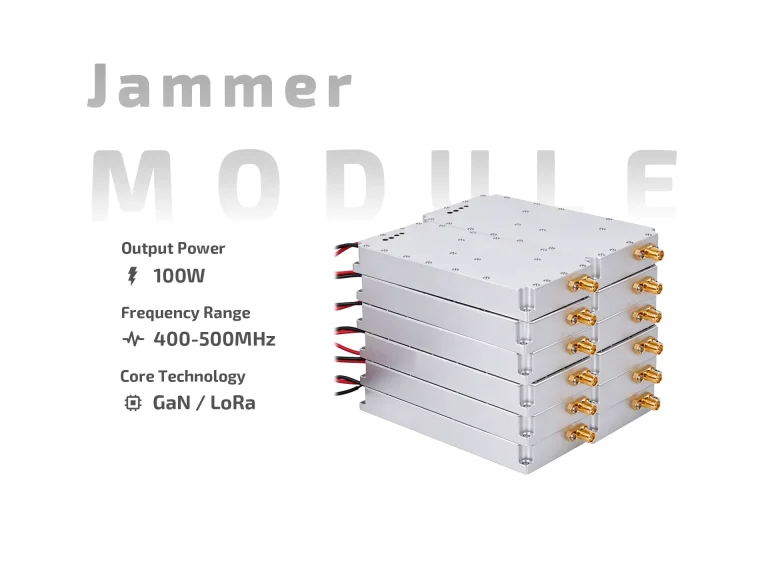
The ETLD-JM0809G100 uses GaN technology and delivers 100W across 870–960MHz. It has a built-in high-speed sweep source, internal absorption-type VSWR protection, +5V logic or grounding control, a DC input of 24–29V, maximum current of 12.0A, and an SMA female RF connector. The module measures 168.5×84.5×23mm and offers efficiency of ≥40%.
The ETLD-JM0710L50 covers 720–1020MHz with 50W output, about 47±1dBm. It includes a built-in high-speed noise modulation source, analog scan speed of 270kHz, custom scan options from 100kHz to 500kHz, 50-ohm impedance, 24–28V operation with 28V nominal, and current draw of ≤3.2–4.5A at 50W. It uses an SMA female connector, provides LED indicators for power, overvoltage, and overtemperature, and operates from -20°C to +65°C. The standard size is 117×58×18mm at about 300g. VCO, DDS, SDR, and custom dimension options are available.
Integration Approach
The allocation followed platform constraints. The 100W modules went into three fixed sentry stations, one backpack unit, and one rack-mounted countermeasure system. The 50W modules went into two handheld jammer guns, one backpack unit, one fixed station, and one rack-mounted system. This gave every platform access to sub-GHz jamming without forcing a single form factor on all teams.
The built-in sweep and noise sources saved significant space. In the handheld gun, the 50W module’s lighter weight and lower current draw were important. In the fixed and backpack units, the 100W module provided more output where heatsinking and battery capacity allowed. The +5V logic control made it straightforward to tie module triggering into the existing detection and command workflow.
Field Results and Data
During a four-week integration trial, the drone jammer modules were tested under controlled conditions and in line with local RF regulations. Once the existing detection layer issued a trigger, full RF output was reached in under one second.
With directional antennas, the 100W 870–960MHz module disrupted LoRa control links at roughly 1.8–2.3km line-of-sight. With omni antennas, the practical range was about 0.8–1.2km. The 50W 720–1020MHz module achieved about 1.2–1.8km with directional antennas and 0.6–1.0km with omni antennas. These figures are site-dependent and were lower in obstructed areas.
Thermally, the 100W module ran continuously for 30 minutes at 28V with current between 11.2A and 11.8A; case temperature stabilized around 58–62°C with a heatsink and airflow. The 50W module drew 3.8–4.3A and settled around 48–53°C. An intentional antenna-disconnect test did not damage the 100W module, confirming that the VSWR protection was working as intended.
Project Value and Future Scalability
The project filled the sub-GHz response gap without rebuilding the customer’s existing architecture. The same module family now supports handheld, backpack, fixed, and rack-mounted equipment, which simplifies spare parts and training. Built-in sources reduced bill-of-materials cost and cable loss, while VSWR protection lowered the risk of operator error during antenna changes.
For future expansion, the institute can add more fixed posts, pair the 50W module with a 5.8GHz GaN module for multi-band coverage, or use custom scan speeds and dimensions for new enclosures. The integration work also leaves room for remote control and networked triggering as the site’s counter-drone workflow evolves.