Project Background
A military unit in Fuzhou required a flexible drone defense capability to strengthen airspace security across its area of responsibility. Unlike a fixed-site installation, the project needed mobile and portable countermeasures that could be deployed quickly in different scenarios. The defense strategy combined portable drone countermeasure equipment, vehicle-mounted drone countermeasure equipment, and an anti-drone gun. The goal was to give trained operators multiple response options for detecting, disrupting, and managing unauthorized drone activity.

Operational Challenge
Military sites often cover large areas and include multiple access points, patrol routes, and temporary activity zones. A single fixed defense system may not provide enough flexibility for patrols, rapid response, or short-notice missions. The Fuzhou unit needed equipment that could be moved quickly, operated by security personnel, and coordinated with existing procedures. The system also had to support a layered response: portable equipment for local coverage, vehicle-mounted equipment for mobile operations, and a handheld anti-drone gun for close-range intervention. Reliability, ease of use, and quick deployment were therefore central to the project.
Solution Overview
The project deployed three complementary products. The Anti-Drone Gun ETLD-HF5-JDS is a multi-role handheld counter-UAV platform. It combines detection, direction finding, positioning, navigation spoofing, signal capture, auto frequency locking, and digital jamming in one unit. Its detection band runs from 300 to 6200 MHz, jamming covers 700 to 6000 MHz, and spoofing supports GPS, BDS, GLONASS, and GALILEO. Detection range reaches 3000 meters, jamming range reaches 2000 meters, and spoofing range is 1000 meters by default and customizable. The gun supports at least 12 channels and a 4.3-inch HD LCD screen, with a removable battery for quick field swaps.
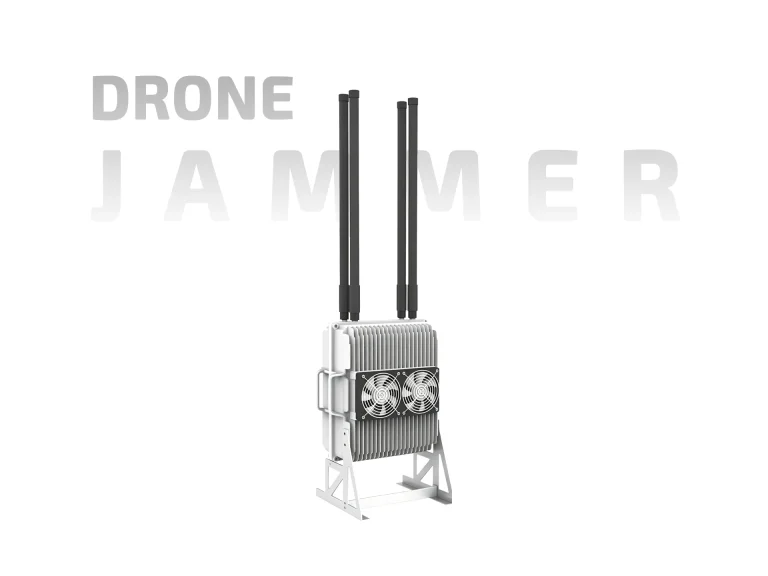
The Vehicle-Mounted Drone Jammer ETLD-V028 provides mobile coverage for patrols and convoys. It covers 400–6000 MHz with eight jamming channels, including common 2.4 GHz and 5.8 GHz drone links. The omnidirectional jamming radius is 0–200 meters, so operators do not need to aim at a specific direction. Power comes from DC12V or DC28V, and a 3-meter control handle allows operation from inside or near the vehicle. The housing is waterproof for outdoor duty.
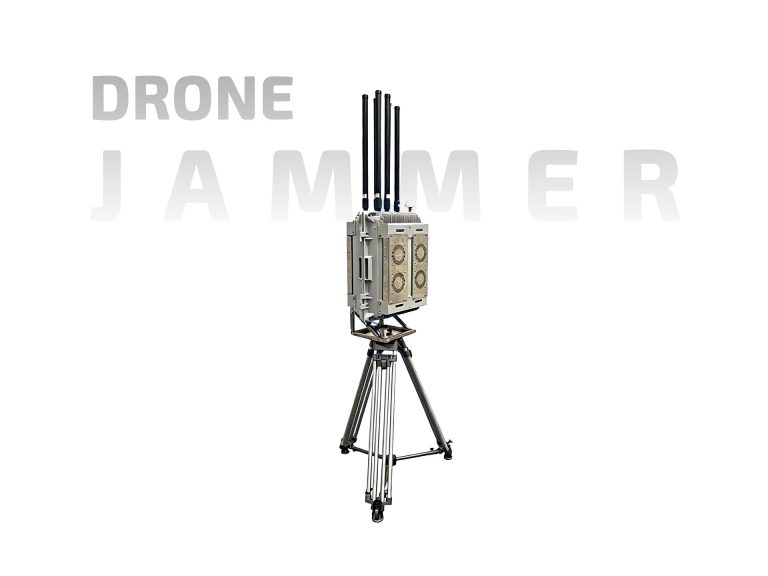
The Trolley Case Signal Jammer ETLD-CHACM adds a high-power, transportable option. It delivers a jamming distance of up to 3 km with 360° coverage. Supported frequencies include 433M, 900M, 1.2G, 1.4G, 1.5G, 2.4G, 5.2G, and 5.8G, with each channel providing 50W to 100W. The unit operates in temperatures from -35°C to +70°C, weighs up to 53 kg, and uses a rugged trolley case with modular components for easy maintenance.
Deployed Products:
Deployment and Integration
The deployment was planned around the unit’s daily security operations and response procedures. The project team reviewed site conditions, patrol routes, and likely drone approach paths before positioning the equipment. The vehicle-mounted jammer was assigned to mobile response tasks, while the trolley case jammer was prepared for flexible positioning at key locations. The anti-drone gun was issued to trained operators for close-range use when a threat was confirmed.
Integration focused on simple, repeatable procedures. Operators were trained to identify suspicious drone activity, communicate with the command element, and select the appropriate countermeasure based on the situation. The equipment was tested under realistic conditions to confirm portability, start-up speed, and operational coordination. Because the system is mobile, the unit can adjust its defense layout as missions or security requirements change. The project also emphasized legal compliance, since jamming and spoofing are regulated in most countries.
Project Results
The Fuzhou project delivered a flexible drone defense capability suited to a military environment. The unit gained multiple response options across portable, vehicle-mounted, and handheld equipment. The ETLD-HF5-JDS provides detection, direction finding, and spoofing in a single handheld unit; the ETLD-V028 extends coverage through vehicle mobility; and the ETLD-CHACM supports high-power portable deployment. Together, they create a layered defense model that can be scaled or adjusted as threats evolve. The equipment is easy to transport, quick to deploy, and suitable for both routine security tasks and short-notice operations.
Conclusion
The Fuzhou military unit drone defense project shows how portable and vehicle-mounted countermeasures can strengthen site security. By deploying the ETLD-HF5-JDS anti-drone gun, ETLD-V028 vehicle-mounted drone jammer, and ETLD-CHACM trolley case signal jammer, the unit established a flexible, layered defense strategy. The solution supports rapid response, mobile coverage, and adaptable deployment—key requirements for modern drone defense in military settings.