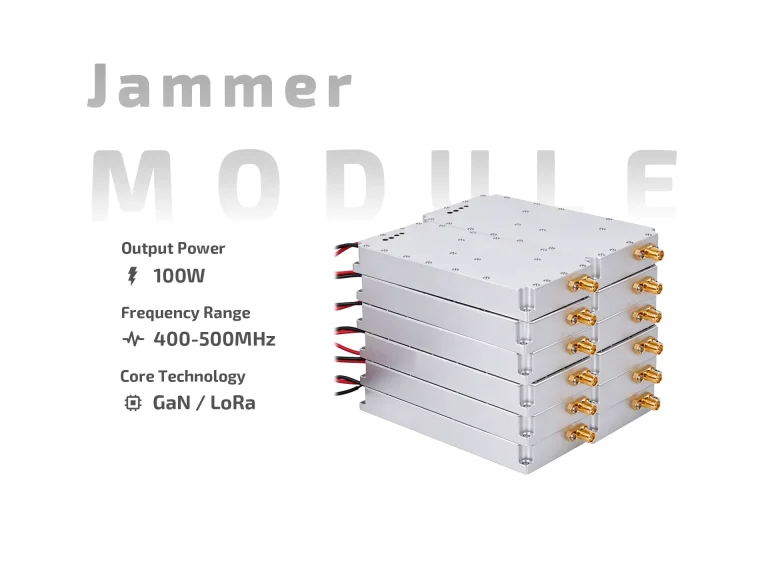
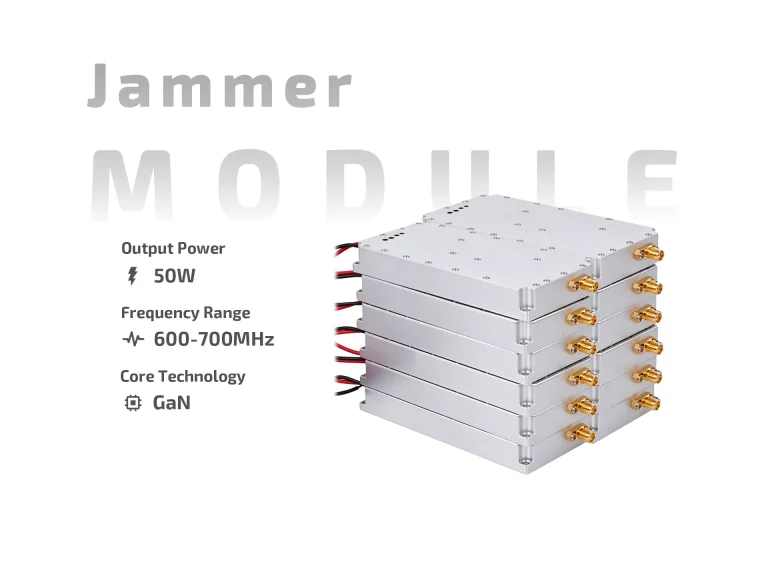
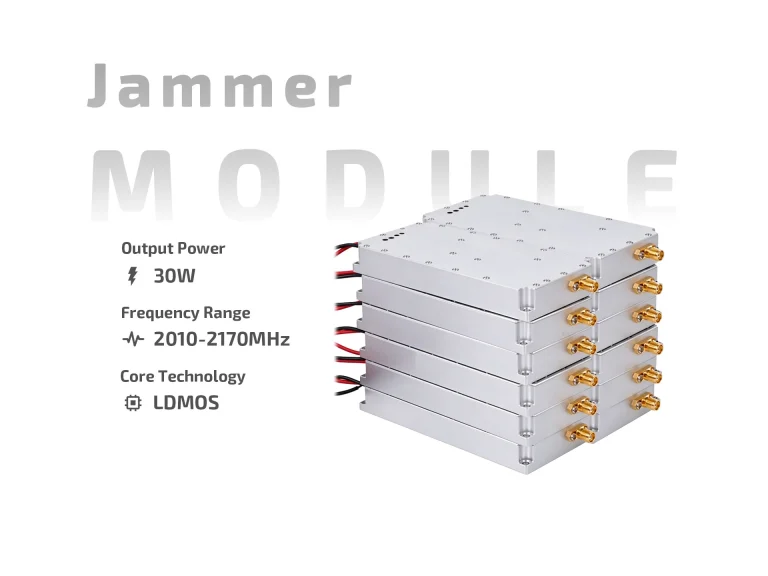
Drone jammer module range is one of the most misunderstood specs in the counter-drone market. Vendors often advertise a single number, such as “3 km” or “5 km,” but range is not a fixed property of a module. It is the result of power, antenna gain, frequency, terrain, receiver sensitivity, and the drone’s own link budget.
In other words, two modules with the same output power can have very different real-world ranges. One may be aimed with a high-gain directional antenna from a hilltop. The other may use a small omni antenna at ground level in a city. The first can reach much farther, even if the second has more raw watts.
This article explains what actually shapes drone jammer module range, how to estimate it, and why legal and operational limits matter as much as RF physics.

Drone Jammer Module Range: The Short Answer
There is no universal range. A small portable single-band module may affect a drone link at a few hundred meters. A vehicle-mounted multi-band system with directional antennas may reach several kilometers under favorable line-of-sight conditions. A fixed high-power installation can go farther, but only when the target link, antenna alignment, and environment allow it.
The practical answer is: range is scenario-dependent. It must be estimated for a specific drone link, a specific frequency band, a specific antenna, and a specific environment.
If you need a basic starting point, review the drone jammer module frequencies first. Frequency choice often has a bigger impact on range than a small increase in power.
Why Range Is Not a Single Number
A jammer works by raising the noise floor at the drone’s receiver. For that to happen, the jammer’s signal must arrive at the drone receiver with enough strength relative to the drone’s own signal. Engineers call this the jamming-to-signal ratio, or J/S.
A high J/S means the jammer is likely to disrupt the link. A low J/S means the drone link may continue to work. Everything that affects J/S also affects effective range.
Key variables include:
-
Jammer output power
-
Jammer antenna gain
-
Antenna beamwidth and polarization
-
Distance between jammer and drone
-
Frequency and bandwidth
-
Drone receiver sensitivity
-
Drone transmitter power and link margin
-
Obstacles, terrain, and weather
-
Whether the drone uses frequency hopping or encryption
Because these variables change, a single “range” number is only useful when the test conditions are stated.
Key Factors That Shape Drone Jammer Module Range
Frequency and Drone Jammer Module Range
Frequency affects propagation, antenna size, and atmospheric loss. Lower frequencies, such as 433 MHz, 868 MHz, and 915 MHz, generally penetrate obstacles better and travel farther at the same power. However, they require larger antennas.
Higher frequencies, such as 2.4 GHz and 5.8 GHz, allow smaller antennas and higher bandwidth. They are also more line-of-sight and more easily blocked by buildings, hills, and dense vegetation. A 5.8 GHz jammer may have excellent range in open air but much shorter range behind obstacles.
GNSS bands behave differently. GNSS signals arrive at the receiver at very low power, so even modest interference can disrupt positioning over a wide area. That does not mean GNSS jamming stops control or video links. It only affects navigation and timing.
Antenna Gain and Drone Jammer Module Range
Antenna gain is one of the most important range factors. A directional antenna concentrates energy toward the target. A 12 dBi directional antenna can add far more effective range than doubling the amplifier power, especially when the operator can aim it accurately.
Omni antennas are easier to use because they cover 360 degrees. They also spread energy in all directions, so their forward range is shorter. Directional antennas increase range in one direction but require tracking or careful aiming.
Polarization matters too. If the jammer antenna and the drone antenna are cross-polarized, the received jamming power can drop sharply. In field use, matching polarization can make a noticeable difference.
Power, Receiver Sensitivity, and Link Budget
More power can increase range, but it is not a simple linear relationship. In free space, received power drops with the square of distance. Double the distance, and the received jammer power falls to one quarter. To double range, you need roughly four times the power, assuming everything else stays the same.
In the real world, obstacles and interference make the relationship even less predictable. A high-power module may also overheat, draw too much current, or create out-of-band interference. Receiver sensitivity matters just as much. A drone with a sensitive receiver and a strong link margin is harder to jam than a low-cost drone with a weak link.
Environment and Terrain
Urban areas are difficult for high-band jamming. Buildings block and reflect 2.4 GHz and 5.8 GHz signals. Multipath can help in some spots and hurt in others. Sub-GHz signals handle urban obstacles better but still suffer from noise and interference.
Open rural areas favor line-of-sight bands. Hills, trees, and even heavy rain can reduce range. Elevation helps: a jammer antenna on a roof, mast, or vehicle roof has a much better chance of reaching a drone in the air than a handheld unit at ground level.
Typical Drone Jammer Module Range by Scenario
The table below is illustrative, not a guarantee. Actual range depends on the exact module, antenna, drone, and environment. Use it only as a rough planning reference.
| Configuration | Typical Bands | Antenna Type | Approx. Range Under Favorable Conditions |
|---|---|---|---|
| Portable single-band | 2.4 GHz | Omni 3–5 dBi | 100–500 m |
| Portable multi-band | 2.4/5.8 GHz + GNSS | Omni 3–6 dBi | 200–800 m |
| Vehicle-mounted multi-band | 433/915/2.4/5.8 GHz + GNSS | Directional 10–15 dBi | 1–3 km |
| Fixed high-power multi-band | Multiple bands | Directional 15–20 dBi | 3–10 km+ |
| GNSS-only disruption | L1/L2/L5 | Omni or directional | Can be wider due to low GNSS signal power |
Again, these are order-of-magnitude estimates. A fixed system may fail at 2 km in a city, while a portable system may succeed at 1 km over open water. The scenario matters more than the brochure.
How to Estimate Drone Jammer Module Range
Estimating range starts with the target link. Ask which frequency the drone uses for control, video, telemetry, and navigation. If you do not know the target frequency, you cannot estimate jamming range accurately.
Next, define the jammer configuration:
-
Output power per band
-
Antenna gain and beamwidth
-
Cable loss and connector loss
-
Polarization
-
Mounting height
-
Distance and angle to the target
Then consider the drone side:
-
Receiver sensitivity
-
Transmitter power
-
Antenna gain on the drone
-
Link margin
-
Anti-jamming features
Finally, add the environment. Line-of-sight, urban clutter, forest, hills, and weather all change the result. For serious planning, RF engineers use link budgets, propagation models, and legal field tests. A spectrum analyzer and a controlled test range can reveal more than a datasheet.
For a deeper technical background, see how a drone jammer module works.
How to Improve Drone Jammer Module Range
If range is a priority, focus on the whole system rather than just amplifier power.
-
Use directional antennas with appropriate gain.
-
Raise the antenna for better line-of-sight.
-
Match polarization with the target link.
-
Reduce cable loss with short, high-quality coax.
-
Use the correct frequency band for the drone link.
-
Avoid overloading the amplifier or overheating the module.
-
Combine jamming with detection and tracking for better aiming.
-
Use multiple units for coverage rather than one oversized unit.
A well-aimed 20 W module with a 15 dBi antenna can outperform a poorly aimed 100 W module with an omni antenna. This is one of the most common lessons in counter-drone field work.
Detection Range vs. Jamming Range
People often confuse detection range with jamming range. A detection system may identify a drone at 5 km, but that does not mean a jammer module can disrupt it at 5 km. Detection depends on receiving the drone’s signal. Jamming depends on reaching the drone’s receiver with enough power.
Detection is usually easier because the drone is transmitting, and the detection system can use sensitive receivers and high-gain antennas. Jamming is harder because the jammer must overcome the drone’s link budget at the drone’s location. That is why a complete counter-drone system may detect far beyond its jamming range.
Legal and Operational Limits on Drone Jammer Module Range
Range is not only a technical question. It is also a legal one. In the United States, the FCC generally prohibits jamming devices. Similar restrictions apply in the European Union, the United Kingdom, Australia, and many other countries. Authorized use is typically limited to government, military, or law enforcement agencies.
Unauthorized jamming can interfere with Wi-Fi, public networks, aviation, emergency communications, and GNSS-dependent infrastructure. A module with a long range can cause long-range interference. That is why legal authorization, operator training, and spectrum monitoring are essential.
Any article about drone jammer module range should make this clear: a longer range is not automatically better if it cannot be used legally and safely.
Common Mistakes When Judging Drone Jammer Module Range
| Mistake | Why It Misleads |
|---|---|
| Trusting a single range spec | Ignores antenna, frequency, and environment |
| Comparing only output power | Antenna gain and aiming often matter more |
| Using an omni antenna for long range | Energy is spread in all directions |
| Ignoring drone link budget | A strong drone link is harder to jam |
| Confusing detection and jamming | Detection range is usually much longer |
| Testing in an illegal or unsafe way | Causes interference and legal risk |
Final Takeaway
Drone jammer module range is a system-level result, not a single fixed number. It depends on frequency, power, antenna gain, polarization, terrain, drone receiver sensitivity, and legal constraints.
If you are evaluating a drone jammer module, ask for test conditions, antenna details, and per-band specifications. Then estimate range for your actual scenario. A realistic range estimate is far more useful than a marketing number, especially when legal and operational limits are taken seriously.